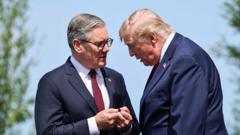
Donald Trump does not want a partner in Downing Street. He wants an asset. For a British prime minister, navigating the second Trump administration is not a game of diplomatic chess; it is an exercise in political survival where the terms are dictated entirely by Washington. The core premise of the trans-Atlantic alliance has been systematically stripped of its romantic veneer, exposed instead as a transactional arrangement where British sovereignty is traded for American market access. The real demand from the White House is total economic and strategic alignment, starting with the erosion of British regulatory independence and ending with absolute compliance on global security.
The recent, dramatic collapse of Keir Starmer’s premiership serves as a stark warning of what happens when a British leader tries to walk this tightrope. Starmer’s political execution was triggered fundamentally by his attempts to manage the Trump reality, specifically through his catastrophic appointment of Peter Mandelson as Washington ambassador—a desperate play for a backdoor channel to Trump’s inner circle that blew up in his face over historical vetting failures.
As Andy Burnham or whoever emerges from the wreckage prepares to take the keys to Number 10, the ledger of American demands remains unchanged, brutal, and entirely non-negotiable.
The Extortion of the Economic Prosperity Deal
The illusion of a free trade agreement between equals died with the unveiling of the U.S.-UK Economic Prosperity Deal. While sold to the British public as a groundbreaking partnership to boost growth, the framework is a asymmetric leverage tool designed to pull Britain away from the European regulatory orbit.
Trump’s trade policy operates on a simple mechanism: compliance or tariffs. Following the "Liberation Day" tariff shocks of early 2025, Downing Street rushed to secure exemptions. The price of those exemptions is now coming due. The White House has made it clear that the temporary pause on punitive duties is contingent on the UK capitulating on two major fronts: opening the British market to American agricultural goods and abolishing the UK Digital Services Tax, which hits Silicon Valley tech giants.
For any British prime minister, this is a domestic minefield. Accepting American agricultural standards means allowing hormone-treated beef and chlorinated poultry into British supermarkets, a move that would permanently derail any hope of a regulatory "reset" with the European Union. The EU remains Britain's largest trading partner. A prime minister who signs off on American agricultural access effectively seals a hard economic border with Europe, trapping the UK in a permanent state of dependency on Washington.
The pressure on the National Health Service is equally acute. Washington has consistently used trade leverage to challenge British pharmaceutical pricing structures. A recent capitulation on pharmaceutical tariffs has already begun driving up procurement costs for the NHS, squeezing an already buckling state infrastructure. The White House view is simple: if Britain wants shelter from the global tariff war, it must dismantle the regulatory walls that protect its domestic institutions.
The 3.5 Percent Defense Mandate
On global security, the demands from Washington are even more aggressive. The White House has successfully shifted the defense burden onto its European allies, using the threat of a U.S. withdrawal from NATO as its primary lever.
Britain has already paid heavily to stay in Trump's good graces. The UK defense budget was rapidly pushed to 2.5 percent of GDP, a target achieved only by eviscerating the country's foreign aid budget, cutting it down to a mere 0.3 percent. But the goalposts have shifted again. The current demand from Washington is a commitment to 3.5 percent of GDP for defense.
UK Defense Spending Targets vs. Reality (Percent of GDP)
[Historical Norm] ████░░░░░░░░░░ 2.0%
[Starmer Era Push] ████████░░░░░░ 2.5% (Funded via Foreign Aid cuts)
[The Trump Demand] ████████████░░ 3.5%
For an economy experiencing sluggish growth and rising unemployment, finding the cash to meet this 3.5 percent mandate requires deep, politically toxic cuts to domestic public services. It means choosing between funding schools and hospitals or purchasing American-made weapons systems to maintain the appearance of global relevance.
Furthermore, this military spending hike is demanded at a time when British foreign policy is being forced to align with an unpredictable American agenda. The escalation of military actions in Iran earlier this year sent oil prices soaring, instantly driving British inflation upward just as it was beginning to stabilize. A British prime minister under Trump is expected to absorb these economic shocks, lend diplomatic cover to Washington’s regional interventions, and pay a premium for the privilege.
The Asymmetry of American Capital
The true constraint on British independence is not diplomatic; it is structural. The United States dominates the British economy to an extent that makes meaningful defiance impossible. American corporations hold over $1 trillion in direct investment in the United Kingdom. More than a third of all foreign investment in British commercial real estate originates from American funds.
From high-street retail to advanced technology, the infrastructure of British life is increasingly underwritten by American capital. The promised gains of the bilateral tech partnership rely entirely on investments from massive U.S. entities like Google, Microsoft, and OpenAI.
When a British prime minister looks out across the country, they are looking at an economy where iconic domestic brands are American-owned and where future productivity is tethered to American software and artificial intelligence. Trump understands this leverage perfectly. When the White House temporarily suspended the tech deal in late 2025 to force concessions on food standards, it demonstrated that every aspect of the economic relationship is a weapon to be deployed when needed.
This economic reality reduces British leaders to a subservient role on the world stage. Downing Street cannot offer an independent stance on international law or global trade disputes because the threat of American capital flight or sudden tariff adjustments hangs over every cabinet meeting.
The next resident of Downing Street faces a bleak structural reality. They must govern a nation with an ailing economy, a fractured political landscape, and a deep dependency on an ally that views foreign policy as a zero-sum commercial transaction. To survive, the next prime minister will have to accept that the Special Relationship is no longer a diplomatic partnership. It is a corporate acquisition.