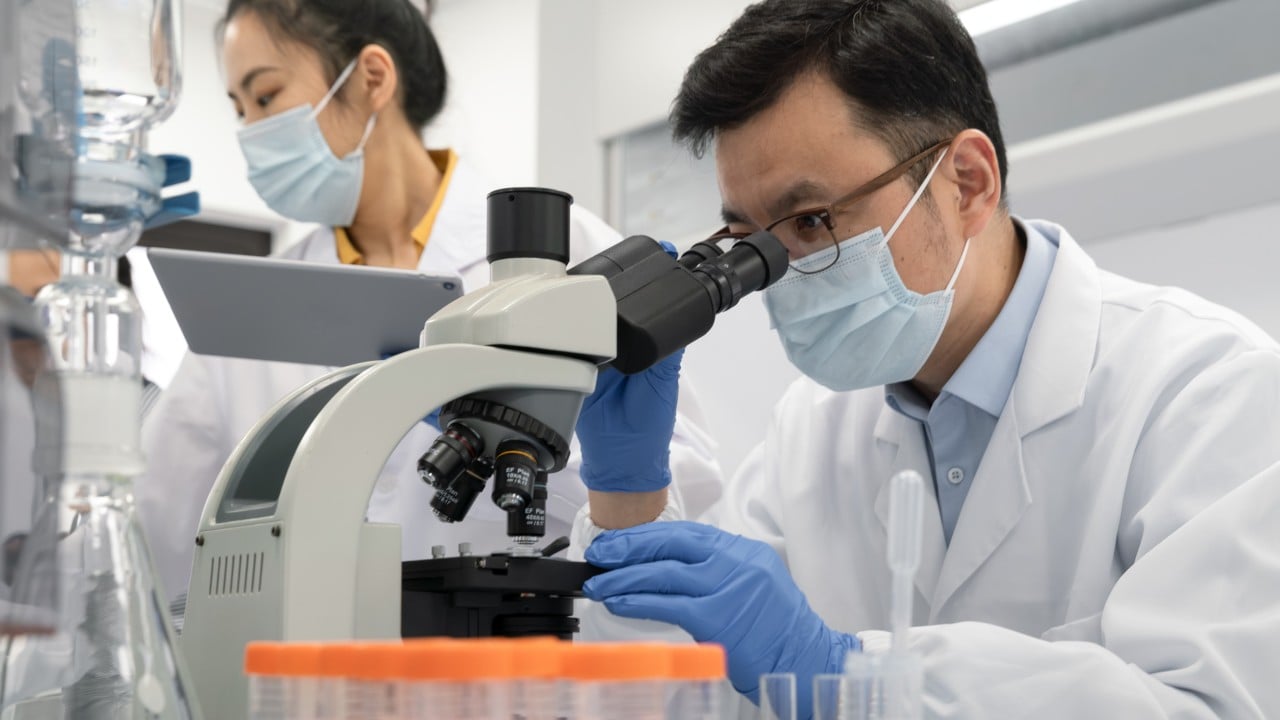
In a high-ceilinged laboratory in Shenzhen, a young researcher named Lin stares at a blank glass screen, waiting for an algorithm to compile. Outside, the night traffic hums a relentless, low-frequency pulse, a city built on speed and raw ambition. Lin is not thinking about geopolitics. He is thinking about silicon, about thermal dissipation, about the microscopic faults that can derail an entire microarchitecture before it ever leaves the wafer.
For years, the narrative from the West was simple, almost comforting in its finality: squeeze the supply lines, choke off the lithography machines, restrict access to the highest-end accelerators, and innovation will freeze. The assumption was that science requires a specific ecosystem of open borders, shared libraries, and privileged hardware.
Physics, however, has a stubborn habit of ignoring diplomatic cables.
When trade barriers slammed shut, they did not extinguish the fire. They redirected the draft. Recent empirical findings reveal a staggering shift: U.S. sanctions have inadvertently catalyzed China’s science-driven innovation metrics by over seventy percent in targeted technical sectors. To understand this counterintuitive surge, we have to look past the macroeconomics and step into the quiet, obsessive world of the people forced to rewrite the rules of invention.
The Architecture of Constraint
Consider what happens when you take away a craftsman's favorite tool. At first, there is frustration. The easy path vanishes. The software built for seamless optimization no longer runs on the restricted hardware.
That was the initial shockwave. In laboratories across Beijing, Shanghai, and Shenzhen, elite teams faced an abrupt reckoning. The imported toolchains they relied on—the refined, turnkey software packages that allowed researchers to plug and chug complex neural network architectures—were suddenly locked behind export controls.
Necessity is not just the mother of invention; sometimes, it is an eviction notice from lazy habits.
Without the crutch of off-the-shelf supremacy, domestic institutions had to build from the bedrock up. (Note: When we speak of "domestic institutions" here, we are using a shorthand for a sprawling ecosystem of state-backed labs, university consortiums, and hyper-agile hardware startups). They began rewriting compilers. They optimized algorithms to squeeze maximum performance out of fewer, less sophisticated transistors. They turned efficiency from an afterthought into an obsession.
Imagine trying to paint a masterpiece, but instead of a full palette of imported oils, you are handed a handful of earth-pigments and a knife you forged yourself. The early strokes are clumsy. But by the time you master the medium, your technique possesses a raw, unyielding discipline that the traditional masters lost generations ago.
That is what happened to Chinese R&D productivity. By forcing researchers to abandon imported abundance, the restrictions triggered a massive internal pivot toward foundational science—materials engineering, indigenous chip architecture, and quantum error correction.
The Invisible Shift in the Labs
Walk into a university lab in Xi'an today, and the atmosphere feels less like a corporate R&D wing and more like a wartime munitions factory operating in slow motion.
The metrics tell part of the story. Patent filings in deep tech, semiconductor physics, and artificial intelligence optimization did not dip; they spiked. But numbers obscure the human cost and the cultural pivot.
Before the sanctions, top-tier domestic talent often dreamed of publishing in Western journals while using Western silicon to train domestic models. The prestige loop was external. You validated your worth by how well you played in an international sandbox governed by established rules.
When those gates locked, the validation loop collapsed inward.
A senior materials scientist in Nanjing described the transition to me—hypothetically framing her experience through the collective exhaustion of her department—as waking up to find the bridge behind you burned. "You don't panic for long," she said. "You look at the river. You realize you have to learn how to swim."
The swimming lessons were brutal. Funding streams shifted overnight. Capital that once chased consumer internet applications—delivery apps, social media algorithms, fintech loops—re-routed toward hard tech. The state opened its vaults, yes, but money alone does not synthesize gallium arsenide or optimize extreme ultraviolet lithography pathways. It took a cultural realignment. Young engineers who might have optimized click-through rates for e-commerce giants suddenly found themselves staring at quantum gate fidelities and domestic EDA software.
The Paradox of Protectionism
History warns us about the dangers of economic isolation, yet it also whispers stories of unintended resilience.
When you isolate a massive, highly educated population with an insatiable appetite for technological dominance, you do not isolate them from progress. You isolate them from your influence. You create an alternate incubator where different pressures breed different lifeforms.
The seventy percent surge in science-driven innovation is not a testament to the benevolence of trade wars. It is a monument to the law of unintended consequences. Western policymakers calculated that withholding advanced nodes would maintain a permanent technological delta. They underestimated the sheer velocity of domestic substitution when backed by state-scale capital and a generation of engineers told that their national pride depended on solving an impossible equation.
We are no longer looking at a unipolar world where technology flows outward from a single Silicon Valley epicenter. We are watching the tectonic plates grind against each other, throwing up jagged, unexpected mountain ranges of sovereign capability on the other side of the planet.
The Final Calculation
Lin finally hits enter. The screen flickers. A line of data green-lights across the monitor, confirming that a domestically designed neural accelerator has successfully parsed a complex materials science simulation using a fraction of the power previously deemed mandatory.
He leans back, rubbing his eyes against the blue glow. The lab is quiet again.
Out in the wider world, trade delegations will meet, tariffs will be adjusted, and pundits will continue to argue over the fine print of export controls. But inside the room, the reality has already outpaced the rhetoric. The sanctions didn't stop the clock. They simply forced the mechanism to run on its own power, ticking louder, faster, and entirely on its own terms.