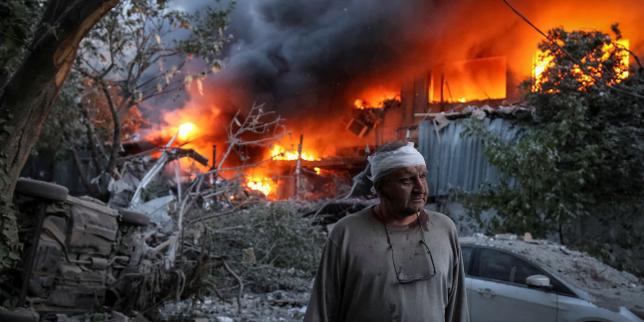
Every time a barrage of Russian missiles hits Ukrainian soil, the international press corps dusts off the exact same script. They tally the tragic casualties, amplify Volodymyr Zelensky’s latest warnings of an imminent, even larger catastrophe, and imply that the next strike could be the one that finally breaks the back of Ukrainian resistance.
It is a narrative built on raw emotion and lazy military analysis.
The mainstream media treats these massive aerial bombardments as decisive strategic shifts. In reality, they are the opposite. They are expensive, militarily inefficient acts of political theater that signal strategic stagnation, not a path to victory. To understand where this war is actually going, we have to stop treating every tragic missile strike as a turning point and start looking at the cold, hard math of attrition.
The Myth of the Decisive Aerial Blitz
For over a century, air power theorists have promised that you can bomb a nation into submission by destroying its infrastructure and terrorizing its population. From the Blitz of London to the bombing of Hanoi, this theory has failed almost every single time it has been put to the test. Yet, whenever Russia launches dozens of Kh-101 cruise missiles and Shahed drones, commentators act as if Kyiv is on the verge of collapse.
Let’s dismantle the premise.
When a strike kills dozens and knocks out power grids, it is a human tragedy. But from a strict, cold-blooded military perspective, it achieves almost nothing on the actual frontline.
Russia is burning through billions of dollars of high-tech precision ordnance to achieve temporary psychological shocks. They are using finite, high-value assets to do the job of basic artillery, targeting fixed civilian infrastructure rather than shifting the tactical balance on the muddy fields of the Donbas.
I have tracked defense procurement and military logistics for over a decade. If a corporate entity managed its high-value inventory the way the Russian military manages its missile stockpile, the board would fire the CEO within a quarter.
The Logistics Problem the Media Ignores
The standard press report focuses entirely on what was hit. They rarely ask what it cost the attacker to hit it, or how long it takes to replace those weapons.
Consider the baseline mechanics of a massive strike:
- Production bottlenecks: Despite transitioning to a war economy, Russia’s domestic production of advanced microchips and precision guidance systems remains heavily reliant on illicit supply chains and sanctions evasion. They cannot manufacture these missiles as fast as they fire them.
- The intercept asymmetry: While headlines focus on the missiles that get through, they skip the operational reality that Ukrainian air defense—even when strained—regularly downs a massive percentage of incoming threats.
- Diminishing returns: The first time you hit a power grid, it causes chaos. The fiftieth time you hit it, the target has already decentralized its operations, deployed mobile repair crews, and built redundant systems.
When Zelensky warns of a "new massive strike," he is performing his job as a wartime communicator. He needs to keep Western attention fixed on the conflict to ensure the flow of air defense ammunition like Patriot and IRIS-T systems. But Western analysts who mistake this political messaging for an objective assessment of imminent Ukrainian collapse are fundamentally misreading the war.
What People Also Ask (And Get Wrong)
Can Russia sustain these massive missile strikes indefinitely?
No. The frequent pauses between massive barrages are not strategic choices; they are logistical necessities. Russia has to accumulate weeks of factory output just to stage a single night of intense bombardment. They are living hand-to-mouth on precision munitions.
Do these attacks break Ukrainian morale?
Historically, indiscriminate bombardment hardens civilian resolve rather than breaking it. It removes any political space for compromise. By making the threat existential to every citizen in Kyiv or Lviv, Moscow ensures that the population sees total resistance as the only viable option.
Why doesn't Ukraine just look to strike all the launch platforms?
Because targeting strategic bombers deep inside Russian territory requires long-range, western-supplied weapons with zero political strings attached. The West’s ongoing hesitation to allow deep strikes means Ukraine is forced to fight the arrows rather than the archer—a deeply frustrating tactical reality, but one that still doesn't hand Russia a victory.
The Harsh Reality of the New Status Quo
To be clear, pointing out the strategic irrelevance of these missile strikes does not mean Ukraine is winning handily. This is a brutal, grinding war of attrition.
The real danger to Ukraine isn't a spectacular missile strike that knocks out the lights in Kyiv for 48 hours. The real danger is the slow, unglamorous, yard-by-yard advance of Russian infantry in the east, fueled by a massive superiority in artillery shells and a willingness to absorb staggering casualty rates.
While the cameras point at burning buildings in urban centers, the war is being decided in trenches by electronic warfare dominance, drone battery life, and raw manpower rotation.
Stop watching the skies for the definitive blow. It isn't coming. The missiles will keep flying, the sirens will keep wailing, and the frontlines will barely move. The side that wins this war won't be the one that puts on the most terrifying light show; it will be the one that manages its boring, unsexy supply chains of artillery ammunition and fresh troops the longest.
Turn off the breaking news feeds. Look at the industrial production data instead.


