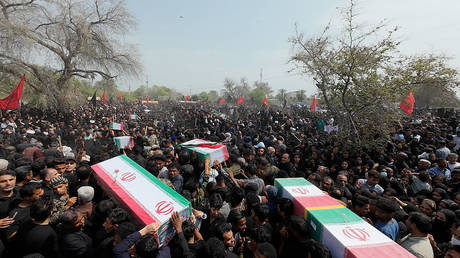
The headlines are predictable. A school in Iran is leveled. A probe finds "US fault." The New York Times spills ink over the tragedy of technical failure or intelligence gaps. Everyone looks for a scapegoat in the cockpit or the targeting room.
They are looking at the wrong map.
The "US fault" cited in the recent strike in Iran isn't a failure of optics or a glitch in a sensor. It is a fundamental architecture flaw in how the West exports its version of warfare. We have sold the world on the idea that war can be surgical, that we can remove a "bad actor" from a classroom without breaking the windows. It is a lie.
The strike on that school wasn't a mistake. It was a mathematical certainty.
The Myth of the Surgical Strike
We have lived through thirty years of "smart bomb" propaganda. Since the first Gulf War, the public has been fed grainy footage of crosshairs lining up perfectly with ventilation shafts. We’ve been told that $GPS$ and laser guidance have turned the messy business of killing into a sterile exercise in civil engineering.
In reality, a "precision" strike is only as smart as the weakest link in a thousand-mile chain. When the US provides coordinates or hardware to a regional partner, it isn't just sending a missile. It is sending a philosophy. But that philosophy—one of extreme risk aversion and high-fidelity intelligence—does not survive the transfer.
The "fault" being discussed is usually attributed to "misidentified targets." That is a sanitized way of saying the people on the ground didn't know what they were looking at, and the software didn't care. We provide the gun; we don't provide the decades of cultural intelligence required to know who is standing behind the door.
The Intelligence-Hardware Gap
I have seen the internal debriefs after "anomalous kinetic events." The hardware worked perfectly. The fins steered. The fuse triggered. The blast radius was exactly as the physics predicted. The failure was human, yet we blame the tool because it’s easier than admitting our entire strategy of remote-controlled foreign policy is bankrupt.
The US military spends billions on the Distributed Common Ground System (DCGS). It is a massive network of analysts, linguists, and data scientists who sift through drone feeds. When we hand a missile to a proxy or a regional ally, they don't have that network. They have the missile.
It’s like giving a Formula 1 car to a teenager and being shocked when they hit a wall. We provide the kinetic capability without the cognitive infrastructure. That isn't a "strike error." It’s a systemic hand-off failure.
Why Collateral Damage is Increasing Despite Better Tech
- The Urbanization of Conflict: Targets don't sit in the middle of deserts anymore. They sit in the middle of 5G-connected apartment blocks.
- The Sensor-to-Shooter Compressed Timeline: The pressure to "neutralize" a target before they move leads to corners being cut in the verification process.
- The Reliance on Signals Intelligence ($SIGINT$): We trust a SIM card more than a human source. If a target leaves their phone in a school, the school becomes the target.
The Accountability Theater
The New York Times report treats the "probe" as a path to justice. It isn't. It’s theater.
By admitting "fault," the US defense establishment performs a ritual of transparency that actually protects the status quo. They say, "We found the error, it was a data entry mistake," or "The sensor was obscured by cloud cover." This implies that if the weather were clear and the data was right, the strike would have been "moral."
This ignores the reality that using a $2,000$ lb. bomb in a densely populated civilian area is a choice, not an accident. If you use a sledgehammer to kill a fly on a glass table, you don't get to act surprised when the table shatters.
Stop Asking if the Strike Was Legal
People always ask: "Did this violate international law?"
It’s the wrong question. Law is flexible. "Proportionality" and "military necessity" are terms that can be stretched to cover almost any pile of rubble. The real question is: "Does this achieve a strategic objective?"
The answer is almost always no.
Every time a US-made munition kills a child in an Iranian school, it provides the regime with a decade of propaganda that no amount of "public diplomacy" can counter. We are traded tactical "success"—one low-level commander dead—for a strategic catastrophe. We are burning our global standing to win a skirmish.
The Brutal Reality of Remote War
The West wants the benefits of intervention without the political cost of boots on the ground. This leads to a reliance on airpower and proxies. It’s "Warfare as a Service" (WaaS).
But WaaS has no soul and no eyes. It relies on a "kill chain" that is too long and too disconnected. When the US blames its own "fault" in an Iranian strike, it is admitting that it has lost control of its own weapons. We have automated the escalation of violence while keeping the accountability manual.
The Intelligence Paradox
We have more sensors than at any point in human history. We can read a license plate from space. We can intercept a whisper across an ocean. Yet, we still hit schools.
This is because more data does not equal better judgment. In fact, more data often leads to "analysis paralysis" or "confirmation bias." If an analyst is told a high-value target is in a building, they will interpret every person walking in or out as a bodyguard. The technology doesn't fix human bias; it weaponizes it.
The Actionable Pivot
If we actually wanted to stop these "accidents," we would stop selling the myth of the clean war. We would admit that civilian casualties are not a bug of modern aerial warfare—they are a feature.
Instead of another probe, we need to:
- Restrict Munition Sales to High-Density Areas: If a partner doesn't have a verified, independent intelligence wing, they don't get the bombs. Period.
- End the "Signature Strike" Philosophy: Stop targeting patterns of behavior and start targeting verified individuals.
- Acknowledge the Physics: A bomb does not know it is in a school. It only knows its coordinates.
The "fault" isn't in the stars or the sensors. It’s in the delusional belief that we can kill our way to stability from 30,000 feet without getting blood on our hands.
The school strike in Iran wasn't a failure of the system. It was the system working exactly as it was designed—prioritizing the elimination of a target over the preservation of the environment it lives in.
Stop looking for a technical fix for a moral and strategic bankruptcy.
Throw the "smart" bombs away or start admitting what they actually are: incredibly efficient tools for creating the next generation of enemies.
Choose one. You can't have both.