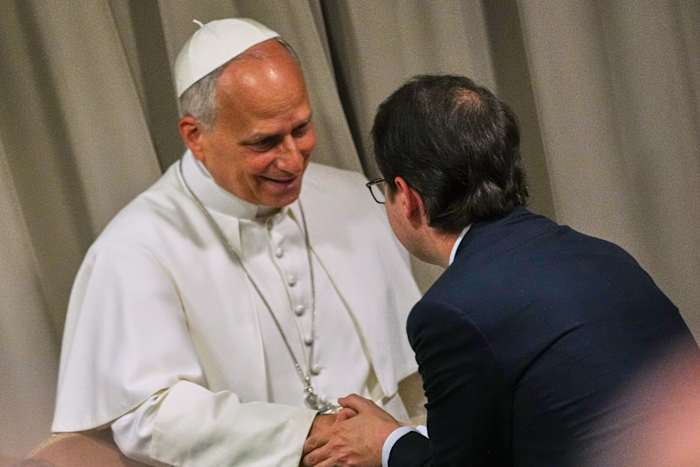
Tech billionaires aren't used to getting lectured by the Vatican. They're used to worshipful headlines, massive venture funding rounds, and rushing products to market before anyone can stop them.
That dynamic just shattered. Pope Leo XIV released his highly anticipated first encyclical, "Magnifica Humanitas" (Magnificent Humanity). It’s a sweeping, deeply critical manifesto on the unchecked expansion of artificial intelligence. It drops a massive theological hammer right onto the desk of every major tech executive.
People searching for news on this document want to know what a religious leader has to say about algorithmic code. The answer is simple. The pope isn't talking about computing power. He’s talking about human survival, the preservation of actual intelligence, and the growing danger of letting a tiny group of private corporations decide how our world operates.
This isn't a vague, feel-good message about being nice online. It's an aggressive, direct challenge to the tech industry and political leaders.
The War on the Culture of Power
The most explosive parts of the manifesto target how AI changes global conflict. Pope Leo XIV explicitly declared that entrusting irreversible, lethal decisions to automated systems is "not permissible." It’s an incredibly sharp line in the sand.
Right now, military tech labs are pushing hard for remote warfare. They want drones and target acquisition systems that act faster than human reflexes. The pope calls this out as a "destructive spiral" that drives a "culture of power."
By stripping human emotion and immediate guilt from the equation, automated weaponry accelerates what the document terms the "normalization of war." When an algorithm decides who lives and dies, humanity loses its soul. The pope demands total transparency and accountability from software developers. He wants a clear, unbroken chain of human command for every automated system used in defense.
This creates an immediate, highly visible flashpoint with the Trump administration. The White House has spent the last year aggressively pushing to deregulate AI development to maintain global tech dominance. The pope completely rejects that logic, citing "opposing imperialisms" where giant powers care only about preserving supremacy.
Beyond Abstract Ethics
Tech companies love talking about internal ethical boards and voluntary principles. They form committees, publish shiny white papers, and promise they're building safe systems.
The Vatican explicitly calls out this corporate strategy as totally inadequate.
“It is not enough to invoke ethics in the abstract; robust legal frameworks, independent oversight, informed users and a political system that does not abdicate its responsibility are required,” the pope wrote. “A more moral AI is not enough if that morality is determined by a few.”
Look at the economic realities. OpenAI and Anthropic are currently valued at hundreds of billions of dollars. Their market power matches or exceeds the gross domestic product of entire nations. The pope argues that leaving the future of human society in the hands of a few private actors is incredibly dangerous, especially for children and the vulnerable.
Interestingly, the Vatican didn't just throw stones from afar. They hosted Anthropic co-founder Christopher Olah at the official launch of the encyclical. It's part of a deliberate, decade-long push by the Church to drag Silicon Valley executives into serious ethical discussions. Surprisingly, Olah actually agreed with the criticism, admitting that the risk of massive human labor displacement is real and that tech labs need moral critics who can't be bent by corporate financial incentives.
The Mathematical Roots of Catholic Social Teaching
To understand why this document is a benchmark, you have to look at the author. Pope Leo XIV was a math major before entering the priesthood. He doesn't look at technology with fear or ignorance. He understands how algorithms work, how they filter data, and how they actively shape our perception of reality.
He signed this text on May 15, purposely timing it with the 135th anniversary of "Rerum Novarum," the 1891 papal document that laid the groundwork for modern Catholic social doctrine during the Industrial Revolution. Back then, the Church stepped in to protect workers from the brutal exploitation of early capitalism. Today, the enemy isn't the steam engine; it's the black-box algorithm.
The pope systematically applies classic theological pillars to the tech boom:
- The Dignity of Work: The obsession with corporate profit cannot justify replacing human workers on a massive scale.
- The Universal Destination of Resources: Data and technological advancement belong to humanity, not just the balance sheets of tech monopolies.
- Environmental Costs: The encyclical slams the "environmental devastation" caused by the frantic mining of rare earth elements needed to power the massive data centers running these models.
An economic system must serve human dignity, not the other way around. Technology should elevate human potential, not degrade it into a simulated version of reality.
What Needs to Happen Next
The message leaves readers with a clear set of immediate obligations. If you think this is just a religious issue, you're missing the point. It’s a blueprint for global tech policy.
First, governments must stop abdicating their legislative roles to corporate tech lobbyists. We need real, binding external laws, not voluntary corporate pledges.
Second, tech developers have to slow down. The relentless race to ship flawed, resource-heavy models for the sake of beating market competitors is causing real-world damage to our social fabric and environment.
Finally, digital literacy needs to change completely. Users must understand exactly how algorithms manipulate their focus, behavior, and worldview. We have to treat data privacy and algorithmic transparency as fundamental human rights, not optional settings inside an app.