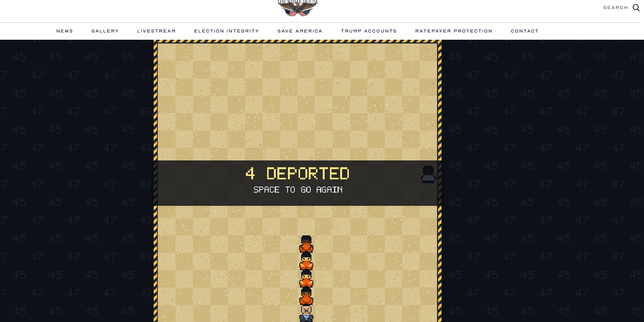
When a government turns mass deportations into an 8-bit arcade challenge, you know political communication has entered uncharted territory. The White House recently launched a retro-style online arcade featuring games where players chase migrants across the Rio Grande and stack bricks to block border crossings. It is brazen, highly provocative, and entirely intentional.
Instead of traditional press releases or solemn policy briefings, officials opted for pixelated nostalgia. They want public policy to look like a weekend high score. But beneath the surface of this viral stunt lies a much deeper shift in how political messaging operates in the digital age.
The Mechanics of Viral Politics
The digital arcade features titles styled after classic arcade hits. One game, called Rio Run, reimagines the classic arcade staple Snake. Players guide a pixelated avatar of U.S. border czar Tom Homan along the banks of the Rio Grande to round up individuals for expulsion. Another game mimics Tetris under the banner Build the Wall, tasking users with blocking a perceived influx of people.
The administration promoted the platform on social media using a modified corporate video game logo with the caption: "CAN'T STOP WINNING. Build the wall. Deport."
Administrators defend the stunt as a fresh, engaging way to showcase political achievements. They argue it contrasts a winning culture against opposing political philosophies. They treat state-backed enforcement actions like casual mobile apps. For supporters, it is witty counter-programming against dry institutional politics. For critics, it represents something far darker.
Why Human Rights Advocates Are Furious
Human rights organizations and border communities reacted with immediate condemnation. Activists working directly along the southern border described the games as cruel, dehumanizing, and fundamentally detached from human empathy.
When real lives, family separations, and high-stakes detentions are reduced to cartoon sprites and score counters, the human cost disappears. Critics point out that turning displacement and border enforcement into interactive entertainment desensitizes the public to real-world suffering. People living in border regions already navigate high levels of tension and scrutiny. Seeing their daily reality reframed as a game controller exercise feels like a direct insult.
Yet, outrage is precisely what drives engagement.
The Attention Economy Wins Again
Modern political strategy no longer relies solely on persuasion. It relies on dominance over the algorithm. By dropping provocative, meme-ready interactive content directly onto official government channels, the administration guarantees wall-to-wall media coverage. Traditional outlets cover the outrage. Supporters share the links to own the discourse.
You might hate the approach. You might find it offensive. But you are talking about it.
This approach treats governance like an influencer brand campaign. Controversies generate clicks, clicks generate visibility, and visibility reinforces the core political narrative. The line between policy execution and internet trolling has officially vanished.
As digital campaigns evolve past simple videos and text posts, expect more political actors to gamify polarizing topics. When shock value becomes the primary metric of success, everyone loses a little more nuance.