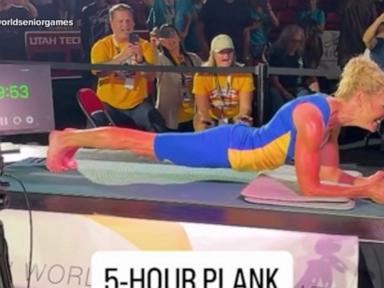
The internet lost its collective mind when a sixty-one-year-old grandmother held a plank for hours on end, shattering another arbitrary endurance record. Headlines flooded feeds with praise about iron willpower, age-defying core strength, and the endless capacity of the human body. Social media gurus jumped on the bandwagon, treating the feat as a masterclass in functional fitness.
They are entirely wrong.
Let us strip away the feel-good sentiment and look at the biomechanics. Staring at the floor while trembling in a static position for hours is not a display of supreme physical capability. It is an exercise in endurance suffering that teaches your nervous system to lock down your spine rather than move it. If your primary goal is looking athletic, moving without pain, or maintaining metabolic health, parking your body on the floor like a concrete slab for hours is a terrible use of your training hour.
The Fallacy of Static Endurance
We have conflated stillness with stability. They are not the same thing.
In real-world movement, your core does not act as a brick wall. It acts as a dynamic transformer that transfers force from your lower body to your upper body, all while resisting unwanted rotation. When you hold a standard plank for ten minutes, let alone hours, you are training your muscles for isometric endurance in a single plane. You are teaching your nervous system to brace statically.
Ask yourself when you last encountered a scenario in daily life or sport where you needed to hold your torso completely motionless against gravity for four hours. You never have. You never will.
Biomechanically, the moment your form breaks—which it inevitably does long before the clock stops during these record attempts—the lumbar spine takes the brunt of the load. Your hip flexors over-fire, your lower back arches subtly, and your shoulder girdle sags. You are not building resilience; you are practicing poor posture under fatigue.
The Fitness Industry Loves a Gimmick
The reason viral planking records get paraded across every news outlet is simple. They are cheap, require zero equipment, and make for easy, digestible viral content. A grandmother holding a plank looks great on a screen. It generates clicks, shares, and superficial awe.
Meanwhile, actual functional strength development is messy, heavy, and hard to film in a living room. Deadlifts, loaded carries, rotational med-ball throws, and split squats do not go viral quite as easily because they involve actual velocity and progressive overload. But those movements build bone density, protect joints, and actually prepare you to carry groceries, pick up children, or sprint across a street without pulling a hamstring.
We need to stop celebrating exercises that test how much boredom and localized burning sensation a person can tolerate. Pain tolerance is a psychological trait, not a comprehensive health metric.
What You Should Do Instead
If you want a resilient midsection that actually protects your spine, ditch the endurance marathon and embrace mechanical variety.
First, train movement, not stillness. Integrate anti-rotation exercises like Pallof presses, where your core must fight an external force trying to twist you. This mimics how your torso actually stabilizes when you walk, run, or swing.
Second, incorporate loaded carries. Picking up heavy objects and walking with them forces every single muscle in your core to brace dynamically while your body is in motion. Farmer carries build grip strength, shoulder stability, and core endurance under realistic conditions.
Third, if you insist on planking, cap it. Sixty seconds of an intensely braced, maximally tensioned RKC plank—where you pull your elbows toward your toes and squeeze every muscle fiber in your body—is infinitely more productive than a ten-minute sag fest. If you can hold a plank for more than two minutes, you are no longer training strength; you are just showing off your stubbornness.
Stop worshipping the stopwatch. Start building a body that moves.