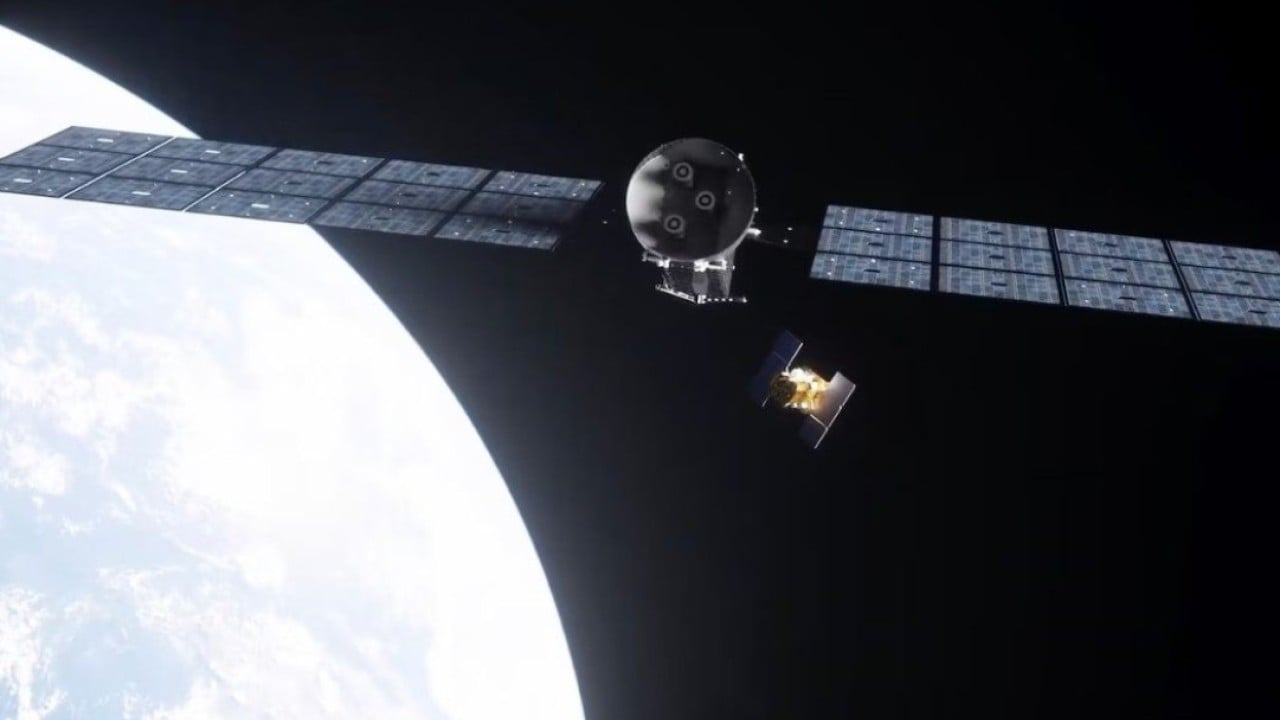
The physical degradation of low-Earth orbit assets due to unpredicted atmospheric drag presents an existential challenge to legacy space infrastructure. This reality materialized with the critical altitude loss of NASA’s $250 million Neil Gehrels Swift Observatory. Launched in 2004, the gamma-ray burst detector was never engineered for orbital servicing or physical docking. Yet, its premature descent—accelerated by unprecedented solar activity—forced a radical shift in operational strategy. Instead of abandoning a highly functional instrument, NASA executed a $30 million robotic intervention via Katalyst Space Technologies’ LINK spacecraft. This deployment establishes a precedent for autonomous orbital salvage, transforming orbital life extension from a theoretical framework into a quantifiable economic strategy.
The Mechanics of Orbital Decay: Solar Maxima and Atmospheric Drag
Satellites residing in low-Earth orbit do not operate in a perfect vacuum. They navigate the thermosphere, a region where trace atmospheric gases exert a continuous resistive force known as atmospheric drag. The mathematical expression governing this phenomenon is defined by the classical drag equation:
$$F_d = \frac{1}{2} \rho v^2 C_d A$$
In this equation, $F_d$ represents the drag force, $\rho$ is the atmospheric density, $v$ is the orbital velocity of the spacecraft, $C_d$ is the drag coefficient determined by the geometry of the satellite, and $A$ is the cross-sectional area projected along the velocity vector.
Under baseline space weather conditions, this force is marginal, leading to gradual orbital decay manageable over decades. Extreme solar activity alters these variables. During a solar maximum, the Sun emits intense levels of extreme ultraviolet radiation and X-rays. This energy flux heats the upper layers of Earth’s atmosphere, causing the thermosphere to expand outward.
The immediate consequence of this thermal expansion is a localized surge in atmospheric density ($\rho$) at altitudes where science satellites reside. For the Swift Observatory, which operated at an altitude of approximately 224 miles (360 kilometers), this density spike dramatically altered the deceleration profile. The increased collision rate with atmospheric particles drained the satellite's kinetic energy, causing its altitude to drop at an accelerating rate.
Left unaddressed, Swift was projected to breach its absolute operational floor of 185 miles (300 kilometers) by late autumn, entering a regime of irreversible terminal decay where structural breakup during atmospheric reentry becomes inevitable. To mitigate this, mission controllers systematically deactivated Swift's scientific payloads to alter its attitude, minimize its effective cross-sectional area ($A$), and buy valuable time for an intervention strategy.
The Financial Calculus: Capital Preservation Versus Replacement Cost
The decision to fund an unproven robotic rescue mission over letting a legacy asset incinerate depends on a highly structured cost-benefit framework. Space agencies traditionally evaluate asset viability through a binary lens: replace or abandon. The deployment of the LINK spacecraft introduces a third option: capital-efficient life extension.
The financial equation driving this operational pivot can be modeled as follows:
$$E = C_R - (C_M + C_D)$$
Where $E$ represents the net economic utility of the salvage operation, $C_R$ is the fully burdened replacement cost of an equivalent scientific platform, $C_M$ is the contract cost of the servicing mission, and $C_D$ is the discounted risk value associated with potential mission failure or collateral asset destruction.
Replacement Cost Barriers
Rebuilding and launching a direct successor to the Swift Observatory requires significant capital expenditure. Designing, testing, instrumenting, and launching an equivalent space-based observatory would far exceed its initial $250 million capital outlay due to modern supply chain complexities and specialized component manufacturing. Space agencies face highly constrained budgetary baselines that leave little room for unplanned capital expenditures to replace failing legacy systems.
Salvage Mission Expenditures
NASA finalized an accelerated $30 million fixed-price contract with aerospace startup Katalyst Space Technologies to execute the rescue. This represents approximately 12 percent of the instrument's baseline asset value. By opting for a commercial services model rather than an internally developed government program, the agency transferred development risks and minimized administrative overhead.
The Opportunity Cost of Capability Gaps
Beyond direct capital expenditures, the loss of an orbital asset creates a profound operational deficit. Swift serves as an orbital first responder, identifying high-energy gamma-ray bursts within seconds and distributing coordinates to ground-based and space-based observatories worldwide. Allowing the platform to burn up would create a multi-year data blind spot that cannot be resolved by upcoming assets like the Nancy Grace Roman Space Telescope, which is optimized for different wavelengths and observation strategies.
The financial calculus favors the salvage model. For an expenditure of $30 million, the agency preserves an active, fully calibrated system capable of delivering high-value scientific returns for another decade, yielding a substantial return on investment.
The Technical Execution Profile: Autonomous Uncooperative Docking
Interfacing with a spacecraft that was built without docking fixtures, visual targets, or automated rendezvous sensors is an exceptionally complex engineering challenge. The LINK mission architecture relies on a specialized three-phase autonomous protocol to successfully capture and reboost the uncooperative satellite.
[Phase 1: Orbital Insertion] ---> [Phase 2: Proximity Operations] ---> [Phase 3: Capture & Reboost]
  Pegasus XL Air-Launch             Lidar/Optical Tracking              Tri-Arm Mechanical Lock
  Low-Earth Orbit Insertion         Autonomous Trajectory Matching      Ion Thruster Lift (+149 miles)
Phase One: Air-Launched Orbital Insertion
The mission commenced via a Northrop Grumman Pegasus XL rocket dropped from the belly of a modified carrier aircraft over the Pacific Ocean near the Marshall Islands. The air-launch configuration minimizes low-altitude atmospheric resistance and offers precise orbital plane alignment. The three-stage solid-propellant booster successfully inserted the LINK spacecraft into a coplanar transfer orbit trailing behind the decaying Swift observatory.
Phase Two: Proximity Operations and Trajectory Matching
Once orbit was established and system health verified, LINK initiated a series of autonomous maneuvers. The spacecraft utilizes a combination of optical cameras and light detection and ranging (lidar) sensors to map the relative position, orientation, and tumble rate of the target observatory. Because Swift possesses no active transponders or cooperative docking markers, LINK’s flight computer runs real-time computer vision algorithms to compare the sensor telemetry against a known three-dimensional CAD model of the telescope. The autonomous guidance system executes precise thruster firings to match velocities down to centimeters per second, establishing a stable relative station-keeping position.
Phase Three: Mechanical Capture and Low-Thrust Reboost
The defining hardware feature of the LINK spacecraft is its trio of electromechanical robotic arms. Each arm spans roughly three feet (one meter) and terminates in a specialized dual-finger pinching gripper designed to replicate simple, mechanical clamping profiles. Because Swift lacks a dedicated docking port, the robot arms are programmed to latch onto a structural ground-transport flange—a robust metal ring used exclusively to secure the telescope to its shipping crate before launch in 2004.
By anchoring to this specific structural point, LINK avoids damaging the telescope's delicate thermal blankets, solar arrays, or sensitive scientific instrumentation. The capture phase is designed to take several weeks of methodical adjustments to guarantee structural alignment.
Once the mechanical connection is verified, LINK will activate its low-power, high-efficiency xenon ion thrusters. Unlike traditional chemical rockets that deliver immense thrust over short durations, ion thrusters produce minute amounts of continuous acceleration by electrostatically accelerating charged ions through a nozzle. Over a duration of 10 to 12 weeks, this persistent force will gradually raise the combined stack’s altitude by approximately 149 miles (240 kilometers), returning Swift to a stable, low-drag orbit of 373 miles (600 kilometers).
Operational Risks and System Limitations
While the engineering blueprint for the LINK mission is highly rigorous, the execution carries distinct failure modes that define the boundaries of modern orbital servicing.
- Rotational Kinetic Energy Anomalies: The primary risk during the physical capture phase is an uncompensated rotational rate or "tumble" of the target satellite. If Swift experiences an unmeasured angular momentum vector during contact, the forces could exceed the structural tolerances of LINK’s robotic arms, causing mechanical failure or inducing an uncontrollable joint spin in both spacecraft.
- Structural Contact Fractures: Because the ground-transport flange was never rated for in-space mechanical loading or structural push vectors, applying continuous thrust through this point could cause unforeseen material deformation. Any structural failure at the interface site would compromise alignment, rendering the reboost vectors inaccurate and potentially puncturing the telescope's internal propellant lines or instrument bays.
- Sensor Saturation and Glint: High-fidelity proximity operations depend heavily on optical feedback loops. Direct solar glint reflecting off Swift’s highly reflective insulation blankets can temporarily blind lidar sensors or saturate camera sensors, triggering automated abort sequences that force the servicing craft to back away, expending valuable cold-gas maneuvering fuel.
Structural Implications for Legacy Space Infrastructure
The success or failure of the LINK mission will dictate how asset managers handle aging orbital infrastructure moving forward. The most immediate candidate for a scaled version of this technology is the Hubble Space Telescope.
Like Swift, Hubble is losing altitude due to the expanding thermosphere brought on by intense solar cycles. Unlike Swift, Hubble is an 11-metric-ton asset residing at roughly 330 miles (530 kilometers) altitude, requiring a substantially larger servicing craft with higher structural load tolerances and greater propulsive capacity. Katalyst Space Technologies is already leveraging data from the LINK flight profile to design a heavier, next-generation robotic servicer targeted for a potential Hubble intervention by 2028.
Beyond scientific instruments, this architecture establishes a clear blueprint for the commercial satellite sector. Geostationary communication assets and low-Earth orbit broadband constellations frequently face premature retirement due to localized propellant depletion rather than payload failure. Integrating simple, standardized mechanical attachment points onto future spacecraft designs will allow third-party robotic tugs to easily clamp, refuel, or reposition assets. This structural evolution will shift the industry away from the disposable hardware model, establishing a dynamic orbital economy defined by capital asset preservation, active debris remediation, and sustainable orbital management.
The strategic play for satellite operators is clear: decouple payload utility from the lifecycle of the propulsive chassis. By utilizing commercial servicing networks to offset atmospheric drag and execute end-of-life disposal, operators can extend the amortization schedule of high-value payloads, maximizing data generation per dollar of initial capital expenditure. Swift is the initial proof-of-concept for this logistical shift. Architectural planning for all future long-duration orbital hardware must now explicitly account for autonomous mechanical servicing interfaces as a core survival variable.