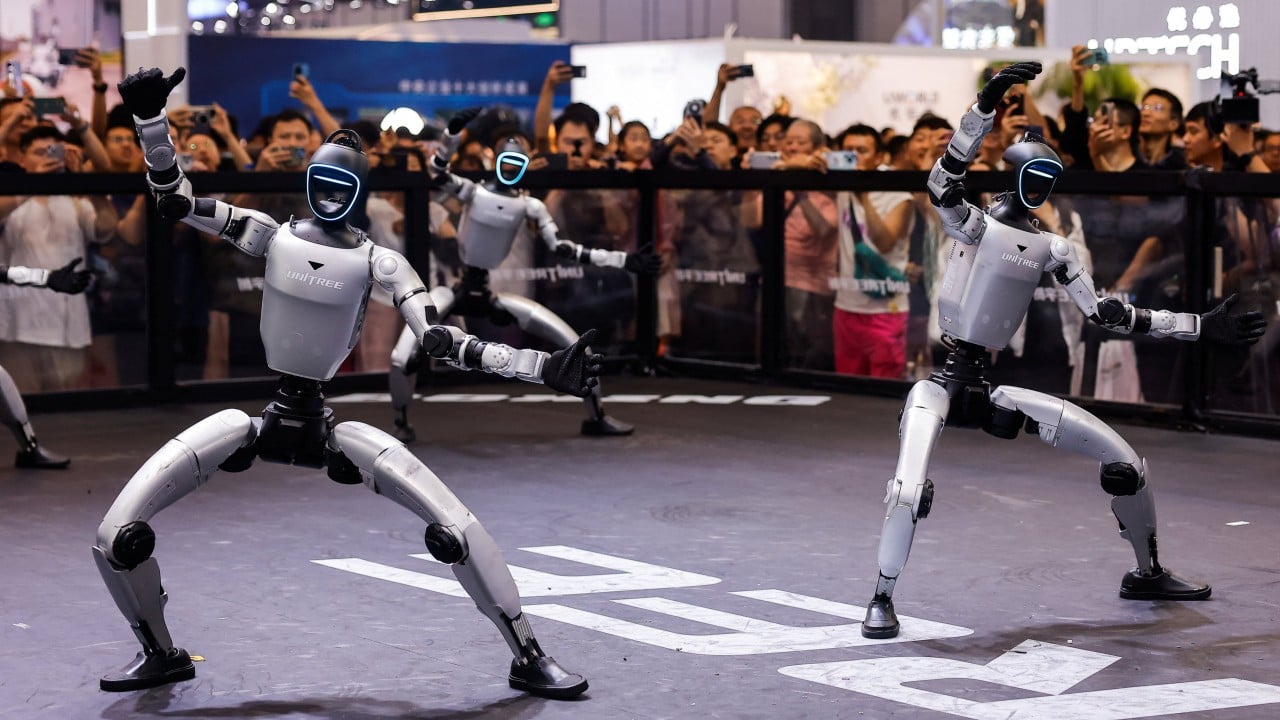
Have you ever watched a robot try to pick up a plastic cup and crush it into confetti? For decades, that was the reality of robotics. Engineers spent months coding every single joint rotation just to make a machine pour water without flooding the table. Now, claims surrounding Unitree humanoid robots powered by GPT-6 mastering painting and chess without task-specific training are turning that slow, painful process upside down.
If you've been following the robotics space closely, you know Unitree Robotics—founded by Wang Xingxing in Hangzhou—has spent the last few years undercutting the entire industry on hardware costs. Their G1 and H1 humanoids brought bipedal agility out of billion-dollar labs and onto university floors. Yet hardware was never the real bottleneck. The brain was. When Unitree's leadership points to foundation models like GPT-6 enabling zero-shot execution in complex tasks like chess and brushwork, they aren't talking about pre-programmed scripts. They're talking about a fundamental shift in how physical machines understand the world. For a more detailed analysis into similar topics, we suggest: this related article.
Let's strip away the hype and look at what actually happens when a large multimodal model controls a bipedal machine.
How Zero-Shot Learning Actually Works in Physical Robotics
Most people assume teaching a robot to play chess means feeding it millions of games and hardcoding the exact XYZ coordinates of every square on the board. That's the old way. It's brittle, expensive, and fails the second someone nudges the table two inches to the left. To get more details on the matter, in-depth analysis is available at MIT Technology Review.
Zero-shot learning changes the pipeline completely. Instead of memorizing coordinates, the robot relies on vision-language-action (VLA) architectures. When you pair Unitree's dexterous actuators with a massive reasoning engine like GPT-6, the model processes raw camera feeds in real time, understands the spatial geometry of a knight versus a pawn, calculates the strategic move, and translates that intent into motor torque commands.
It sounds effortless on paper. In practice, bridging the gap between digital reasoning and physical friction is brutal.
Think about painting. Holding a brush isn't like gripping a steel wrench. Bristles bend. Paint viscosity changes as it dries on the palette. If a humanoid pushes down two millimeters too hard, the stroke ruins the canvas. Traditional reinforcement learning requires millions of simulated attempts inside environments like NVIDIA Isaac Gym before a robot even touches a real brush. By leaning on massive pre-trained foundation models, the system already holds an abstract understanding of physics, object permanence, and tool use before it ever boots up.
Why Chess and Painting Are the Ultimate Stress Tests
Choosing chess and painting as benchmarks isn't a random PR stunt. Engineers pick these two activities because they sit on opposite ends of the robotic difficulty spectrum.
- Chess demands discrete precision and spatial planning. The robot has to identify pieces from awkward camera angles, plan a collision-free trajectory through a crowded board, and exert just enough grip force to lift a lightweight piece without knocking over its neighbors.
- Painting requires continuous analog control. There's no grid. The machine must adjust wrist compliance, manage fluid dynamics, and adapt visually to every stroke it just laid down.
If a single general-purpose model can handle both without a human engineer rewriting the underlying control loop, the traditional robotics software stack is officially on borrowed time.
The Hardware Reality Behind Unitree's Rapid Iteration
You can't talk about this software breakthrough without looking at the metal doing the heavy lifting. I've seen plenty of impressive AI demos fail miserably because the underlying actuators overheated after four minutes or lacked the tactile feedback to hold an egg.
Unitree built its reputation by obsessive vertical integration. Unlike Western competitors that outsource motors and gearboxes at massive markups, Unitree designs its own high-torque, low-inertia joint motors. Their G1 humanoid, priced starting around $16,000, proved that you don't need a $150,000 budget to put human-like kinematics in a lab.
Here's the catch nobody mentions in press releases. Raw motor strength doesn't give you fine motor control. Early versions of affordable humanoids suffered from gear backlash—that tiny mechanical slop between motor movement and limb response. When you're doing backflips or jogging across gravel, a millimeter of slop doesn't matter. When you're holding a fine-tipped paintbrush or pinching a chess bishop, a millimeter of slop makes the robot look like it had six espressos.
To pull off delicate tasks driven by high-level AI, Unitree had to upgrade its end-effectors—specifically the multi-fingered hands—with higher-resolution force sensing and tighter mechanical tolerances. GPT-6 can tell the arm where to go, but the local low-level controller still has to run at roughly 1,000 Hz to keep the hand from shaking.
What Critics and Engineers Are Still Skeptical About
Whenever a CEO makes bold claims about "no training required," healthy skepticism isn't just smart—it's mandatory. Let's look closely at the caveats that usually get buried in viral video clips.
First, "no training" rarely means zero preparation. While the humanoid might not have been trained specifically on that chessboard or that painting, the underlying foundation model consumed unimaginable amounts of internet video, human motion-capture data, and synthetic physics simulations. The training happened upstream. You're simply seeing the generalization payoff downstream.
Second, latency remains a massive headache. Running massive frontier models requires serious compute. You can't easily cram a multi-GPU server rack inside the torso of a lightweight humanoid without killing the battery in ten minutes. That means the robot is either tethered to a local workstation or streaming visual data over a low-latency wireless connection to cloud servers. If your Wi-Fi hiccups mid-brushstroke, the painting is toast.
Third, speed is still noticeably slow. Watch unedited footage of vision-language models controlling physical robots, and you'll often see a two-to-five-second pause before the arm moves. That's the model "thinking"—tokenizing visual frames, reasoning through the spatial layout, and outputting action tokens. Humans process that reflexively in milliseconds.
Why Open-Access Robotics Changes Everything for Developers
If you're a developer, researcher, or business owner watching this unfold, the real story isn't that a robot can paint a landscape or beat you at chess. Nobody is buying a $16,000 humanoid to replace an artist or a chess app.
The real story is generalization at scale.
Historically, automating a warehouse or a small manufacturing line meant hiring systems integrators to build custom cages, rigid conveyor belts, and single-purpose robotic arms. If your product packaging changed size, you paid tens of thousands of dollars to reprogram the line.
When general-purpose AI models pair with affordable, human-form hardware, deployment flips from coding to prompting. You show the robot a task, give it a verbal instruction, and let its spatial reasoning figure out the mechanics. That lowers the barrier to entry for small factories, logistics hubs, and research labs that could never afford bespoke automation.
Practical Ways to Track and Test This Tech Right Now
If you want to separate genuine engineering breakthroughs from edited marketing reels over the coming months, watch for three specific indicators whenever a new humanoid demo drops:
- Look for uncut, real-time footage. Speed-ramped videos (often 2x or 4x) hide inference latency and jerky motor corrections. Always check the clock or background movement to verify if the robot is operating in real time.
- Watch the environment lighting and clutter. Demos filmed in sterile, brightly lit rooms with high-contrast objects are easy mode for computer vision. Real competence shows up when a robot handles messy tables, shadows, and transparent objects.
- Check whether the compute is onboard or offboard. Ask whether the model is running locally on embedded chips (like NVIDIA Jetson Thor) or streaming to a remote cluster. True autonomy requires onboard inference.
For engineers and technical founders looking to get hands-on, don't wait for consumer-ready perfection. Start experimenting with open-source vision-language-action frameworks and simulation environments today. Download Isaac Lab or MuJoCo, test how multimodal models handle spatial prompting in simulation, and start mapping out the repetitive, unstructured physical workflows in your own operations that rigid automation has never been able to touch. The hardware is already cheap enough to buy; the advantage now belongs entirely to the teams who know how to prompt it.