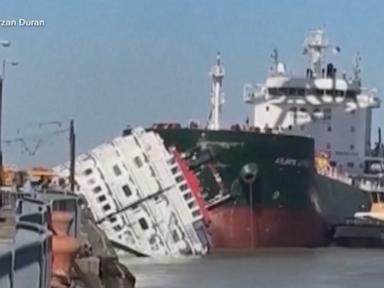
Viral maritime crash videos always trigger the exact same armchair reaction online. People watch a massive commercial tanker plow into a smaller river vessel, see the hull buckle, and immediately blame a sleeping captain or faulty steering.
They're usually wrong.
When a tanker collision and riverboat sinking makes headlines, the real story isn't a single catastrophic mistake at the helm. It's a slow-motion physics problem that started twenty minutes before the cameras ever started rolling. Deep-draft ocean vessels and shallow-water riverboats operate under completely different laws of momentum, visibility, and river hydrodynamics. Once those two worlds occupy the same narrow channel, stopping isn't an option.
The Physics Behind a Tanker Collision and Riverboat Sinking
Water isn't forgiving. On a highway, slamming the brakes stops a car in a few hundred feet. On a river, a loaded tanker carrying tens of thousands of tons of cargo acts like a floating skyscraper with zero friction beneath it.
Here's what actually happens when an ocean-going tanker meets a riverboat in tight quarters:
- Stopping distances defy common sense. A fully loaded tanker moving at a modest 10 to 12 knots often needs more than a mile—and sometimes over two miles—just to come to a complete halt. Reversing the engines doesn't immediately pull the ship backward; it creates violent turbulence around the rudder that actually destroys steering control.
- Blind spots swallow entire boats. From the bridge of a modern tanker, the water directly in front of the bow is completely invisible for hundreds of yards. A low-profile riverboat sitting inside that dead zone disappears entirely from the pilot's line of sight.
- Hydrodynamic suction pulls vessels together. This is the part almost nobody talks about outside maritime academies. When a massive hull pushes through a narrow channel, it displaces an enormous volume of water. That water rushes past the sides of the ship, creating a low-pressure zone known as the Venturi effect or bank suction. A smaller riverboat passing too close gets physically sucked sideways into the tanker's hull, even if both captains are steering away from each other.
I've spent years studying marine casualty reports from the National Transportation Safety Board and the U.S. Coast Guard. Almost every major inland waterway collision shares that exact DNA. By the time the bow of a tanker kisses the side of a riverboat on surveillance footage, the outcome was locked in miles upstream.
Why Surveillance Video Distorts What Actually Happened
New video footage of a maritime crash feels definitive. You see the impact, the listing hull, and the frantic rescue boats swarming the wake. Yet raw video routinely misleads viewers about who had the right of way and why the evasive maneuver failed.
Camera angles compress distance. A telephoto lens mounted on a bridge or shoreline makes two vessels look like they're parallel until the exact second they collide. In reality, river bends force large ships to swing wide—a maneuver called flanking or crabbing against the current. To an untrained eye watching a viral clip, a tanker drifting sideways across the channel looks out of control. To a licensed river pilot, that sideways drift is the only way to keep the stern from grounding on the mudbank.
Audio is also missing from almost every shoreline security camera. You don't hear the VHF Channel 13 bridge-to-bridge radio calls. You don't hear the five short blasts of the ship's whistle signaling danger. Without the radio logs and Automatic Identification System (AIS) tracking data, watching a crash video is like watching a football play with the stadium lights turned off except for the end zone.
The Right-of-Way Myth on Inland Waterways
Recreational boaters and casual observers assume maritime rules work like city traffic lights. They don't. Under the Inland Navigation Rules enforced by the U.S. Coast Guard Navigation Center, a vessel constrained by its draft—meaning a deep-hull tanker stuck inside a dredged shipping channel—cannot simply swerve out of the way.
Smaller riverboats have shallow drafts and high maneuverability. Under Rule 9 of the Inland Rules, smaller vessels are legally required not to impede the passage of a ship that can safely navigate only inside a narrow channel. When a riverboat lingers in the main shipping lane, stalls near a bend, or misjudges a tanker's speed, the tanker captain has nowhere to go. Steer left, and the tanker runs aground, risking an environmental disaster or a broken hull. Stay straight, and the smaller boat takes the hit.
What Happens Inside the Hull During a Riverboat Sinking
When a steel tanker strikes a smaller passenger or work riverboat, the structural mismatch is brutal. Tankers are built with reinforced double hulls designed to survive heavy ocean swells and port impacts. Riverboats—especially older tour boats, towboats, or flat-bottomed ferries—are built for stability in calm water, not side-impact armor.
Flooding happens fast. Once the hull plating tears below the waterline, river water rushes in at roughly 60 pounds per cubic foot. A compartment the size of a living room takes on tens of tons of water in less than a minute.
That sudden weight shift triggers a chain reaction:
- Free surface effect destroys stability. Water sloshing freely across an open deck or uncompartmentalized hold shifts the vessel's center of gravity violently with every roll. Even a partially flooded boat can capsize before it actually sinks to the bottom.
- Downflooding accelerates the drop. As the boat lists to one side, open doors, low vents, and main-deck windows dip below the river surface. Water pours into previously dry spaces, turning a survivable breach into a rapid sinking.
- Cold shock and current trap passengers. Rivers aren't swimming pools. Strong subsurface currents pull debris and swimmers downstream immediately, while cold water drains muscle strength in minutes even during warmer months.
The Human Factor Nobody Wants to Admit
Modern bridges are packed with electronic chart displays, radar overlays, and AIS transponders that broadcast every ship's speed and heading in real time. So why do collisions still happen?
Radio complacency and assumption.
Two captains see each other on radar. Both assume the other knows the passing arrangement—port-to-port (left side to left side) or starboard-to-starboard. Instead of confirming the pass over VHF radio early, one vessel waits until the gap shrinks to a few hundred yards. Language barriers, garbled transmissions, or a distracted deckhand on lookout duty turn a routine passing into an unrecoverable collision course.
Fatigue plays an equally quiet role. River crews and coastal pilots work grueling watches, often navigating fog, blinding shore lights from industrial plants, and shifting river currents at three in the morning. When shore lights reflect off dark water, small navigation lights on a riverboat blend straight into the background clutter. By the time a lookout spots the red and green sidelights against a backdrop of refinery floodlights, seconds remain.
How River Travelers and Boaters Can Protect Themselves
Whether you work on the water, take a commercial river cruise, or run a small skiff near commercial shipping lanes, treating big ships with healthy paranoia keeps you alive.
- Stay completely out of marked shipping channels. If you're on a smaller vessel, treat the dredged center channel like an active airport runway. Cross it at a right angle as quickly as possible, and never anchor or drift inside the buoys.
- Monitor VHF Channel 13 and Channel 16. Commercial pilots talk to each other constantly on Channel 13 to arrange passes. Listening in tells you exactly where heavy traffic is moving around blind river bends long before you see a mast.
- Never cut across a tanker's bow. Tankers move much faster than their massive size makes them appear—often 15 to 18 miles per hour. If you can't see the ship's bridge windows, the crew on that bridge definitely cannot see you.
- Locate life jackets before the boat leaves the dock. On commercial riverboats, crews store personal flotation devices in overhead racks or under bench seats. When a boat lists 30 degrees in ten seconds, reaching an overhead compartment becomes nearly impossible. Know where the nearest exit and life vest sit the moment you step aboard.
Viral crash videos turn maritime tragedies into thirty seconds of online spectacle, yet every single frame is a reminder of basic river physics. Heavy steel doesn't stop on command, narrow channels leave zero margin for guesswork, and respecting a ship's blind spots is the only rule that matters when sharing the water.