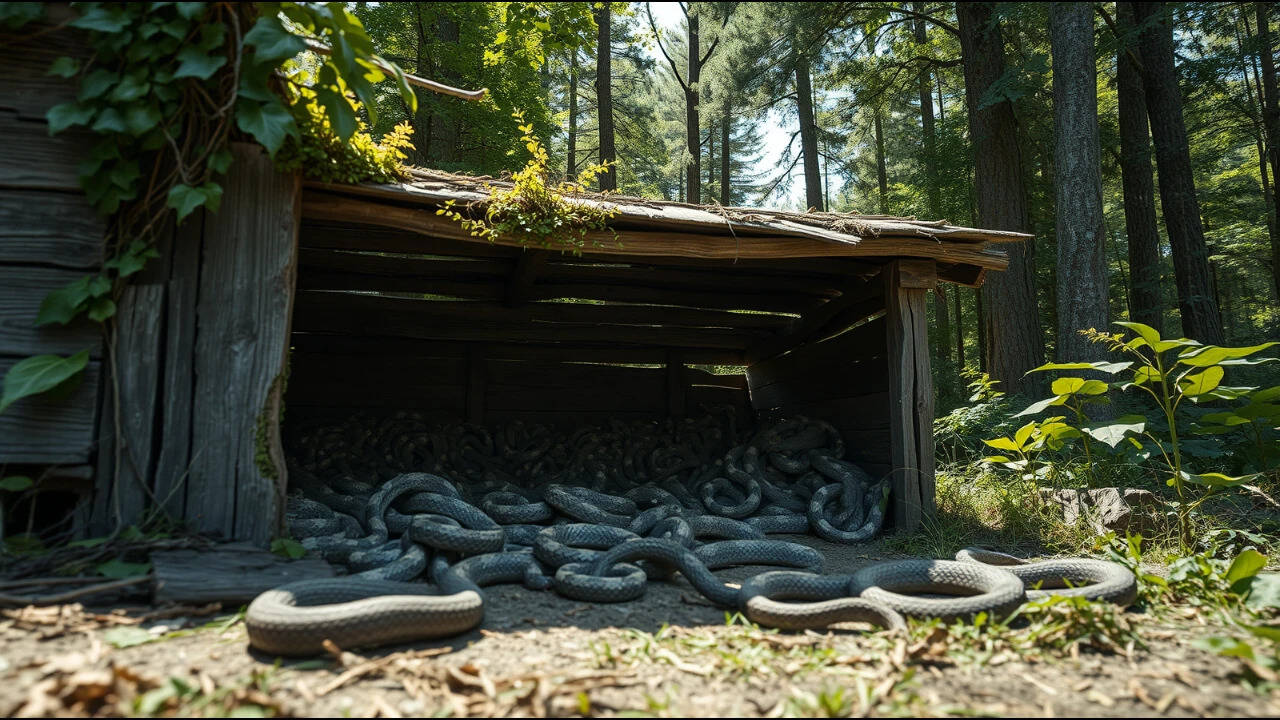
Stumble across an old, forgotten building draped in peeling snakeskins, and your first instinct might be to back away slowly. When researchers Frank and Chris Hensley found a dilapidated structure in central Mississippi coated in shed skins, they did the opposite. They pointed time-lapse cameras right at it.
What they captured over multiple seasons upended standard assumptions about Pantherophis obsoletus alleghaniensis—commonly known as the gray ratsnake. Popular media loves to paint these constrictors as singular villains terrorizing every bird nest in sight. But tracking them at what researchers nicknamed "The Snake Shed" showed a much more complex daily routine centered around survival needs, moisture access, and seasonal body temperature regulation.
Why Gray Ratsnakes Actually Gather in Old Structures
If you assume snakes only crawl into abandoned human dwellings by accident, you're missing the biology of how these animals handle seasonal shifts. The Mississippi study proved that an empty shed functions as a multi-tool for local reptiles.
During early spring, activity spiked dramatically. The snakes used the structure as a secure thermal buffer after emerging from underground dormancy. They could slip deep into the walls overnight, avoiding freezing spring lows, and then ascend directly into the adjacent tree canopy when the morning sun hit.
Water management played an equally vital role. During heavy rainstorms, cameras recorded snakes partially emerging from crevices to drink moisture pooling on the building's exterior. Finding reliable hydration without exposing themselves to avian predators like hawks or owls is a high-stakes daily puzzle. An old roof and warped siding solved that puzzle neatly.
The Truth About Climbing Behavior and Nest Predation
For decades, finding a ratsnake draped over a bluebird box or hanging near an open-cup nest led to a simple conclusion: they live in trees to hunt birds. To test this long-standing theory, the Mississippi researchers compared their time-lapse climbing data against nearly a thousand regional bird nesting records curated by the Cornell Lab of Ornithology's NestWatch program spanning a decade.
The logic was straightforward. If snakes were scaling trees primarily to gorge on eggs and nestlings, the peak of snake climbing activity should mirror the peak of local bird nesting.
It didn't.
Arboreal activity peaked very early in the spring, right as the snakes emerged from winter rest, and then dropped off sharply just as bird eggs and nestlings became fully abundant later in the season. This matches dietary data showing that small mammals remain the primary staple of a gray ratsnake's diet year-round, even when forest canopies are full of easy avian meals.
Snakes do raid nests, of course. But treating them as full-time avian predators misreads their broader ecological movements. They climb trees to bask, hunt mice, navigate territories, and escape ground predators just as often as they check for a meal of eggs.
Ecdysis and the Mystery of September Shedding
Another surprising pattern caught on camera involved the timing of ecdysis, or skin shedding. Total snake activity around the abandoned building dipped significantly during the late summer and autumn months. Yet, actual shedding events peaked heavily in September.
Why congregate to shed when overall movement is low? Old buildings offer tight, humid microclimates that protect vulnerable reptiles. When a snake is preparing to shed, its vision becomes clouded by opaque spectacle scales, leaving it nearly blind and deeply defenseless. The interior walls of an abandoned structure provide a safe perimeter where they can rub against rough wood to peel away old skin without running a gauntlet of mammalian or avian predators.
What Property Owners Can Learn From the Data
If you happen to manage land or own a rural property with old outbuildings, seeing a population of ratsnakes move in can feel alarming. Yet, trying to eradicate them usually backfires. Gray ratsnakes act as an elite, free pest-control crew keeping local rodent populations under strict natural limits.
If you want to discourage them from moving onto your active front porch or into a workshop, stop trying to fight their biology and alter the habitat instead. Clear dense brush piles away from exterior walls, seal up structural entry points where mice can nest, and elevate firewood racks. When you remove the food sources and easy hiding spots, the snakes will naturally disperse into the broader woodland canopy rather than sharing your living space.