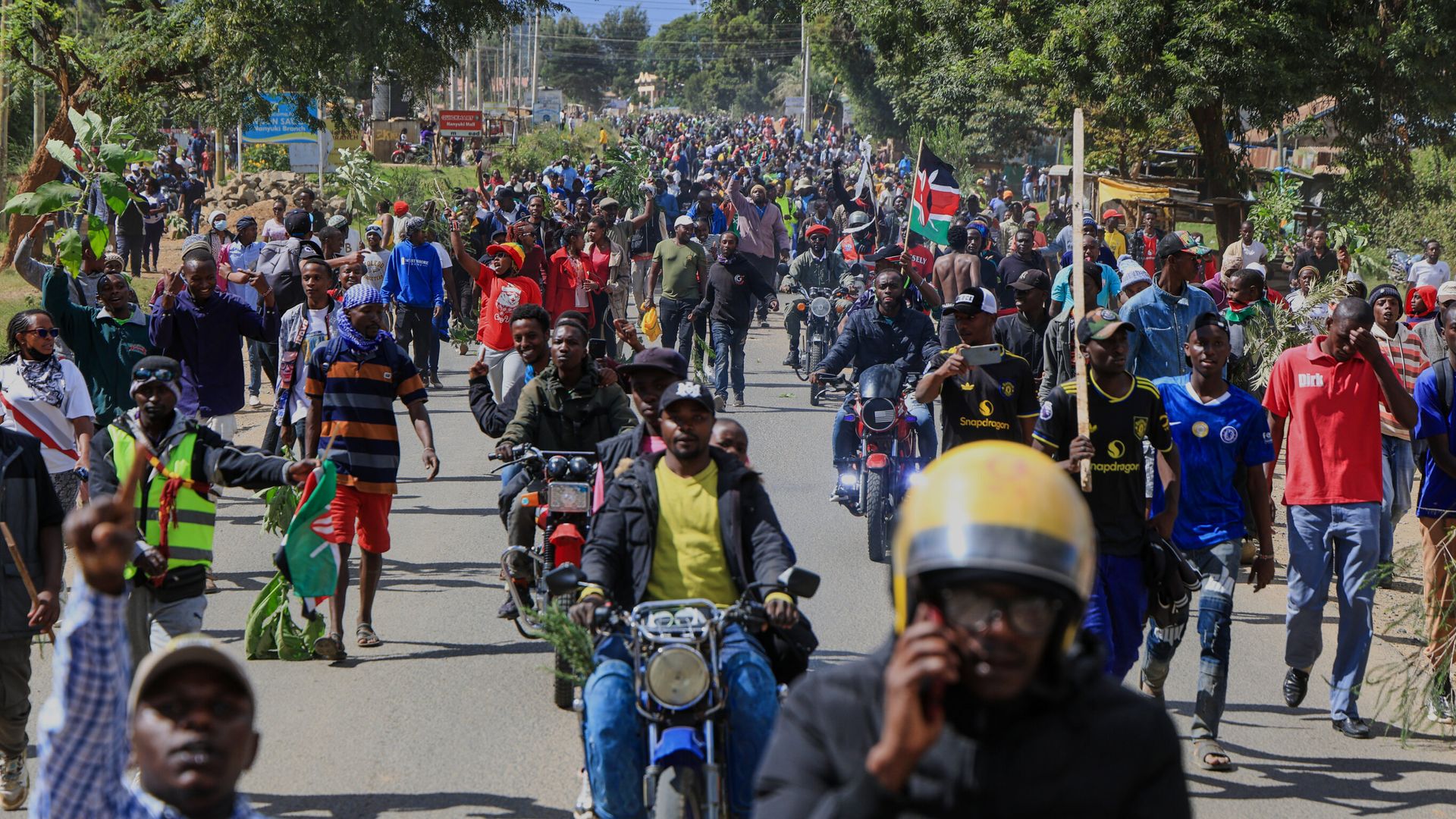
The headlines screaming out of Nairobi and Nanyuki right now are serving up a predictable cocktail of righteous outrage, geopolitical drama, and deep-seated panic. Hundreds of youths are marching at the gates of the Laikipia Air Base. The High Court has slapped down a temporary injunction. Activists and medical unions are decrying an "apartheid healthcare model," claiming the US is using Kenya as a "containment colony" or a "dumping ground" for the deadly Bundibugyo Ebola variant spreading through the Democratic Republic of Congo and Uganda.
It is a great narrative for selling newspapers. It is also an incredibly short-sighted perspective on global health security.
The mainstream consensus is lazy: it frames this 50-bed quarantine facility as a straightforward case of Western exploitation, an operational risk forced onto a fragile domestic health system in exchange for a $13.5 million aid package from Washington. But this knee-of-the-curve outrage ignores the hard physics of epidemiology. The real danger to Kenya is not a locked-down, military-grade isolation ward staffed by American specialists on a secure airbase. The real danger is the porous, unmonitored border miles to the west, combined with a total lack of regional surge capacity.
By blocking this facility, activist lawsuits and street protests are not protecting local biosecurity. They are actively dismantling it.
The Containment Colony Myth vs Epidemic Realities
Let us clarify exactly how the current Bundibugyo outbreak operates. Unlike respiratory pathogens, Ebola viruses do not drift through the air across airbase fences to infect passing pedestrians. Transmission requires direct contact with infected bodily fluids.
I have watched public health agencies mismanage resource allocation during outbreaks across sub-Saharan Africa for over a decade. The pattern is always the same: political posturing takes precedence over actual containment geography.
When the Law Society of Kenya and the Katiba Institute argue that Kenya lacks the infrastructure to manage such a facility, they are fundamentally misunderstanding the operational design. The facility at Laikipia was planned to be a self-contained unit staffed entirely by foreign medical professionals, meant for stabilizing exposed personnel before potential evacuation to Europe. It does not put a strain on local hospitals. It does not pull Kenyan doctors off their shifts.
To call it a dumping ground is a fundamental mischaracterization of the mechanics of quarantine.
Consider two distinct operational scenarios.
Scenario A: The Controlled Facility
An exposed or infected individual is flown directly via contracted aeromedical evacuation into Laikipia Air Base. They enter a high-containment, military-managed ecosystem with dedicated waste management protocols and international oversight. The local population has zero contact with the patient or the facility's waste streams.
Scenario B: The Reality of Regional Spreading
The Bundibugyo outbreak continues to expand undetected across the border from Uganda, which has already reported multiple cases. Because local health systems are overwhelmed, an infected individual travels commercial routes across the border, seeks treatment at an under-resourced public clinic in western Kenya, exposes dozens of local healthcare workers, and sparks a domestic chain of transmission.
Protesters think they are fighting Scenario A. In reality, by halting the creation of specialized regional infrastructure, they are guaranteeing that Kenya remains entirely vulnerable to Scenario B.
Why Outbreak Proximity Matters for Everyone
The US decision to build a facility closer to the epicenter—rather than flying exposed individuals back to North America—is being weaponized by politicians who claim Washington thinks Kenya is "too dangerous for America, but fine for Africa."
This is a fundamental misunderstanding of clinical logistics. Flying a patient bleeding from a hemorrhagic fever across an ocean on an 11-hour flight is bad medicine and worse epidemiology. Every hour matters when treating Ebola, especially a variant like Bundibugyo that lacks an approved vaccine or targeted therapeutic.
[Outbreak Epicenter: DRC/Uganda]
       │
       ├───► [Laikipia Air Base Facility] ──► Immediate Stabilization & Triage
       │
       └───► [Transatlantic Evacuation]   ──► 11+ Hour Flight Risk / Clinical Decline
Having high-tier isolation capabilities within the region is a massive asset for East Africa, not a liability. Health Minister Aden Duale was correct when he noted that the facility would ultimately serve broader regional preparedness, not just American nationals. Diseases do not carry passports, and they do not respect national borders. Having a fully functional, highly capitalized isolation unit sitting on Kenyan soil provides a critical strategic backstop if the regional outbreak breaches containment.
The Real Cost of Rejecting the $13.5 Million
The medical unions are furious about the $13.5 million US funding package, calling it a bribe for national biosecurity. Let us look at that number without the emotional rhetoric.
Kenya has a highly vulnerable health system that regularly struggles with basic equipment shortages, labor disputes, and inadequate surveillance infrastructure at remote border crossings. If the High Court permanently blocks this agreement, that money vanishes. The US will simply move the asset to another regional partner or rely entirely on high-risk, long-range extractions.
What happens to Kenya then? The country remains exposed to the very real, unmitigated spillover from Uganda and the DRC, but without the millions of dollars intended to shore up its own domestic surveillance and diagnostic capabilities.
That is not a victory for sovereignty. It is an act of fiscal and epidemiological self-sabotage.
Dismantling the Public Health Premise
The standard arguments against the Laikipia facility fall apart under close inspection.
| The Popular Protest Argument | The Hard Epidemiological Reality |
|---|---|
| "The facility will leak Ebola into the local community." | High-level quarantine facilities on military bases are among the most secure environments on earth. The transmission risk to the surrounding town of Nanyuki is effectively zero. |
| "Kenya's healthcare system cannot handle the burden." | The facility was designed to be entirely self-funded, self-contained, and self-staffed. It places zero operational load on the public healthcare network. |
| "Accepting foreign patients degrades national dignity." | Rejecting infrastructure investments while remaining vulnerable to unmonitored border spillovers degrades national security. Real dignity lies in robust containment. |
The public debate has been completely hijacked by populist rhetoric ahead of next year's general election. Factions like Linda Mwananchi are using the quarantine facility as an easy club to beat the current administration, relying on xenophobic tropes and historical grievances rather than objective medical data.
The court cases cite a lack of public participation. While public consensus matters for domestic policy, managing an international health crisis via local town halls is a recipe for paralysis. Pandemics do not wait for bureaucratic sign-offs or judicial reviews.
The Dangerous Precedent of Courtroom Epidemiology
If the High Court permanently rules against this project based on the idea that foreign pathogens cannot be brought into the country for controlled treatment, it sets a catastrophic precedent for international cooperation.
Global biosecurity relies on the strategic placement of specialized resources where outbreaks happen. If every nation adopts a strict NIMBY (Not In My Back Yard) policy for quarantine facilities, the global response architecture collapses. We will be left with a fractured system where wealthy nations pull their personnel out entirely, leaving local populations to deal with catastrophic outbreaks with zero external clinical support.
The protesters marching in Nanyuki believe they are defending their homes. They are actually cheering for their own isolation from the global health security grid. When the Bundibugyo variant inevitably hits a Kenyan border town through standard, messy, human migration patterns, the country will not need lawsuits or political slogans. It will need high-containment beds, trained specialists, and international funding.
By killing the Laikipia facility, Kenya is throwing away all three.