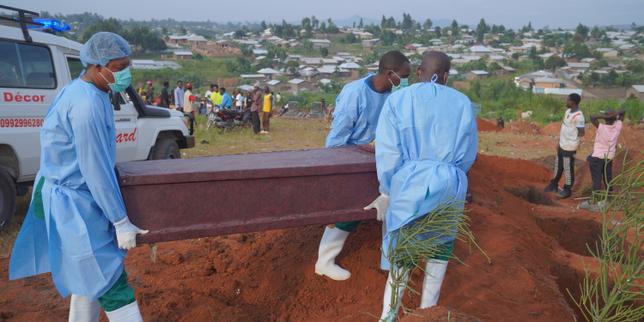
The headlines always read the same way. The United Nations sounds the alarm. Major news outlets echo the panic. Words like exponential, catastrophic, and out of control flood the pages. When the Ebola outbreak in the Democratic Republic of Congo crossed the grim milestone of 2,500 deaths, the global commentariat treated it as an apocalyptic runaway train.
They are wrong. Not because people didn't die—every single one of those fatalities is a tragic human loss—but because the framing of the crisis fundamentally misunderstands how infectious diseases actually move through human populations.
I have spent years watching international agencies misdiagnose public health crises from comfortable offices thousands of miles away from the equator. They love the drama of exponential curves because panic opens checkbooks. But math in a vacuum ignores human reality. An epidemic is not a mathematical formula ticking upward on an infinite vector. It is a collision between a pathogen, human behavior, geography, and local social structures. When you treat a localized transmission chain like a global contagion event, you miss every single practical lever that actually stops the virus.
The Flaw of the Exponential Fallacy
Let us look at the standard narrative. The UN report warned that the epidemic was surging exponentially, implying a runaway train with no brakes. That sounds terrifying. It is also mathematically illiterate when applied to filoviruses over the long term.
Ebola is not an airborne respiratory virus that spreads silently through a crowded subway car. Transmission requires direct contact with bodily fluids from someone who is symptomatic or deceased. That fundamental biological reality places an inherent ceiling on how fast and how far the virus can travel without active human vectors.
When epidemiologists scream exponential growth early in an outbreak, they are capturing the initial vertical climb of case detection in a newly seeded area. But diseases burn out their fuel sources. They hit community resistance, safe burial interventions, contact tracing walls, and localized immunity. The curve flattens. It always flattens. Treating a localized flare-up as an unstoppable planetary doom loop is a lazy shortcut that sells clicks while obscuring the messy, ground-level operational failures that actually prolong outbreaks.
Trust is the Only Vaccine That Matters
The real story in the DRC was never about the virus outsmarting science. It was about science completely ignoring the population it claimed to save.
When international responders arrive in Kivu or Ituri clad in full hazmat suits looking like extras from a sci-fi thriller, they project an image of foreign threat rather than healing. Decades of institutional neglect, armed conflict, and exploitation by outsiders mean that local communities do not trust men with clipboards carrying badges from Geneva or Kinshasa.
I have watched millions of dollars poured into high-tech treatment centers that local residents refused to visit because being taken away meant vanishing forever into a sealed ward where families could not perform traditional death rituals. If your medical intervention violates the cultural fabric of the community, your intervention is broken, not the community.
The turning point in these outbreaks never comes from a new pharmaceutical breakthrough flown in on a private jet. It comes when public health organizations finally swallow their pride, stop treating locals like obstacles to be managed, and hand contact tracing, community engagement, and burial management over to trusted local nurses, elders, and leaders.
The Uncomfortable Truth About Resource Allocation
Let us address the elephant in the room. Why do certain outbreaks trigger a planetary alarm while others quietly devastate millions?
Ebola terrifies the Global North because of its gruesome symptoms and high case fatality rate. It triggers a visceral, cinematic fear. Yet, malaria, preventable diarrheal diseases, and measles quietly claim vastly more lives in the exact same regions year after year without a fraction of the UN emergency press conferences or international funding surges.
Throwing emergency capital exclusively at the monster of the month creates a distorted, reactionary healthcare ecosystem. Local clinics are stripped of staff and resources to feed the massive bureaucratic apparatus of an emergency Ebola response, only for those foreign teams to pack up and leave the moment the numbers dip, leaving the baseline health infrastructure weaker than before.
If we genuinely cared about stopping future loss of life in the Congo, we would stop funding frantic, top-down panic responses and instead invest heavily in permanent, community-led primary healthcare networks. But steady, unsexy infrastructure building does not make for a dramatic press release at the United Nations General Assembly.
Stop buying into the panic narrative. The next time a global agency warns you about an exponential viral apocalypse, look past the math, look at who is holding the microphone, and ask who benefits from keeping everyone terrified.
The virus is manageable. The institutional arrogance is the real epidemic.


