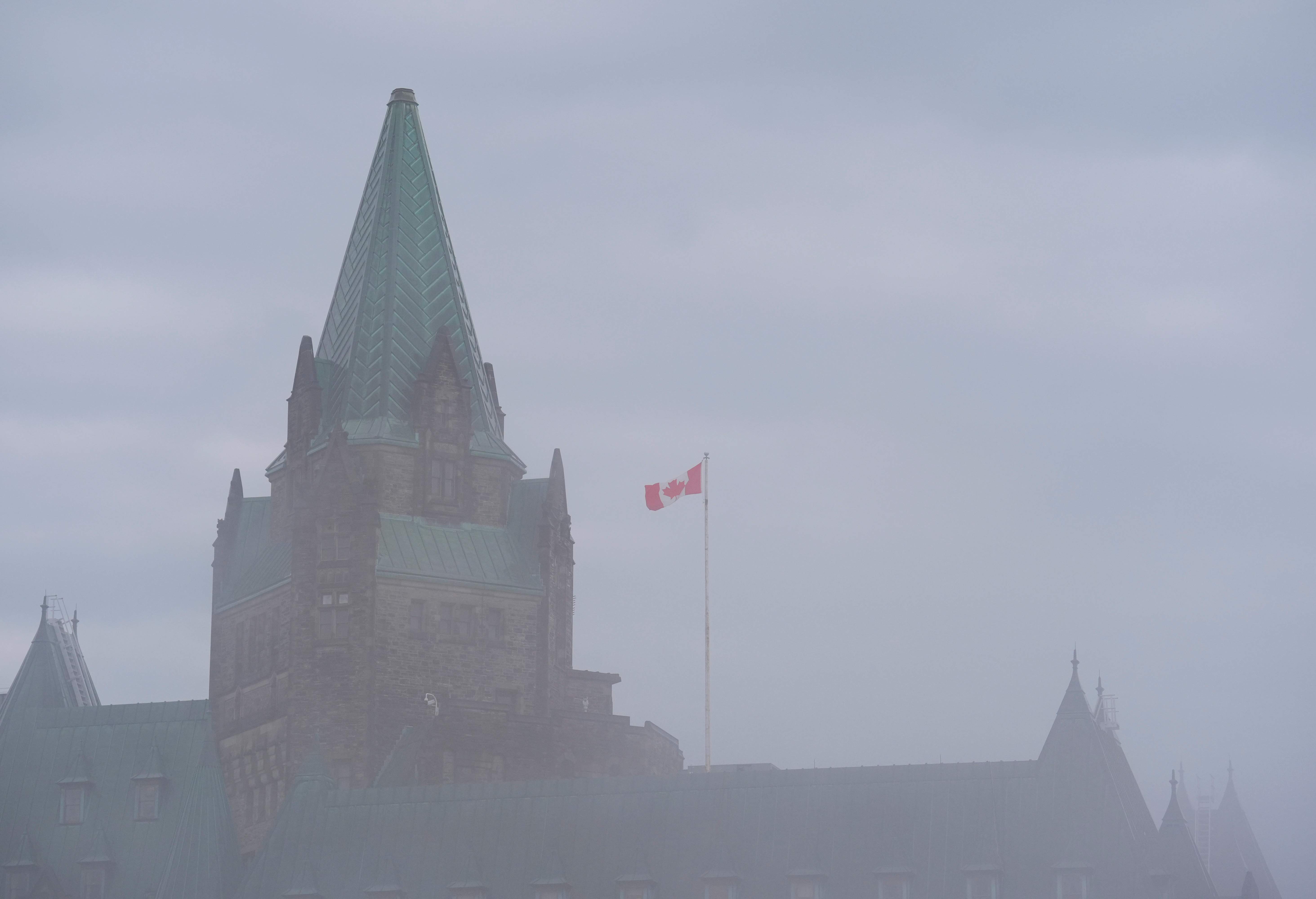
A 3.9 magnitude earthquake just "rumbled" through Ottawa and Quebec. Cue the frantic social media posts. Cue the local news anchors leaning into the camera with grave expressions. Cue the inevitable, low-effort articles detailing exactly where people felt a slight vibration in their coffee mugs.
Stop panicking. It’s embarrassing.
A 3.9 magnitude event is not a disaster. It is barely a footnote. In the world of seismology, we refer to this as a "light" earthquake. It happens thousands of times a year globally. Yet, every time the Western Quebec Seismic Zone clears its throat, the Canadian media treats it like the opening scene of a Roland Emmerich film. This obsession with minor seismic activity isn’t just annoying; it’s a distraction from the real infrastructure vulnerabilities we refuse to address.
The Magnitude Myth
The average person views the Richter scale—or more accurately, the Moment Magnitude scale ($M_w$)—as a linear progression. It isn't. It’s logarithmic.
A magnitude 4.0 is ten times "shaking" amplitude than a 3.0, but it releases roughly 31.6 times more energy. When you see a headline screaming about a 3.9, you are being sold a story about a firecracker as if it were a stick of dynamite. To put this in perspective:
- Magnitude 3.0-3.9: Felt by some, no damage. Total energy equivalent to a large lightning bolt.
- Magnitude 7.0: Major damage. Total energy equivalent to several hundred kilotons of TNT.
By treating a 3.9 as "breaking news," we dilute the public's understanding of risk. We are crying wolf with a poodle. When a legitimate 6.5 eventually hits the St. Lawrence Valley—which is geologically possible—the public will be fatigued by years of "emergency" alerts for events that didn't even knock a picture frame off the wall.
The St. Lawrence Rift Trap
The competitor's coverage focuses on the feeling of the quake. "I felt a jolt in Gatineau." "My dog barked in Nepean." This is anecdotal junk.
The real story is the Western Quebec Seismic Zone. This isn't a plate boundary like the San Andreas. We are in the middle of the North American Plate. This is "intraplate" activity. The crust here is old, cold, and rigid. Because the rock is so dense, seismic waves travel significantly further and more efficiently than they do in California.
A 3.9 in Ottawa is felt across a much wider radius than a 3.9 in Los Angeles. This creates a false sense of scale. People 100 kilometers away feel a tremor and assume they just survived a "big one." They didn't. They just live on top of a highly efficient acoustic guitar string of a geologic basement.
The False Security of Modern Building Codes
The media likes to reassure us that Ottawa is "prepared." This is a lie.
While the National Building Code of Canada (NBCC) has evolved, it largely applies to new builds. Ottawa is a city of heritage stone, unreinforced masonry, and aging government blocks.
If you want to be worried about something, don't worry about the 3.9. Worry about the Leda Clay.
Much of the Ottawa-Gatineau region sits on Champlain Sea sediments, specifically sensitive glaciomarine clays known as Leda Clay. In a minor 3.9 event, this clay stays stable. In a sustained, higher-magnitude event, this soil can undergo liquefaction. It turns from a solid to a liquid in seconds.
The "lazy consensus" says our biggest risk is falling bricks. The reality is that our biggest risk is the ground beneath our most expensive infrastructure literally dissolving. We spend millions on seismic sensors to tweet out alerts within seconds of a tiny jolt, but we spend almost nothing on large-scale soil stabilization or retrofitting the "soft-story" buildings that dominate the downtown core.
The Economic Theater of Seismology
Why does the media lean so hard into these non-events? Because it's cheap engagement.
It costs nothing to aggregate "Did You Feel It?" reports from the Natural Resources Canada website. It’s harder to investigate why the City of Ottawa hasn't mandated seismic retrofits for private schools and hospitals built before 1970.
We are participating in a form of geologic theater. We track the minor quakes to feel like we are monitoring the threat, while ignoring the fact that a magnitude 6.0—the kind of quake this region sees every century or two—would cause billions in damages because we’ve prioritized "awareness" over actual engineering.
Stop Asking if People Felt It
If you go to a search engine and type "Ottawa earthquake," you’ll see the "People Also Ask" section filled with:
- "Is Ottawa on a fault line?"
- "Can a big earthquake happen in Ontario?"
- "Why did I feel a vibration today?"
These questions are symptoms of a failed education on local geography. Yes, there are faults. The Gloucester Fault runs right through the city. But "fault lines" are not the problem. The problem is the recurrence interval.
Instead of asking "Did you feel it?", we should be asking:
- Is my gas shut-off valve automatic? (Most aren't).
- Is my water heater strapped to the wall? (In Ottawa, almost never).
- Does my insurance policy actually cover earthquake damage? (Usually, it’s a separate rider with a massive deductible that most people decline because "nothing ever happens here").
The Industry’s Dirty Secret
I have spent years looking at risk assessment models for urban centers. The dirty secret of the insurance and civil engineering world is that we rely on "probabilistic" models that are heavily skewed by the most recent 50 years of data.
In geologic terms, 50 years is a heartbeat.
Because we haven't had a devastating quake in the Ottawa River Valley in living memory, the political will to spend money on seismic resilience is non-existent. We get 3.9 magnitude tremors, we get a few clicks on a news site, we feel a bit of excitement, and we go back to sleep.
This latest tremor wasn't a warning. It wasn't a "scare." It was a reminder that the crust is moving, and we are built on a foundation of sand and clay that doesn't care about our building codes or our "breaking news" banners.
If you felt the quake, congratulations. You experienced a minor release of energy from a 450-million-year-old rift system. Now stop tweeting about it and go check if your foundation has cracks that have been there for a decade.
Stop treating every twitch of the earth like a catastrophe. If you want to worry, worry about the fact that we are building a high-density city on a liquid-prone basin and calling it "stable."
The next time the ground shakes and it’s under a 5.0, don’t check Twitter. Check your exits. Everything else is just noise.