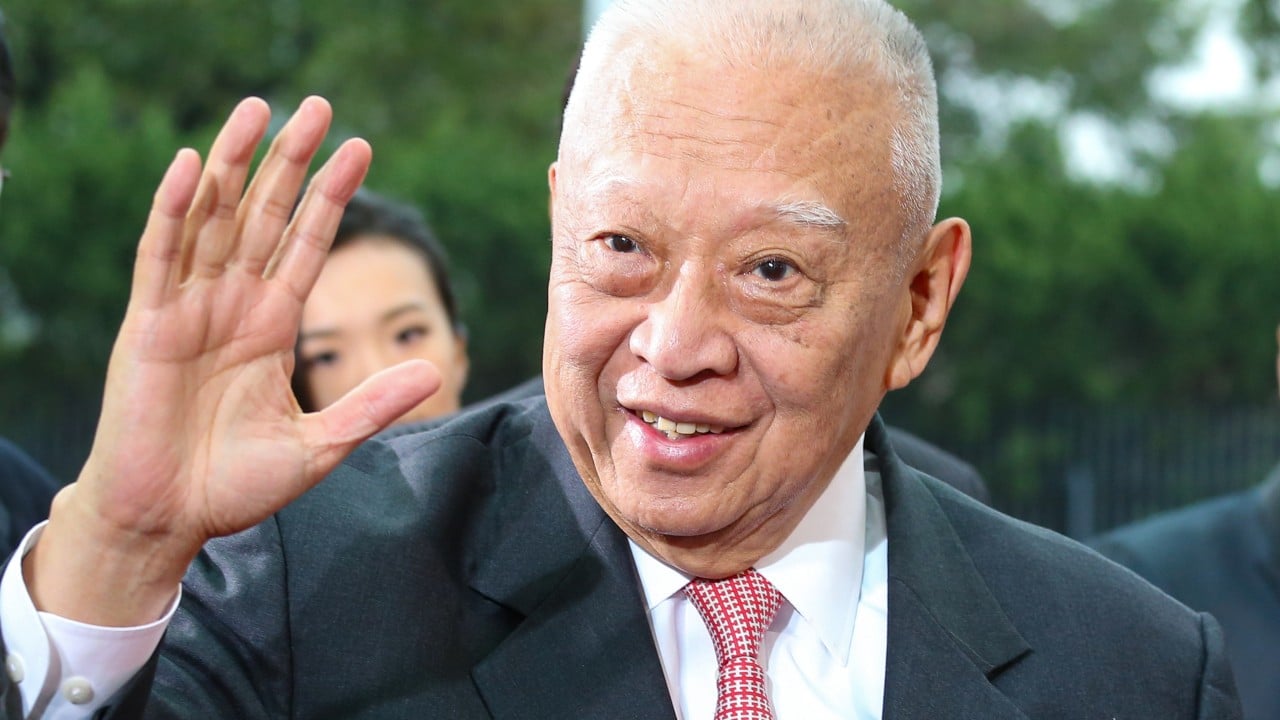
The media coverage surrounding the state funeral arrangements for Hong Kong’s first post-colonial leader, Tung Chee-hwa, suffers from a predictable, lazy fixation. Standard reports hyper-ventilate over the "blanket of security", the heavy police presence in North Point, and the choreography of high-ranking mainland officials flying in. Observers treat these optics as a direct barometer of political tension, interpreting every barricade and motorcade as a symptom of acute institutional anxiety.
This is a profound misreading of how high-stakes political ceremonies actually function.
Security cordons around elite state send-offs are not improvised panic responses to modern civil friction. They are routine, highly calculated exercises in state choreography. When senior figures like Politburo member Shi Taifeng and other key officials converge to honor a former leader who later served as a vice-chairman of the Chinese People's Political Consultative Conference (CPPCC), the massive police deployment is standard operating procedure for elite political transitions. Focusing entirely on the barricades misses the deeper structural signaling happening in plain sight.
The Myth of Reactive Fortification
We have been conditioned by lazy headline writing to view heavy security as a defensive measure born out of fear. I have watched analysts spend days breaking down traffic control plans and perimeter locks as if they were tactical military deployments rather than administrative boilerplate.
Consider a simple truth: absolute state security protocols at high-level memorial events are designed for predictability, not threat mitigation. When figures of monumental political weight are laid to rest, the apparatus of the state moves to eliminate variables. It is an exercise in total environmental control. The heavy police footprint in North Point during Tung's farewell was less about handling immediate dissent and more about projecting unyielding administrative order.
The lazy consensus assumes that visible security equals visible vulnerability. In reality, statecraft dictates that maximum force projection is used precisely when stability is highest, serving as a reminder of institutional continuity. Tung's passing closed a specific, turbulent chapter that began with the 1997 handover. The governance struggles of his tenure—from the Asian financial crisis fallout to the intense public friction of 2003—are well-documented history. Yet, analyzing his state funeral through the lens of historical grievances or temporary security flashpoints ignores how modern statecraft institutionalizes memory.
Redefining the Optics of Continuity
When industrialist Ann Tse-kai and tycoon Henry Fok Ying-tung received state funerals in 2000 and 2006 respectively, the institutional mechanics were remarkably similar. Each event was meticulously coordinated by committees chaired by senior national figures. The security measures scaled accordingly because the state treats these ceremonies as architectural pillars of its official narrative.
To obsess over whether a side street is blocked off or how many officers are stationed near the funeral home is to miss the forest for the barricades. The real signal is who attends, who leads the committee, and how the official narrative frames the legacy. The presence of top-tier Beijing leadership communicates institutional permanence. It tells the public that the architects of the early post-colonial era are anchored firmly into the historical pantheon, regardless of past administrative turbulence.
Stop treating state funerals as security crises. They are political punctuation marks. The heavy hand of the state is not trembling; it is simply writing in permanent ink.
State funeral for Hong Kong's first chief executive Tung Chee-hwa
This video provides an authentic look at the proceedings and official proceedings of Tung Chee-hwa's state funeral, showcasing the actual scale of the event and the presence of senior dignitaries.