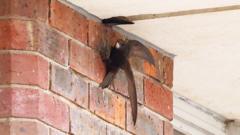
Campaigners love a clear villain. When a local authority bulldozes an old building and local bird populations face displacement, the script writes itself. Activists wave placards, developers issue hollow apologies, and the public gets treated to a predictable narrative about greedy corporations destroying nature.
It is a neat, emotionally satisfying story. It is also entirely wrong.
The furious reaction to swifts losing nesting sites during urban regeneration projects exposes a fundamental flaw in how we approach urban wildlife. We are hyper-focused on the spectacular failures—the dramatic demolitions—while completely ignoring the systemic structural issues that actually dictate whether a species survives in our cities. For decades, I have watched conservation groups pour immense energy, funding, and media capital into fighting losing battles over individual structures. It is bad strategy, worse science, and it does absolutely nothing to fix the broader crisis.
The Myth of the Sacred Ruin
The standard outcry relies on a comforting premise: if we just stop knocking down old, dilapidated buildings, the birds will be fine. This is a nostalgic fantasy.
Swifts are migratory birds that spend most of their lives in the air, but they rely on specific nooks, crannies, and gaps under roof tiles to breed when they arrive in Europe for the summer. Historically, poorly insulated, decaying architecture provided these accidental sanctuaries. But treating crumbling infrastructure as a permanent conservation strategy is a recipe for disaster.
Old buildings are, by definition, temporary. They decay, they become unsafe, and they eventually require either gutting or flattening. Expecting modern cities to maintain a crumbling inventory of 19th-century brickwork purely to serve as accidental bird hotels is not a policy; it is a delusion.
The real issue is not that we are pulling down old walls. The issue is that we have spent the last forty years building new ones that are completely hostile to life.
The Synthetic Urban Desert
Walk through any major city and look at the new developments. They are slick, airtight, glass-and-steel monoliths. Modern building regulations quite rightly demand high thermal efficiency and flawless insulation to combat climate change. But the unintended consequence of making buildings completely draft-proof is that we have sealed shut every conceivable entry point for urban wildlife.
This is where the standard campaign logic falls apart. If you successfully block the demolition of one old warehouse, you save a handful of nesting sites for a few years. Meanwhile, fifty new residential blocks go up down the road, offering precisely zero entry points for the next generation of birds.
By focusing on the demolition site, campaigners are treating the symptom while ignoring the terminal diagnosis. The battle lines should not be drawn at the perimeter of a demolition zone. They should be drawn at the planning permission stage for every single new building.
The Problem with the Quick Fix
When developers face public backlash over displaced wildlife, their go-to solution is the swift box. They slap a few wooden or plastic boxes onto the exterior of a finished building, snap a photo for the corporate social responsibility report, and call it a day.
I have seen developers use these retrofitted boxes as a literal get-out-of-jail-free card to smooth over PR disasters. The public goes home happy, thinking the problem is solved.
Here is the inconvenient truth that nobody wants to admit: retrofitted external boxes have an incredibly high failure rate.
- Thermal Shock: External boxes are exposed to extreme weather. Without the insulation of a thick brick wall, they can turn into ovens during summer heatwaves, literally cooking chicks inside.
- Predation: Slapping a box onto a flat wall often makes it an easy target for crows, magpies, and rodents.
- Acoustic Failure: Swifts are colonial nesters that rely on social cues. They rarely colonize a random new box unless you install an acoustic system to play swift calls to lure them in—something developers almost never bother to maintain long-term.
Relying on external boxes to fix the displacement caused by demolition is like handing a tenant a pup tent after burning down their apartment complex. It looks like a gesture of goodwill, but it is practically useless.
The Structural Alternative
If we want to actually fix this, we have to stop romanticizing old buildings and start mandating wildlife integration into new ones. This means moving away from external boxes entirely and forcing the adoption of integral nesting bricks, often called "swift bricks."
These are hollow, insulated blocks built directly into the fabric of the wall during construction. They mimic the exact conditions of an old cavity wall—stable temperatures, protection from predators, and durability that lasts for the lifetime of the building—without compromising the property's energy efficiency.
Organizations like the Royal Society for the Protection of Birds (RSPB) and Action for Swifts have pushed for this for years, yet it remains a niche consideration rather than an industry standard. Why? Because fighting a developer at a demolition site makes for a great local news headline, while arguing over municipal planning frameworks and building codes is painfully boring.
Dismantling the Practical Objections
When you push for mandatory integral nesting bricks, the real estate industry immediately pushes back with a laundry list of excuses. Let us dissect the most common objections and look at why they hold zero weight.
"It Costs Too Much"
This is the most laughable argument in real estate. An integral swift brick costs roughly the same as a couple of standard facing bricks. When integrated during the initial build phase, the labor cost is negligible. On a multi-million-pound development, installing fifty swift bricks represents a microscopic fraction of a percent of the total budget. The cost argument is not a financial reality; it is a symptom of administrative laziness.
"It Causes Maintenance and Structural Issues"
Architects often fret about water ingress, structural integrity, or maintenance access. This is a solved engineering problem. Properly designed integral bricks are self-contained units that shed water outward and require zero maintenance once installed. They do not grant birds access to the actual cavity insulation of the house; they create a isolated, secure pocket within the facade.
"Birds Will Damage the Property"
Unlike pigeons or gulls, swifts do not mess up facades. They are incredibly clean birds that leave virtually no droppings outside the nest cavity, and they do not feed on or damage the building's structure. They arrive, breed, and vanish back to Africa without leaving a trace.
Redefining the Conservation Goal
The current framework of urban conservation is entirely reactive. We wait for a crisis, we express outrage, we secure a minor, compromised concession, and we repeat the cycle six months later. It is a loop of perpetual defeat disguised as activism.
If we want to stop the decline of urban bird populations, we must abandon the obsession with preserving specific old walls. We need to accept that cities change, buildings come down, and density is a necessity in a growing world. The goal should not be to freeze our urban centers in amber. The goal must be to ensure that every new piece of infrastructure we create is automatically designed to support life.
Stop looking at the demolition crew. Look at the local planning board. Until municipal laws mandate that every new residential and commercial development includes permanent, integrated spaces for wildlife, the outrage over displaced birds is just noise.