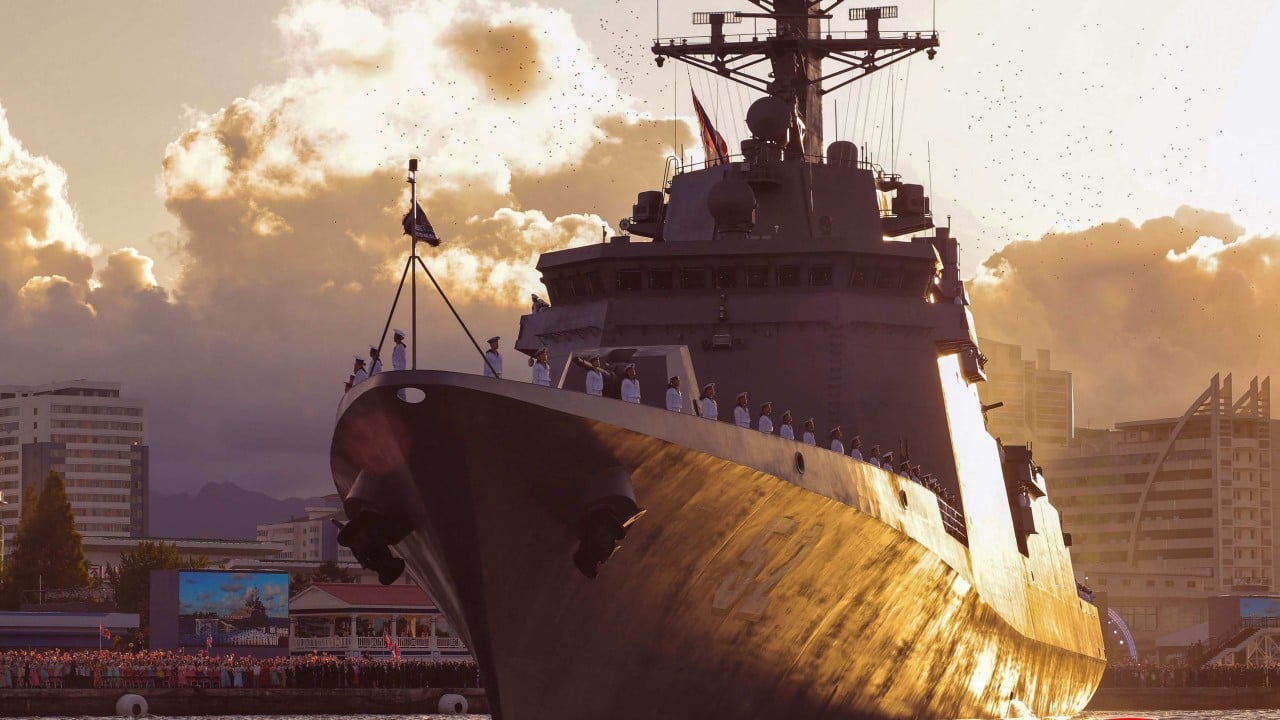
Every defense analyst in Washington is currently hyperventilating over satellite imagery of a shipyard in Sinpo. The lazy consensus dominating the security sector claims Pyongyang just pushed out a second nuclear capable surface combatant while Seoul, Tokyo, and Washington kicked off trilateral maritime exercises. The narrative practically writes itself. Dictator builds shiny grey hull, allies respond with aircraft carriers, regional tension ticks upward on an inevitable escalator toward conflict.
The analysis is wrong. It misses the entire operational reality of how asymmetric navies actually fight. For an alternative look, consider: this related article.
Focusing on the hull classification of a corvette or a light frigate obscures the actual engineering constraint. Pyongyang does not possess a blue water navy, nor is it trying to build one. Looking at North Korea through the prism of a 1990s US Navy battle group doctrine guarantees complete analytical failure. The leadership in Pyongyang operates under a doctrine of coastal denial wrapped in strategic deterrence. A floating platform designated as a destroyer by Western intelligence agencies functions primarily as an upgraded missile barge with an advanced command and control superstructure, designed to complicate target acquisition rather than engage in Mahanian fleet actions.
Military history offers clear precedents. When an economically constrained state faces an industrial colossus, it does not attempt symmetrical parity. Imperial Germany tried building dreadnoughts to match the Royal Navy and starved its army in the process. Pyongyang studied that mistake. Every dollar funneled into a displacement hull is a dollar diverted from hardened underground missile silos, mobile TEL launchers, and nuclear material enrichment. Similar coverage regarding this has been published by NPR.
Treating these launches as evidence of an emerging conventional naval threat misunderstands the economics of deterrence on the Korean peninsula.
The Western security establishment treats naval tonnage as the ultimate metric of power because Western defense budgets rely on procuring multi-billion-dollar destroyers. When you sell surface combatants, every foreign hull spotted on a slipway validates your procurement requests. This creates an institutional incentive to exaggerate the lethality and systemic capability of adversarial platforms.
Examine the propulsion systems and sensor suites visible on these hulls. Publicly available imagery from commercial satellites consistently reveals radar cross-sections that would make a modern Aegis radar operator laugh out loud. These vessels lack the integrated air defense architectures required to survive twenty minutes against a modern task force equipped with supersonic anti-ship missiles.
Pyongyang understands this limitation better than its critics do. The strategic utility of these ships is not found in their ability to slug it out in the Sea of Japan. Their utility is political signaling wrapped in tactical ambiguity. By putting a missile-armed platform on the water during high-profile allied drills, the regime forces Washington, Seoul, and Tokyo to dedicate intelligence, surveillance, and reconnaissance assets to track it.
That is asymmetric warfare at its finest. You spend a fraction of a percent of your GDP on a mediocre hull with advanced missile tubes, and you force your adversaries to redirect multi-billion-dollar maritime patrol aircraft and spy satellites away from critical strategic targets to monitor it.
The trilateral drills involving the USS Theodore Roosevelt or similar carrier strike groups response squads are theatrical performances. They reassure domestic audiences in South Korea and Japan, but they do nothing to alter the strategic equation on the ground.
Naval analysts frequently ask how the international community should respond to these provocative naval expansions. The question itself exposes a fundamental misunderstanding of the problem.
The question assumes that more sanctions, more naval patrols, or more stern communiques from the UN Security Council will alter a regime that has spent seven decades perfecting isolation and autarky. Sanctions have failed to stop the nuclear program, and they certainly will not stop a government from welding missile tubes onto steel plates.
Asking how to stop the construction of these ships is like asking how to stop a toddler from finger-painting on the wall while you are standing in a burning house. The hull in Sinpo is a symptom of a much larger, structural reality that defense contractors and career bureaucrats refuse to acknowledge: containment has failed, deterrence has evolved into a bizarre theater of mutual posturing, and the Korean peninsula is locked into a permanent state of high-stakes friction.
Realizing this shifts the analytical burden entirely.
Defense planners need to stop treating every piece of military hardware in North Korea as a direct copy of Soviet or Chinese doctrine. Pyongyang operates on a shoestring budget with an existential mandate. Every asset is dual-use, highly redundant, and designed for maximum political leverage per dollar spent.
When evaluating naval strength in the Indo-Pacific, displacement tonnage matters far less than network resilience and missile inventory. A nation with five thousand underground artillery pieces aimed at Seoul does not need a blue-water fleet to project power. The destroyer in the shipyard is a prop. A very expensive, nuclear-capable prop designed to dominate the evening news cycle in Seoul and Washington while the real deterrent work happens deep underground where satellites cannot see.
Stop buying the narrative that an arms race is happening on the waves. The real competition was won by the side that figured out how to make everyone panic over a glorified missile barge.