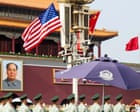
Beijing doesn't do "relaxed." When a U.S. President rolls into town, the city usually tightens up, but this week feels different. It's May 2026, and Donald Trump is back in the Chinese capital for the first time in nearly nine years. If you walk past the embassy district or Wangfujing right now, you aren't seeing the usual tourist bustle. You’re seeing a fortress.
The air is thick with more than just the usual spring haze. There’s a palpable sense of "here we go again" among the locals. Security personnel with crew cuts and black T-shirts are crawling over five-star hotels. The Beast—Trump’s armored limousine—has already touched down. But while the Chinese government is rolling out the literal red carpet, the people living here are holding their breath. They’ve seen this movie before, and they don't love the sequel.
The Fortress Mentality in the Embassy District
I’ve seen Beijing under lockdown for high-level summits, but the scale of this security operation is massive. One global five-star hotel near the U.S. Embassy has basically stopped being a hotel. Most exits are chained shut. Armed police Jeeps are parked in the lots, and you can’t move five feet in the lobby without bumping into someone carrying a walkie-talkie and a floor plan.
It isn't just about physical safety. It’s about control. The Temple of Heaven—a spot where Trump and Xi are supposed to have one of those staged "friendship" walks—has been closed to the public. For the average Beijing resident, these visits don't mean diplomacy; they mean a longer commute and more ID checks at the subway.
The skepticism on the street is real. I spoke with a few locals who weren't exactly buying the "win-win cooperation" lines being fed to the state media. One shopkeeper near Wangfujing told me flatly that Trump isn't trustworthy. There’s a feeling that whatever deal gets signed today could be shredded by a post on social media tomorrow. People remember the 2025 tariffs that sent the cost of living up. They remember the trade war that never really ended.
The Iran Shadow and the Trade Truce
You can’t talk about this visit without talking about the war with Iran. It’s the elephant in the room that actually delayed this trip. Trump’s arrival comes as a ceasefire in the Middle East is basically on life support. He’s looking for a win—any win—to show he’s still the master negotiator.
The agenda is packed with things that sound good on a teleprompter but are messy in reality.
- The Boeing Deal: Rumors are flying about China buying 500 aircraft.
- Agricultural Pledges: More soybeans, more corn, more "buying American."
- The Busan Truce: A desperate attempt to formalize the trade peace that has been shaky since late last year.
But here is what most people are missing. China isn't the same country Trump visited in 2017. They’ve spent the last few years diversifying. In early 2026, China’s exports to non-U.S. markets surged by over 20%. They’ve learned how to live without us. That makes the leverage Trump thinks he has a lot thinner than he realizes.
High Stakes and Empty Promises
Beijing is playing a long game. They’ll give Trump the "optics" of success. They’ll give him the state banquet and the flattering photos. Why? Because they want him to leave. They want to preserve their access to U.S. technology and stop the tightening of export controls on AI and semiconductors.
But don't mistake the hospitality for a reset. Xi Jinping has been very clear that Taiwan remains the "red line" that can’t be crossed. While Trump might be focused on selling Boeing planes, the Chinese leadership is focused on making sure the U.S. stops selling arms to Taipei. These two agendas aren't just different; they’re fundamentally at odds.
The skepticism isn't just local—it's structural. Even the experts at places like the Brookings Institution are calling this "tactical stabilization." It’s a fancy way of saying both sides are too tired to fight right now, but they still don't like each other.
What Happens When the Red Carpet is Rolled Up
If you're looking for a "grand bargain," stop. It isn't happening. The most likely outcome of this week is a temporary extension of the trade truce and some headline-grabbing purchase orders.
For the rest of us, the takeaway is simple. Watch the rare earth minerals. In 2025, China showed it could choke off supply chains for defense and EVs whenever it wanted. If this summit goes south, those restrictions will tighten again.
Don't get distracted by the photos of Trump and Xi smiling at the Great Hall of the People. Look at the security guards blocking the streets and the falling trade numbers. That’s where the real story is.
If you're doing business in the region, keep your supply chains flexible and don't bet on a permanent trade peace. This visit is a band-aid on a bullet wound.


