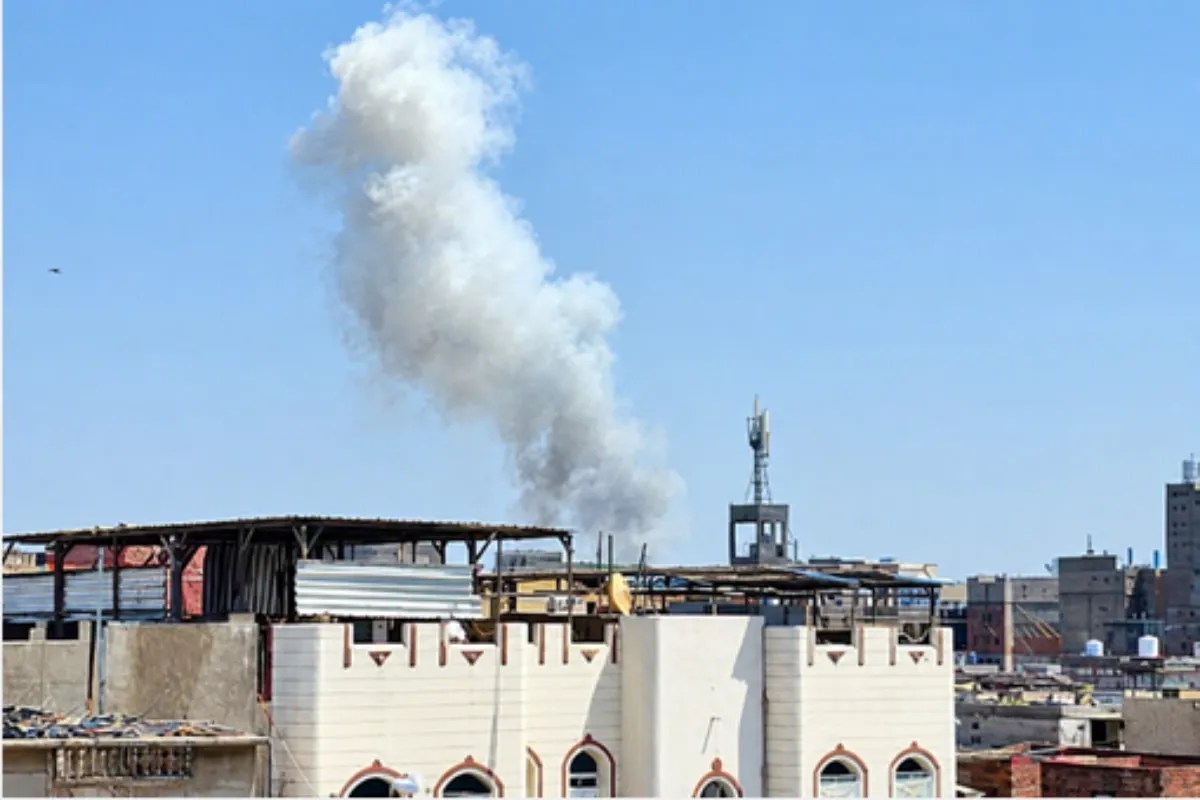
The coffee in Tariq’s ceramic cup had gone cold hours ago, a dark, motionless puddle reflecting the orange glow of a distant streetlamp in Sana'a. He didn't drink it. He didn't dare move away from the window frame, where the glass vibrated with a low, rhythmic thrum that every resident in the capital had learned to memorize by heart. It was the sound of air displacement, the heavy churning rotors of unseen machines or the sharp, whistling rupture of supersonic steel cutting through the night.
Then came the flash.
It wasn't a sunrise. It tore across the horizon with a sudden, violet intensity that bleached the color from the old stone buildings and turned the dust motes in Tariq's living room into dancing sparks of white fire. A second later, the concussion hit. Windows rattled in their rotting wooden frames, dust sifted down from the ceiling like gray snow, and somewhere down the block, a car alarm began its frantic, mechanical wail.
Far across the peninsula, in the gleaming marble corridors of Riyadh, the mood was entirely different. Maps glowed on high-definition screens. Analysts in crisp suits watched satellite telemetry track glowing red arcs across a dark tactical display. To them, the coordinates were numbers, serial codes, operational imperatives. To Tariq, it was the ceiling of his bedroom shuddering as the counter-offensive struck the international airport and the military camps on the city's rugged outskirts.
War is never a single event. It is a terrifying chasm between the boardroom and the basement.
Saudi Arabia’s retaliatory airstrikes against Houthi positions did not happen in a vacuum. They were the violent, inevitable crescendo of a long-simmering fracture that had turned the skies of the Arabian Peninsula into a shooting gallery. When drones and ballistic projectiles began crossing international borders with increasing frequency, threatening civilian infrastructure and vital shipping lanes, the calculus in Riyadh shifted from containment to raw projection of force.
Consider what happens when diplomacy completely breaks down. The language shifts from negotiations to ordnance.
The Houthis, officially known as Ansar Allah, had long mastered the art of asymmetric resistance. Operating out of rugged mountainous terrain and urban strongholds, they built a formidable arsenal of drones and missiles, frequently targeting airports, oil facilities, and strategic economic hubs. For years, the conflict ground on through fragile truces, secret talks, and sporadic skirmishes. But patience has a finite half-life. When the red lines drawn in sand were repeatedly crossed, the response was swift, heavy, and aimed squarely at crippling the launch capabilities and command nodes that fueled the strikes.
Jet engines roared over the Red Sea coast, banking hard toward Sana'a and Hodeidah.
In military planning rooms, this is called neutralization. On the ground, it sounds like thunder rolling across a dry riverbed, shaking the foundations of homes that have stood for centuries.
I remember standing on a balcony years ago during a period of escalating tensions in the region, watching the horizon light up with flashes that felt entirely detached from humanity until the sound wave arrived to remind us of our fragility. The statistics tell us about tonnage, sortie counts, and precise targeting coordinates. They tell us about intercepted projectiles and radar signatures. But they omit the smell of sulfur drifting through an open window, or the way a child clutches a mother's sleeve when the walls begin to hum.
War forces ordinary people to become experts in ordnance. A twelve-year-old in Sana'a can tell the difference between the high-pitched whine of an incoming reconnaissance drone and the deep, chest-crushing rumble of a fighter jet breaking the sound barrier. They know which neighborhoods are buffer zones and which walls are thick enough to offer a fraction of protection. This is a cruel education, handed down by circumstance.
The strategic rationale behind the Saudi military’s heavy response is clear enough on paper. Airfields used as staging grounds for drone attacks must be neutralized. Command and control hubs must be dismantled to disrupt the supply chain of asymmetric warfare. In the calculus of state security, inaction invites further escalation. If a neighbor’s infrastructure is continually targeted, a sovereign state is compelled to demonstrate that the cost of hostility outweighs its utility.
Yet, every action births a reaction in an endless, punishing loop.
When the smoke cleared over the airport facilities, the immediate aftermath was a suffocating silence, broken only by the distant wail of ambulances navigating cratered tarmac. Power lines sparked and died, plunging entire neighborhoods into absolute blackness. Families huddled together in hallways, whispering reassurances that neither they nor anyone else really believed.
The geopolitical chessboard moves fast, but human recovery moves at a glacial pace.
We talk endlessly about regional stability, maritime security, and the delicate balance of power between regional heavyweights. We dissect the alliances, the proxy dynamics, and the economic fallout on global oil markets. We treat these conflicts as complex puzzles to be solved by diplomats and generals.
But back in that darkened room in Sana'a, Tariq finally closed the wooden shutter, shutting out the glowing embers of a burning depot on the skyline. He sat down in the dark, listening to the quiet breathing of his children asleep on the floor.
The jets had turned back toward their bases. The tactical screens in Riyadh were dimming as the night shift rotated. But the air still tasted of ash, and the morning would bring no answers, only the waiting.


