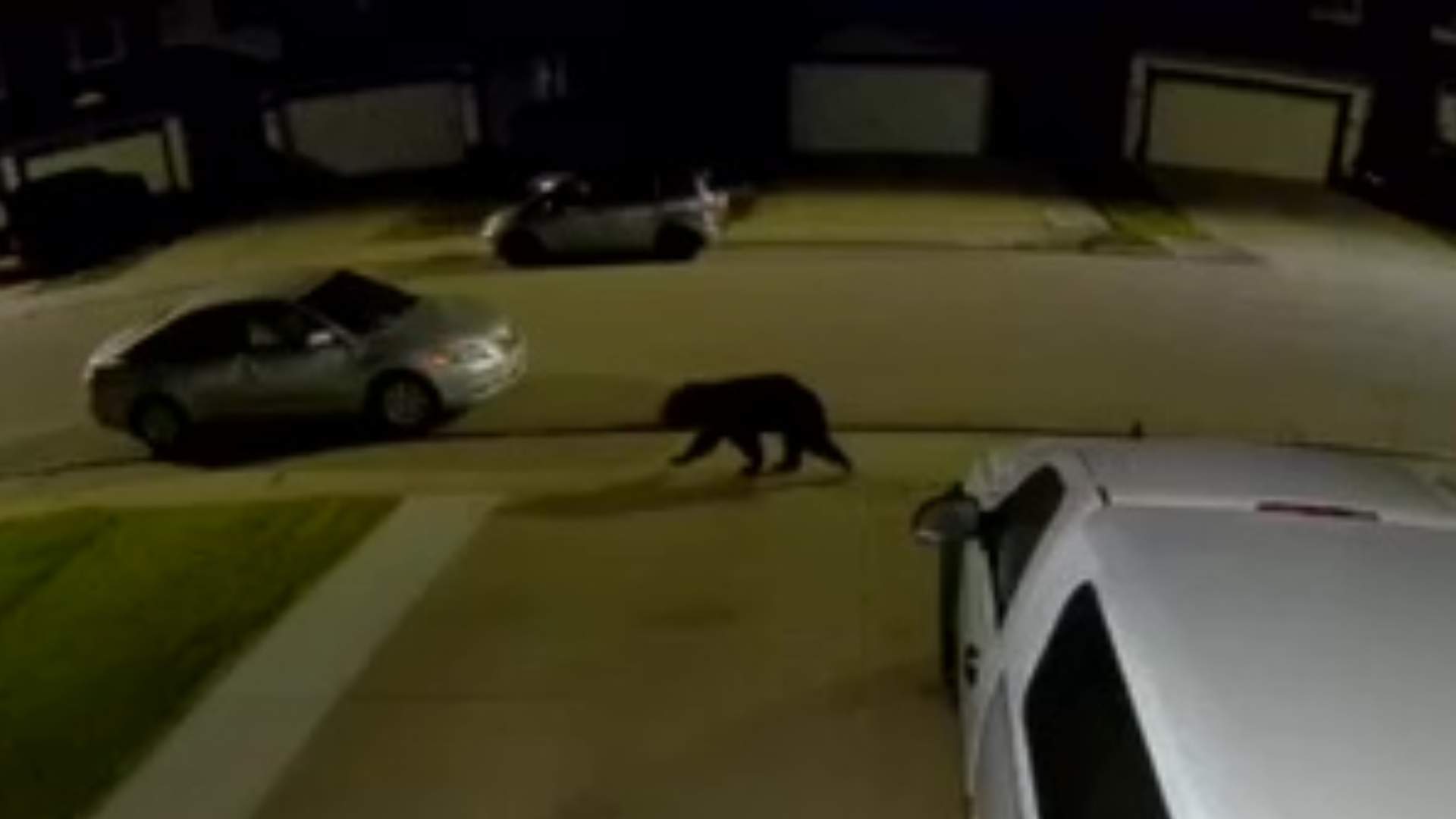
Midnight in a modern neighborhood usually sounds like nothing. A distant refrigerator hums. A security light blinks red against a vinyl siding wall. The air smells faintly of damp pavement and cut grass, cool and predictable. People are sleeping behind locked doors, trusting the invisible architecture of streetlights and property lines to keep the wild world safely contained out in the deep timber, far away on the other side of the river valley.
Then the motion-activated floodlights flicker on in a backyard on the city's edge.
Not for a stray cat. Not for a raccoon tipping over a green plastic bin.
A heavy, dark mass moves across the manicured lawn with a surprising, fluid silence. It is a black bear, wandering through Edmonton neighborhoods overnight, stepping over garden gnomes and pausing by a trampoline that still smells faintly of children. To the animal, there are no suburbs. There are only river corridors, ancient migration paths sliced through by concrete, and the intoxicating, irresistible scent of unsecured garbage bins left out like a midnight buffet.
Most of us live with a comforting illusion. We imagine civilization as a hard line. On one side lies the human world, ruled by mortgages, civic bylaws, and asphalt. On the other side lies nature, neatly bounded by national parks and wildlife warning signs. But nature does not recognize our zoning laws. The North Saskatchewan River cuts a massive, forested green ribbon right through the heart of Edmonton, acting as an invisible highway for wildlife. When a young bear—perhaps pushed out by a dominant older rival, or simply following its nose in search of spring calories—finds itself surrounded by cul-de-sacs instead of aspens, it does not panic. It adapts.
Consider what happens next in a typical household.
It is 3:00 AM. Sarah wakes up to a strange metallic scraping sound against the side of her house. She pads barefoot across the hardwood floor, expecting a raccoon or maybe a stray dog. She peeks through the living room blinds, right past her prized houseplants, and freezes. Ten feet away, standing squarely on her back deck, is an animal with coal-black fur and small, rounded ears, effortlessly ripping open a heavy-duty bin. The bear is massive, yet moves like a ghost. Sarah does not scream. A cold spike of adrenaline floods her system, replacing sleep with a hyper-focused, primal awareness. She realizes how thin the glass of her window is, and how easily a city routine can shatter in a single, silent heartbeat.
This is the reality of living in a city built inside a river valley.
Wildlife biologists and urban conservationists have spent decades tracking these nocturnal visitors. When a black bear wanders into Edmonton's residential streets—whether in areas like Windermere, calling out near Mill Creek Ravine, or drifting close to the river valley parks—it is rarely looking for a fight. It is looking for easy calories. A single unsecured chest freezer on a back porch, an apple tree left unpicked in autumn, or a poorly timed garbage rollout can turn a quiet suburb into an urban foraging ground.
And yet, our reaction to these encounters is often defined by panic or misplaced outrage. We treat the animal as an intruder, a criminal trespassing on our turf. But from the bear's perspective, we built our houses on its grocery aisle.
The friction between urban expansion and wildlife habitat is not a new story, but it is one that intensifies every spring when bears emerge from hibernation ravenous and desperate for food. Their metabolism demands thousands of calories a day, and the easiest way to get them is often found two blocks away from a playground, inside a green bin with a loose lid.
When conservation officers receive the midnight calls—citizens whispering frantically into phones about a bear rummaging through their alleyway—they face a difficult calculus. Relocation is rarely simple. A bear that learns to associate human neighborhoods with easy meals is a bear on a dangerous trajectory. Once an animal loses its natural fear of people and views backyards as feeding stations, the outcome is almost always tragic for the animal.
Prevention, therefore, remains our only real defense. It requires a shift in how we think about our property lines. Securing a garbage bin isn't just a civic chore; it is an act of wildlife protection. Picking fallen fruit from backyard trees isn't just about lawn care; it is about keeping predators out of school zones.
Dawn breaks slowly over the Edmonton skyline. The orange light of morning hits the high-rises downtown, while the mist still clings to the river valley below. The neighborhood stirs back to life. Car engines turn over. School buses idle at corners. Children walk down sidewalks with heavy backpacks, laughing and kicking at loose gravel.
Just a few hours earlier, a wild animal walked that exact same path, testing the boundaries of our artificial world, seeking sustenance in the quiet dark. The bear is long gone now, slipped back down the ravine into the thick brush before the first alarm clock went off. But the imprint remains—a torn bin lid in an alley, a muddy footprint by a garden hose, and the lingering, quiet reminder that we are never quite as separated from the wild as we like to think.