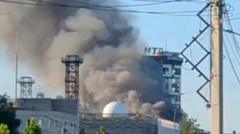
The sirens in the western Russian province of Kursk do not sound like the ones in the movies. They do not wail with a cinematic, rising cadence. Instead, they emit a flat, mechanical groan that cuts through the dense midnight air, vibrating in the soles of your feet before it ever reaches your ears.
For the factory workers on the late shift at the military manufacturing plant, that sound is a countdown.
For months, the war was something that happened somewhere else. It was a sequence of maps on state television, a collection of colored arrows pushing across territories hundreds of miles away. But modern warfare possesses a terrible fluid dynamic. It refuses to stay contained. It flows along the lines of supply, tracking the scent of diesel, steel, and high explosives back to their source.
When the Ukrainian missiles struck deep inside Russian territory, they did not just shatter concrete and twisted rebar. They shattered the psychological insulation of a nation that believed the distance of its borders was an absolute shield.
The Anatomy of an Echo
To understand how a missile launched from a mobile platform in Ukraine finds its way to a heavily fortified industrial complex deep inside Russia, you have to look past the political rhetoric. You have to look at the geometry of modern flight.
Consider a hypothetical engineer named Mikhail. He has spent fifteen years working the metallurgy lines at a plant that refines the specialized casings for long-range artillery shells. To Mikhail, the war is a ledger of production quotas, raw iron ore, and the smell of sulfur and machine oil. His world is bounded by the perimeter fence and the daily commute.
Then comes the flash.
A modern cruise missile does not travel in a straight line. It behaves more like a predatory bird, hugging the contours of the earth, dipping into river valleys, and hiding behind the radar shadows of hills. When it travels deep into enemy territory, it is playing a complex game of hide-and-seek with air defense systems that cost billions of dollars to deploy.
The Ukrainian military strike was a calculated demonstration of a shifting technical reality. By striking a military plant deep within the Russian interior, Kiev signaled that the technological asymmetry of the conflict has flattened. The deep rear—once considered a safe zone for refueling, refitting, and manufacturing—is now the front line.
The strike targets the very mechanics of endurance. In a war of attrition, factories are more valuable than trenches. A trench can be retaken if you have the artillery to clear it. But if the factory that makes the artillery shell ceases to exist, the trench becomes a graveyard.
The Invisible Stitches of Logistics
Every conflict is dictated by a brutal mathematical equation: the rate of consumption versus the rate of replenishment.
When we read standard news briefs about military industrial sites being targeted, our minds tend to picture empty warehouses or dramatic explosions. The reality is far more tedious and far more devastating. A military production plant is not just a building; it is a highly calibrated ecosystem of specialized machinery, computer numerical control (CNC) tools, and skilled labor.
If a missile destroys a stockpile of finished shells, that is a temporary setback. If a missile destroys the German-made precision lathe used to rifling the barrels of advanced weapons systems, that is a catastrophic bottleneck. Those machines cannot be replaced on the open market due to international sanctions. They cannot be easily replicated domestically.
The strategic intent behind pushing strikes deep into the Russian interior is to force a choice.
- Option A: Pull expensive air defense batteries away from the active battlefields in the Donbas to protect the manufacturing hubs in the rear.
- Option B: Leave the factories exposed and watch the supply lines dry up from the source.
It is a dilemma designed to induce paralysis. If Moscow moves its radar networks and surface-to-air missile systems backward to shield its industrial base, Ukrainian ground forces find gaps in the sky above the trenches. If Moscow keeps those systems forward, the factories burn.
The Sound of Two Hundred Miles
Distance changes its meaning when the sky begins to fall.
For the civilian populations living in these industrial corridors, the psychological toll is immediate. There is a specific vulnerability that comes with knowing that the airspace above your home is no longer sovereign. The ceiling has been removed.
Imagine sitting in a kitchen in a quiet suburb of Kursk, the tea cooling in a ceramic mug, while the sky outside turns a brief, violent shade of violet. You do not hear the missile approach. It travels at speeds that outrun its own sound signature. You only hear the arrival. The shockwave rattles the glass in the cabinets, a dull thud that feels like a heavy fist striking the earth a mile away.
This is the deliberate expansion of the friction of war.
For the first eighteen months of the conflict, the daily reality of violence was a localized phenomenon, borne almost entirely by Ukrainian citizens running to subterranean shelters or Russian soldiers in muddy dugouts. Now, the geography of fear has broadened. The war has found its way to the quiet towns where the components are assembled, where the workers sleep, where the decisions are turned into physical iron.
The strategic calculations made in Kiev are no longer restricted by old boundaries. The deployment of domestic drone technology combined with modified long-range strike capabilities means that the depth of the Russian mainland is no longer a passive asset. It is a liability.
The Balance of the Scale
We often look at these escalations through the lens of political grandstanding. Analysts argue over red lines, international law, and the shifting definitions of provocation. But the truth of the matter is much colder. It is found in the physical reality of a smoking crater where a turbine assembly line used to stand.
The strike deep inside Russia changes the internal economy of the conflict. It forces the state to recalculate the cost of its campaign. When the infrastructure of defense production becomes vulnerable, the entire project of prolonged military occupation begins to lose its material foundation.
The fires at the military plant eventually go out, replaced by the acrid smell of burnt plastic, scorched iron, and wet ash. The state media will report that the damage was minimal, that the debris was contained, that the air defenses functioned precisely as intended.
But the workers who return to the morning shift will see the sky through the collapsed roof of the assembly bay. They will look at the empty spaces where the machines used to hum, and they will understand, with absolute clarity, that the distance between the decision to start a war and the consequence of that choice has just shrunk to nothing.