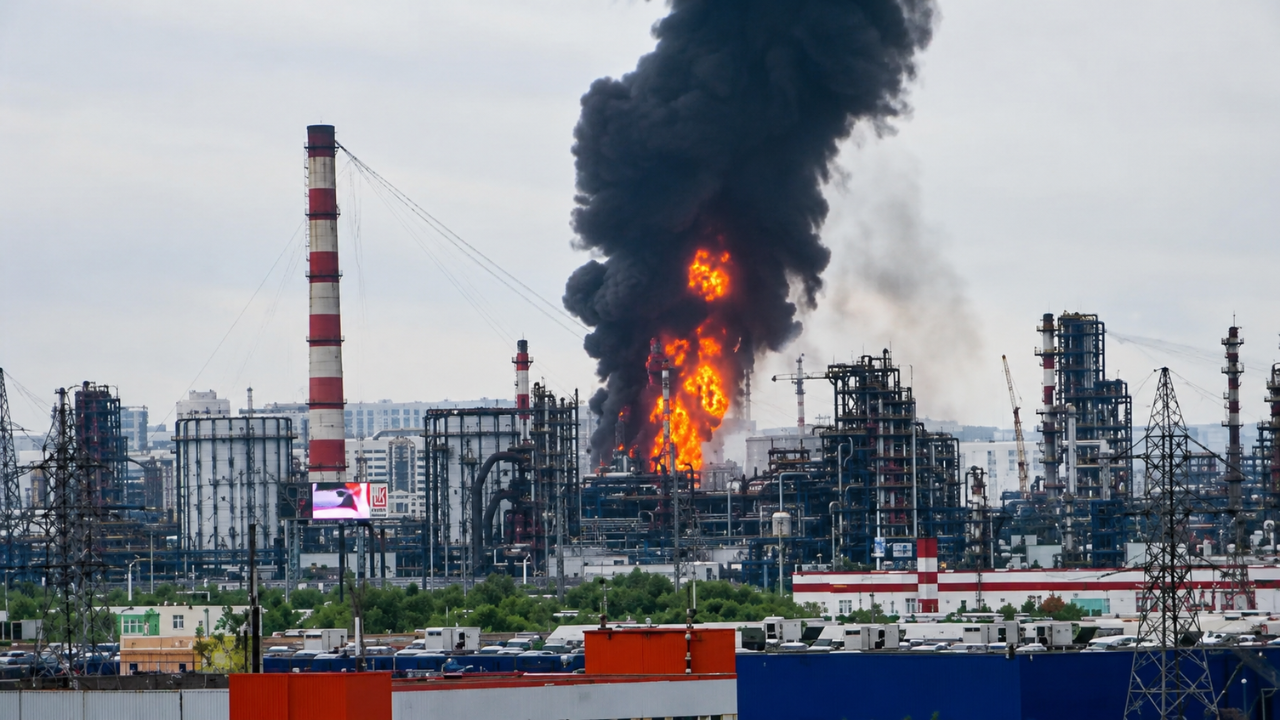
The metal grid of the Moscow oil refinery at Kapotnya does not look like a front line. On a typical Tuesday evening, it smells of sulfur, heavy machinery, and the damp earth of the Moscow River bank. For decades, this massive industrial footprint has been the beating, oily heart of the Russian capital’s daily commute. It processes tens of thousands of tons of crude oil every single day, turning dead organic matter into the gasoline that fuels the endless traffic jams on the MKAD ring road. It is a monument to brute-force engineering.
Then came the whistle in the dark.
It was a sound the residents of the surrounding high-rise apartments had only ever heard on the news. A low, mechanical buzz, growing into a frantic whine. Seconds later, a orange plume of fire tore through the distillation columns. The blast rattled the cheap double-glazed windows of Soviet-era panel blocks miles away.
For the people living in the shadow of Kapotnya, the war in Ukraine had previously been an abstract reality. It was something confined to glowing television screens, patriotic billboards, and the occasional awkward conversation about a neighbor’s son who had stopped calling from the front. But when the sky turned the color of a bruised peach at three in the morning, the abstraction dissolved. The conflict had traveled over eight hundred kilometers through the night sky to knock on Moscow’s front door.
The Physics of the Long-Range Punch
To understand why a single point of impact in a Moscow suburb matters, we have to look past the dramatic video footage of burning storage tanks. We have to look at the geometry of modern attritional warfare.
Ukraine’s strategy has undergone a radical transformation. In the early days of the full-scale invasion, the defensive effort was reactive, fought in the muddy trenches of the Donbas and the ruined streets of Mariupol. But a nation fighting a neighbor with vast resource superiority cannot win by trading blows on its own soil indefinitely.
Consider a giant machine that relies on a constant flow of water to keep from overheating. You can try to catch every drop of water as it sprays out, or you can walk back to the source and turn off the main valve.
Kapotnya is that valve.
The refinery is owned by Gazprom Neft. It supplies roughly one-third of all gasoline and half of all diesel used in the Moscow metropolitan area. It is not just an economic asset; it is a critical logistical node. When Ukrainian long-range strike drones hit the Euro+ refining unit—a sophisticated, multi-billion-dollar piece of technology that integrates multiple stages of fuel processing—they didn't just cause a fire. They tore out the nervous system of the facility.
Replacing that technology is not a matter of ordering parts online. Under the current regime of international sanctions, high-tech refining components, catalysts, and specialized software are almost impossible for Russia to acquire legally. Every successful hit on a modern distillation column creates a permanent bottleneck. The damage accumulates like plaque in an artery, slowing down the entire system until the pressure builds to a breaking point.
When the Abstract Becomes Concrete
Let us imagine a man named Mikhail. He is a hypothetical composite of the thousands of delivery drivers who keep Moscow’s gig economy humming. Mikhail doesn't care about geopolitics. He cares about his aging Lada, his daily quotas, and the price of regular unleaded at the local Rosneft station.
On the morning after the attack, Mikhail wakes up to a barrage of Telegram notifications. Rumors fly faster than the smoke clearing over Kapotnya. He drives to his usual gas station. The digital display is dark. The attendant shakes his head through a crack in the window.
"No premium today. Maybe tomorrow."
This is how a deep-strike campaign works on a psychological level. It does not need to flatten a city to be effective. It merely needs to introduce friction into the ordinary routines of life. When a superpower cannot guarantee that its own capital city will have a steady supply of fuel for delivery vans, ambulances, and commuter buses, the illusion of total control begins to splinter.
The Kremlin’s official narrative has consistently painted the conflict as a distant, controlled "special operation" that requires no sacrifice from the urban elite of Moscow and St. Petersburg. The strikes on the Moscow oil refinery break that social contract. They force the average citizen to confront a deeply unsettling truth: the borders are porous, the air defenses are imperfect, and the material cost of a protracted war cannot be fully hidden behind state media broadcasts.
The Cold Math of Drone Warfare
The economic calculus of these deep strikes reveals a stark asymmetry that favors the attacker.
A Ukrainian long-range attack drone, built in a hidden workshop somewhere in the forests of central Ukraine, costs anywhere from twenty thousand to fifty thousand dollars. It is often constructed from cheap fiberglass, powered by a basic internal combustion engine similar to those found in commercial lawnmowers, and guided by a mix of satellite navigation and primitive machine vision.
On the other side of the ledger, a single Pantsir-S1 air defense missile used by Russia to shoot down these drones costs hundreds of thousands of dollars. If the missile misses, or if the drone evades the defense grid entirely, the resulting damage to a refining unit like the one at Kapotnya can easily run into the tens of millions of dollars. Worse yet is the lost production capacity—hundreds of thousands of barrels of refined products that will never make it to market or to the military supply depots in Rostov.
+------------------------+----------------------------------+
| Cost of Striking Asset | Cost of Targeted Asset/Damage   |
+------------------------+----------------------------------+
| Ukrainian Drone:       | Russian Refining Unit:           |
| $20,000 - $50,000      | $10,000,000+ (Plus lost revenue) |
+------------------------+----------------------------------+
This is not a sustainable equation for a wartime economy. Russia possesses some of the most sophisticated air defense systems in the world, but the sheer vastness of its territory makes total coverage an impossibility. To protect an oil refinery in Moscow, air defense batteries must be stripped away from the front lines in Ukraine or from vulnerable infrastructure in the oil-rich regions of the Urals and Siberia. Every choice is a compromise. Every protection grid established in one city leaves another city naked to the sky.
The Scent of Burning Oil
Those who have spent time near an industrial disaster know that the smell stays with you. It is a thick, greasy aroma that coats the back of your throat and makes your eyes water long after the flames are extinguished. It smells like a future being consumed by the present.
For Ukraine, the strike on Kapotnya is a declaration of capability. It sends a message to the international community, which has often wavered and hesitated over the provision of long-range weaponry. The message is simple: we do not need permission to strike back, because we are building the tools to do it ourselves. By shifting the focus of the war to Russia’s domestic energy infrastructure, Ukraine is attempting to shorten the conflict by making its continuation too painful for the Russian state to bear.
But the strategy carries immense risk. The line between striking a state-owned industrial asset and triggering a broader, unpredictable escalation is razor-thin. For the international observer, watching the videos of black smoke billowing over the Moscow suburbs, the spectacle can feel like a movie. For the people on the ground, it is a reminder of how quickly the comforts of modern civilization can be peeled away.
The fires at Kapotnya were eventually contained by specialized fire brigades, according to Moscow’s mayoral office. The state media reported minimal disruption, asserting that the city’s fuel reserves were more than adequate to handle the temporary setback.
Yet, as the sun dipped below the horizon the following evening, the residents of the high-rises near the refinery did not look at the sky the same way they used to. They listened closely to the hum of the city, waiting to see if the next sound they heard would be the familiar roar of the evening traffic, or the distant, terrifying whistle of a drone cutting through the dark.