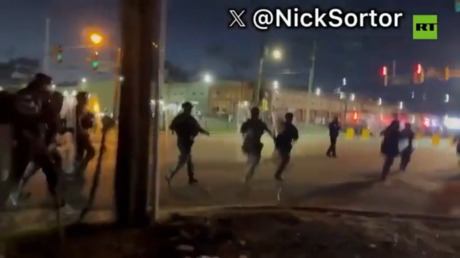
The air outside the chain-link perimeter smelled of stale exhaust and damp wool. It was 11:42 PM. On a standard digital police scanner, the event was logged as a routine dispersal order at an Immigration and Customs Enforcement detention facility. To the casual observer scrolling through a social media feed the next morning, it would look like a thirty-second blur of shaky phone video, flashing blue lights, and the indistinct shouts of anonymous bodies pushing against shields.
But standard news copy strips the heat out of a radiator. It turns friction into a statistic.
To understand what happened under those sodium vapor lights, you have to look at the gravel. Specifically, the way a boot heels into it when a body realizes it is no longer moving forward by choice.
Consider a hypothetical protestor. Let’s call her Elena. She isn’t a career activist; she owns a small dry-cleaning business three miles down the interstate. She wore running shoes because someone on a forum said to, but she forgot gloves. Now, her fingers are jammed into the cold diamond weave of a perimeter fence. On the other side of that wire, less than fifty feet away, sits a low-slung concrete block building. It has no windows on the exterior wall. It holds human beings. Some of those human beings have names that match the letters on the tags sewn into the jackets hanging in Elena’s shop.
That is the invisible thread. The local news segment anchors the story on the arrest count—twelve people processed, two officers treated for minor scrapes. But the real story is the tension of that wire, pulled taut between two fundamentally different ideas of what a border is supposed to do.
The Sound of Two Tons of Steel
A detention center at midnight does not look like a battlefield until it suddenly does. For three hours, the gathering was quiet. People held cardboard signs that softened and drooped under the midnight fog. There was a low hum of conversation, the occasional strike of a lighter, the rustle of thermal blankets being shared among strangers.
Then came the transport van.
When a two-ton secure vehicle shifts into reverse, its backup beeper cuts through the human voice like a razor. It is a sterile, mechanical sound. Chirp. Chirp. Chirp. To the crowd, that sound didn’t signify a logistical routine; it signified a subtraction. It meant someone inside that concrete block was about to be moved, processed, or transferred further into the interior of a system designed to be opaque.
The crowd surged. Not with weapons, but with the collective mass of their own weight.
Elena’s hands left the fence as the wave pushed her toward the access gate. Suddenly, the space between the citizens and the state shrank to zero. When you are that close to a line of riot gear, you don't see an institution. You see the fogged-up plastic of a visor. You see the sweat bead on a lip. You hear the heavy, rhythmic breathing of a twenty-two-year-old deputy who is just as terrified as the teenager he is pushing back.
The first flashpoint wasn’t a brick or a chemical canister. It was a stumble.
An older man near the front lost his footing on the slick grass near the culvert. He went down sideways, his shoulder striking the shin guard of an officer. In that fraction of a second, the collective nervous system of the line snapped. The response was instinctive, trained, and immediate.
The Geometry of Dispersal
What follows a flashpoint is never a conversation. It is a kinetic formula.
The officers moved in a wedge formation, a tactical shape designed to split a crowd into manageable pockets. To watch it from a drone camera, it looks like a zipper opening up a jacket. On the ground, it feels like being caught in an undertow. The noise changes from a unified chant into a chaotic symphony of sharp commands, tearing fabric, and the heavy thud of batons striking plastic shields to create a wall of sound.
Chaos.
One woman lost both her shoes in the scramble and stood on the cold asphalt in white socks, her face illuminated by the strobe of a cruiser’s roof lights. A young man, his hands zip-tied behind his back, sat on the curb with his forehead resting against his knees, whispering a phone number over and over again so he wouldn’t forget it before they took his wallet.
This is where the standard reporting fails us. It tells us what happened, but it refuses to explain how the mechanics of a protest actually function on a psychological level. People don’t risk arrest because they want to spend a Tuesday morning in a holding cell drinking lukewarm water from a paper cup. They do it because the alternative—staying home, watching the television screen flicker with the names of deportees—feels like a slow rot of the conscience.
The system relies on the assumption that the average person will choose comfort over friction every single time. It is a logical deduction. Why leave a warm living room to stand in the mud?
But human behavior isn't always governed by a spreadsheet. Sometimes, the sight of a government van turning its lights on in the dark triggers an ancient, stubborn survival mechanism. Not for oneself, but for the tribe.
The Weight of the Aftermath
By 2:00 AM, the street was empty again. The fog had rolled in completely, turning the blue and red emergency lights into a purple haze that hung over the ditches. The transport van had long since departed through a rear exit, its destination unconfirmed by the shift supervisor on duty.
What remained was the debris of conviction.
A single shoe. Three flattened mega-phones. A sign written in marker that read We See You, now half-submerged in a puddle of oily water.
The twelve who were taken away were logged into a different system, their names entered into database fields that look identical to the fields used for the people inside the facility they were protesting. That is the ultimate irony of the night. For a few hours, the protestors and the detained shared the exact same air, separated by twelve feet of steel and wire. By morning, they shared the same bureaucracy.
The facility itself went dark again, its exterior lights casting long, geometric shadows across the empty driveway. The administrative machinery doesn't stop for a demonstration; it simply recalibrates. The paperwork moves from one desk to another. The shifts rotate. New guards arrive with thermoses of coffee, stepping over the crumpled cardboard in the gravel without looking down.
Consider what happens next when the sun comes up. The dry-cleaning shop will open. Elena's hands will still be stiff from the cold iron of the fence, her skin marked with the grey residue of oxidized zinc. She will handle the garments of people who have no idea she spent the night standing between them and the state.
The world returns to its rhythm. The concrete building remains. But the gravel by the gate is permanently shifted, tracked into the road by dozens of boots that refused to stay where they were told.