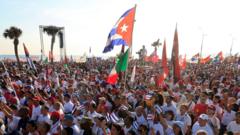
The air in Havana didn't just feel heavy with humidity this May Day; it felt heavy with defiance. As thousands marched past the American embassy, the rhetoric coming from the Palace of the Revolution reached a fever pitch. Foreign Minister Bruno Rodríguez didn't mince words, labeling the latest wave of US sanctions as "illegal," "abusive," and "collective punishment." But if you look past the standard diplomatic sparring, you'll see a situation that's rapidly spiraling into a humanitarian and geopolitical mess that 2026 wasn't supposed to witness.
Let's be real about what's happening. The Trump administration just dropped a massive executive order that doesn't just tweak existing rules—it basically tries to wall off the Cuban economy from the rest of the world. By targeting foreign banks, energy sectors, and mining operations, Washington is betting that if the lights stay off long enough, the government will finally fold. Cuba, meanwhile, is calling it "economic warfare." Honestly, they aren't far off. Meanwhile, you can find related developments here: Brazilian Labor Market Structural Shifts and the 6.1 Percent Unemployment Threshold.
The Reality of a 90 Percent Fuel Drop
You can't talk about these sanctions without looking at the gas tank. Since January, Cuba has seen a staggering 90% drop in its fuel supply. This isn't just about people not being able to drive to work. It’s about 11,000 children waiting for surgeries because hospitals can't guarantee the power will stay on. It’s about trash piling up in Havana because only 40% of the garbage trucks have enough diesel to run.
The US strategy is clear: link Cuba to "malign actors" like Russia and Iran to justify a total blockade. By declaring a national emergency, the White House has created a "proxy blockade." They aren't necessarily stopping every ship with a destroyer—though Trump did joke about parking the USS Abraham Lincoln 100 yards offshore to see if Havana would surrender—but they're threatening any country that sells oil to Cuba with massive tariffs. To see the bigger picture, check out the detailed article by TIME.
- Energy Grid Collapse: In March 2026, the entire Cuban grid collapsed. Millions were left in the dark for days.
- Tourism Death Spiral: Airlines like Air Canada and Rossiya have suspended flights because there literally isn't enough jet fuel on the island to get the planes back home.
- Medical Crisis: Over 96,000 people are currently in a backlog for essential medical procedures.
Why This Isn't Just Another Embargo
Most people think of the Cuban embargo as this static thing that's been around since the 60s. That’s a mistake. What we're seeing now is a hybrid model of coercion. The US is using its control over the global financial system to turn every foreign bank into an unpaid enforcer of American policy. If a bank in Spain or Mexico helps a Cuban mining company, they risk losing access to the US market. It’s a brutal, effective, and highly controversial tactic.
The Cuban government’s "My Signature for The Homeland" campaign has gathered thousands of signatures, trying to show the world that the people are standing with the leadership. But if you talk to people on the ground, the sentiment is more complex. There’s a lot of anger at the US, sure, but there’s also deep exhaustion. When you’re cooking over a charcoal fire in a city apartment because the stove won't turn on, "geopolitics" starts to feel like a very thin excuse for a very hard life.
The Regional Fallout Nobody is Talking About
Washington claims these sanctions are necessary because Cuba is a "permissive environment" for foreign intelligence and is driving migration. It’s a bit of a self-fulfilling prophecy, isn't it? If you crush the economy of a country 90 miles off your coast, you shouldn't be surprised when more than 850,000 people show up at your border looking for a way to eat.
The ousting of Nicolás Maduro in Venezuela earlier this year was the first domino. Cuba lost its primary oil provider, and now the US is making sure no one else steps in to fill the gap. Even Mexico, which usually ignores US pressure on Cuba, is starting to get nervous about the tariff threats. It’s a high-pressure cooker, and the lid is starting to rattle.
The UN has already weighed in, with human rights experts calling these measures a "serious violation of international law." But in the current political climate, those statements don't carry much weight in the Oval Office. The goal is "regime change," plain and simple. Whether that’s actually achievable through starvation-level economics is a question that 60 years of history suggests the answer is probably "no."
If you’re watching this from the outside, don't expect a quick resolution. The Cuban government is digging in, using the sanctions to fuel a "defend the homeland" narrative that keeps their base energized. Meanwhile, the US is doubling down, convinced that one more turn of the screw will be the one that breaks the machine. It’s a gamble with 10 million lives in the middle.
Watch the shipping lanes and the price of Russian Urals crude. If more tankers like the one that docked in late March don't start arriving soon, the "collective punishment" Rodriguez talks about will move from a political talking point to a full-scale humanitarian disaster. Stay updated on the specific entities being added to the OFAC list; that's where the real damage is done, one bank account at a time.