Mammograms save lives, but they are far from perfect. If you have dense breast tissue, standard mammography can miss up to seventy percent of tumors. That terrifying statistic leaves millions of women in the dark, forced to rely on expensive, invasive follow-up tests like MRIs or ultrasounds.
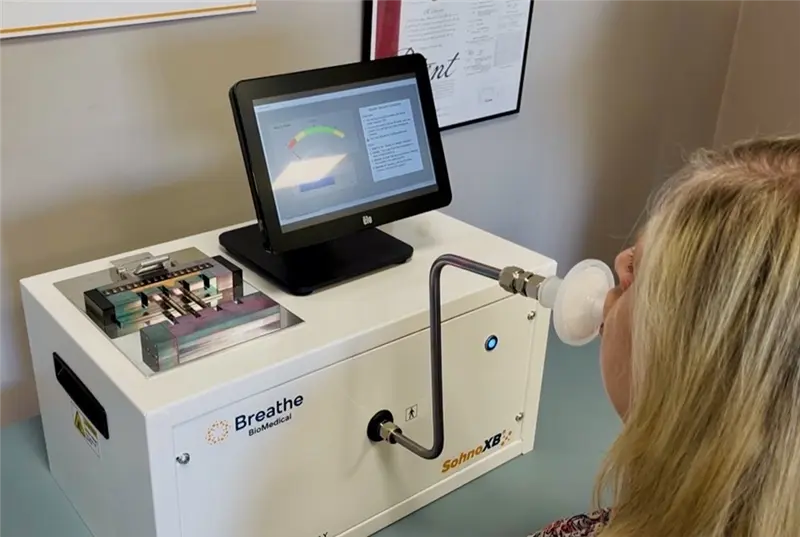
Moncton-based medical technology company Breathe BioMedical is trying to fix this exact problem. They have developed a simple breath test designed to catch early-stage breast cancer. You breathe into a device, similar to blowing up a party balloon. The machine then analyzes your breath for specific chemical compounds tied to the disease.
It sounds like science fiction. But early clinical data shows it might actually work.
How the Breath Signature Technology Works
Your body constantly produces volatile organic compounds, or VOCs, as metabolic byproducts. When a tumor develops, it alters your metabolism and creates oxidative stress. This process changes the chemical mix of what you exhale.
Breathe BioMedical captures these exhaled molecules and runs them through advanced machine learning algorithms. In initial proof-of-concept studies, the technology spotted differences in breath signatures with an 88.2% accuracy rate. Even better, sub-group analyses showed that dense breast tissue had zero impact on that accuracy.
Mammography struggles with dense tissue because both dense tissue and tumors appear white on an X-ray. Breath analytics completely bypasses structural visibility issues. It reads your chemistry, not your anatomy.
The Push for Validation Through Major Trials
A clever prototype means nothing without rigorous clinical backing. That is why the company expanded its observational study across multiple high-profile research institutions, including sites in the United States and Canada. Major health networks, such as the Mayo Clinic, Duke University, and George Washington University, are helping evaluate a broader patient demographic.
Closer to home, facilities like Pittsburgh’s Weinstein Imaging Associates and the Vitalité Health Network in New Brunswick have joined the protocol. Researchers are collecting breath samples from patients who are already scheduled for biopsies after routine imaging. By comparing the chemical profiles of women with confirmed cancer against those without, the algorithms grow smarter and more reliable.
The current trial aims to enroll up to 800 participants. That scale provides the statistical power needed to push toward regulatory approval.
Where This Fits Into Existing Care
Nobody is suggesting you skip your yearly mammogram. The goal here is integration, not replacement.
Think of this breath test as a bridge. If a standard mammogram yields ambiguous results, or if a patient faces high risks due to dense tissue, a quick breath analysis could help doctors decide who genuinely needs an immediate biopsy or an expensive MRI.
Jennie Dale, founder of Dense Breasts Canada, notes that scalable solutions are desperately needed to reach the masses without creating massive healthcare bottlenecks. If a six-minute breath test can rule out malignancy for low-risk patients, it clears the system of unnecessary panic and slashes screening costs.
The medical community remains cautiously optimistic. True diagnostic shifts take years of regulatory navigation. But if current trials hold up, giving a simple breath sample during your annual check-up could soon become the standard baseline for catching tumors before they spread.