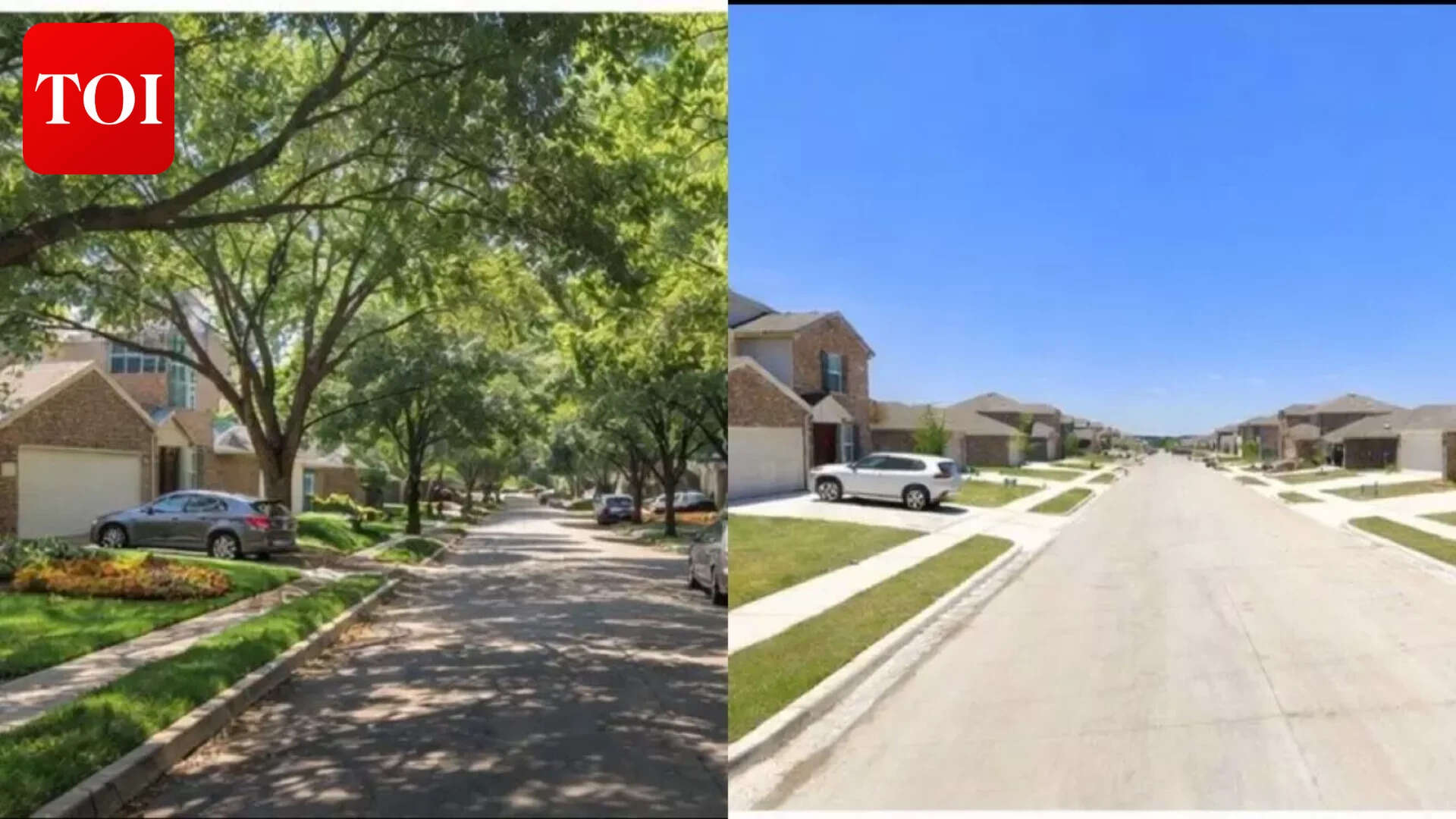
You’ve seen them from the highway or scrolling through Zillow. Rows of beige houses packed tightly together, sitting on patches of bright green sod without a single leaf in sight. It looks like a glitch in a simulation. It isn’t just an aesthetic choice or a weird coincidence. It’s a calculated financial move by developers that's changing the temperature of our neighborhoods and the value of our homes.
The recent viral outcry over "treeless subdivisions" isn't just about people missing the shade. It’s about a fundamental shift in how American homes are built. Builders are stripping lots down to the bare dirt to save around $5,000 per house. That sounds like a win for "affordability" on paper. In reality, it’s a short-term saving that dumps a lifetime of costs onto the family moving in.
The Cold Math Behind the Treeless Lot
Developers aren't villains in a cartoon, but they're beholden to the bottom line. When a company prepares a 50-acre tract for a new community, the most efficient way to work is to clear-cut everything. They bring in heavy machinery, level the topography, and create a blank slate. This "scorched earth" approach allows them to move faster. Speed is money.
If a builder decides to keep a mature oak or maple, the costs spiral quickly. You have to hire an arborist. You have to fence off the "drip line" of the tree so heavy equipment doesn't compact the soil and kill the roots. You might have to reroute a utility line or shift the foundation of the house by five feet.
By the time you account for the specialized labor and the slower construction pace, that single tree has cost the builder thousands. To them, it’s a liability. To a homeowner, it’s an asset. This disconnect is where the problem starts.
Why Five Thousand Dollars Now Costs You More Later
That $5,000 "saving" the builder pockets doesn't stay in your pocket. It actually migrates to your electric bill. Mature trees act as natural air conditioners. Through a process called evapotranspiration, a single large tree can produce the cooling effect of ten room-size air conditioners operating 20 hours a day.
When you strip the canopy away, you create a localized urban heat island. The asphalt driveways and dark shingles soak up the sun. Without shade, your AC unit has to grind 24/7 to keep the house at 72 degrees. Research from organizations like American Forests shows that neighborhoods with ample tree cover can be 10 to 15 degrees cooler than those without.
You’re also losing immediate property value. Data from the Council of Tree and Landscape Appraisers suggests that a mature tree can add between 3% and 15% to a home’s value. On a $400,000 house, that’s a minimum of $12,000. By choosing the "treeless" lot, you’re starting your investment behind the curve.
Soil Compaction and the Death of the Suburban Yard
It’s not just about the trees that are gone. It’s about the trees you try to plant later. When builders clear-cut a site, they use massive scrapers and bulldozers. These machines weigh tons. They crush the soil structure until it’s basically as hard as concrete.
Most new homeowners find out the hard way that they can’t just dig a hole and drop in a sapling. The roots hit that compacted layer and stop. They can’t get oxygen or water. Then the tree dies in three years, and the homeowner thinks they have a "black thumb." Honestly, it’s not your fault. The ground was sabotaged before you even got the keys.
The Social Cost of the Clear Cut
We don't talk enough about the psychological impact of living in a barren environment. There’s a reason park-side real estate is the most expensive in the world. Humans aren't meant to live in a sea of concrete and shingles.
A treeless street feels exposed. It feels temporary. It lacks the "enclosure" that makes a neighborhood feel walkable and safe. When the sun is beating down on an unshaded sidewalk at 105 degrees, nobody goes for a walk. Nobody talks to their neighbors. The social fabric of the community literalize dries up because the environment is hostile to human presence.
How to Fight Back Against the Barren Lot
If you're in the market for a new build, you have more leverage than you think. Don't just look at the floor plan and the granite countertops. Look at the site plan.
Demand a Tree Preservation Plan
Ask the builder for the site’s arborist report. If they don't have one, that’s a red flag. Professional builders who care about long-term value will often identify "legacy trees" and build around them. It’s harder, but it’s a sign of a quality developer.
Inspect the Soil Before You Landscape
If you've already bought a treeless home, don't just buy five saplings from a big-box store and hope for the best. You need to address the compaction. This usually means renting a small excavator or a heavy-duty tiller to break up the "hardpan" layer at least 12 to 18 inches deep.
Choose Strategic Species
If you're starting from scratch, don't just plant what looks pretty. You want "pioneer species" that can handle tough, disturbed soil. Think about Red Maples or certain types of Oaks that are native to your specific region. They’ll grow faster and survive the harsh conditions of a new subdivision better than a sensitive ornamental tree.
The Regulation Gap
Part of the reason this keeps happening is that local zoning laws are often toothless. Some cities have "tree ordinances," but builders often find it cheaper to pay the "fine" for cutting down a tree than to actually save it. These fines are just treated as a cost of doing business.
Until buyers start prioritizing the "green infrastructure" of a lot as much as they prioritize a walk-in closet, builders won't change. We need to stop viewing trees as decorations and start viewing them as essential utilities, just like water lines or electricity.
Stop accepting the "scorched earth" model of development. Look for builders who leave the maples standing. Your wallet, your AC unit, and your mental health will thank you in a decade when you're sitting in the shade instead of hiding from the sun.
Check your local municipal code for tree canopy requirements before you sign a contract. If your city doesn't require a minimum number of trees per lot, show up to a planning commission meeting and ask why. Real change starts with the dirt under your feet.