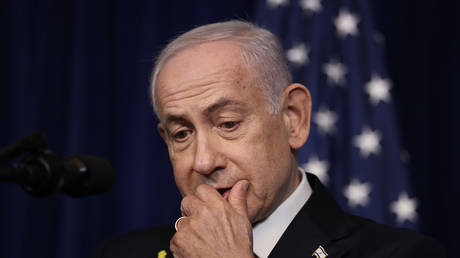
Benjamin Netanyahu’s political longevity is historically indexed to the "Security Paradox": his approval ratings generally inversely correlate with the actualization of long-warned existential threats. While the prime minister has long positioned an Iranian nuclear breakout as his raison d’être, the transition from a "shadow war" to a direct kinetic exchange with Tehran yields diminishing returns for his domestic coalition and international standing. The assumption that war provides a permanent "rally 'round the flag" effect ignores the specific friction points in the Israeli socio-political landscape. In a direct conflict with Iran, the tactical success of the Israel Defense Forces (IDF) does not automatically translate into political capital for the Prime Minister.
The Triad of Strategic Constraints
To understand why a war with Iran fails to provide a sustainable political exit for Netanyahu, one must analyze the three structural constraints currently pinning the Israeli executive.
1. The Asymmetry of the Burden of Proof
In conventional warfare, victory is often defined by territorial gain or the destruction of enemy assets. In the context of the "Iran Ring of Fire" strategy, Netanyahu faces an impossible metric for success. Because Iran operates through a decentralized network of proxies (Hezbollah, Houthis, PMF), a direct strike on Iranian soil must achieve "Total Neutralization" to be seen as a success. Anything less—such as a retaliatory exchange that leaves Iran’s nuclear infrastructure intact or its proxy network operational—is framed by the Israeli public as a failure of deterrence. The risk-to-reward ratio is skewed; the political cost of a missed target or a successful Iranian counter-strike on Israeli population centers outweighs the marginal gain of a degraded Iranian IRGC facility.
2. The Internal Coalition Fracture Points
Netanyahu’s current government relies on a fragile alignment between the Likud establishment and ultra-nationalist factions. A full-scale war with Iran requires a massive mobilization of reserves and a prolonged state of emergency. This creates an immediate collision with the Haredi (ultra-Orthodox) draft crisis.
- The Mobilization Pressure: As the secular and national-religious middle class bears the brunt of combat duties, the exemption of the Haredi population becomes an explosive social friction point.
- The Economic Bleed: A direct conflict with Iran is not a "surgical strike." It implies a multi-front engagement involving Lebanon and Yemen. The resulting credit rating downgrades and the paralysis of the high-tech sector (which accounts for roughly 18% of Israel's GDP and 50% of exports) would erode Netanyahu’s historical claim to economic stewardship.
3. The Washington Friction Coefficient
Netanyahu’s political brand is built on his perceived ability to manage—and at times defy—the United States. However, a war with Iran necessitates an absolute dependence on American logistics, intelligence, and regional interceptor umbrellas. This creates a "Sovereignty Trap." To fight the war, Netanyahu must concede to U.S. demands regarding Palestinian governance and regional integration—concessions that would likely collapse his right-wing coalition.
The Mechanics of Deterrence Erosion
The transition from the "Begin Doctrine"—the concept that Israel will not allow any enemy in the Middle East to acquire weapons of mass destruction—to the current state of "Managed Escalation" has fundamentally altered the utility of war for an incumbent leader.
The Attrition Variable
Modern warfare against non-state actors and "threshold states" like Iran is characterized by attrition rather than decisive maneuvers. For a leader under indictment and facing low polling numbers, attrition is a political death sentence. Attrition demands a clear "End State" which Netanyahu has consistently avoided defining to keep his coalition intact. Without a defined political objective (e.g., "The Day After" in Gaza or a post-war regional architecture), the military effort lacks a strategic anchor. The public perceives the conflict not as a path to security, but as a mechanism for delaying the inevitable electoral reckoning.
The Intelligence Gap and Public Trust
The failure of October 7th dismantled the "Mr. Security" persona. Consequently, any intelligence-led justification for expanding the war into Iran is met with a degree of skepticism that did not exist three years ago. The prime minister no longer enjoys the benefit of the doubt. If an escalation is perceived as a "diversionary war" to postpone legal proceedings or a Commission of Inquiry, the domestic backlash will likely manifest in mass civil disobedience, further destabilizing the war effort.
The Cost Function of Regional Isolation
Netanyahu’s strategy has long relied on the "Outside-In" approach—normalizing relations with Arab states to isolate the Palestinian issue. A direct, uncoordinated war with Iran threatens to reverse the gains of the Abraham Accords.
- The Overflight Bottleneck: Operational success against Iran requires the use of regional airspace. This cooperation is contingent on Israeli restraint regarding the Palestinian theater.
- The Energy Pivot: Major regional players (UAE, Saudi Arabia) prioritize economic diversification (e.g., Vision 2030). A regional conflagration that spikes oil prices and disrupts shipping lanes in the Strait of Hormuz aligns the interests of the Gulf monarchies with the Biden/Harris administration’s desire for de-escalation, leaving Israel as the lone outlier.
The Displacement of the Hostage Crisis
Perhaps the most significant political inhibitor is the unresolved hostage situation in Gaza. An escalation with Iran shifts the military's focus and resources away from the tunnels of Khan Younis and Rafah toward the long-range threats of the Iranian heartland.
- Resource Allocation: The IAF cannot simultaneously provide the level of Close Air Support (CAS) required for urban counter-insurgency while maintaining a high-readiness posture for deep-strike missions in Iran.
- The Narrative Conflict: The families of the hostages and the broader protest movement view an Iranian front as an intentional pivot to "forever war." In this framework, war is not a tool for national security but a survival tactic for the executive.
The Strategic Play: Forced Transition
The data suggests that Netanyahu’s path to political recovery does not lie in the expansion of kinetic operations against Iran, but in the successful closure of existing fronts. The "Netanyahu Survival Function" is currently failing because it relies on maintaining a state of "neither war nor peace."
The strategic recommendation for the Israeli executive is a pivot toward a Stabilization Framework. This involves:
- The Formalization of the Northern Border: Accepting a diplomatically mediated solution (based on a modified UN Resolution 1701) to return displaced citizens to the Galilee.
- The Gaza Transition: Moving from high-intensity warfare to a targeted raid model, allowing for a localized Palestinian administration that is neither Hamas nor a direct Israeli military government.
- The Regional Defense Pact: Trading the "image of victory" in a direct strike on Tehran for a formal, U.S.-led regional defense alliance. This provides a tangible security achievement that outweighs the ephemeral gains of a tactical bombing run.
The Prime Minister’s current trajectory—seeking a decisive blow against Iran to reset his domestic standing—is a miscalculation of modern geopolitical variables. The friction of the draft, the fragility of the economy, and the erosion of public trust mean that a war with Iran is more likely to be the catalyst for the government’s collapse than the foundation of its renewal. The only viable move is to decouple the survival of the state from the survival of the coalition. Failing to do so ensures that even a military "win" against Iran will be recorded as a strategic loss for the State of Israel and the end of the Netanyahu era.