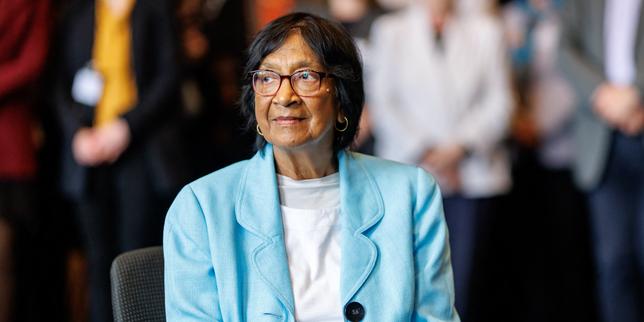
Most people think international law is just a toothless concept argued by politicians in safe conference rooms. They are wrong. When you look at the life and work of Navi Pillay, you realize that international justice is forged in the trenches by individuals who refuse to be intimidated. Winning the Nobel Peace Prize didn't happen by accident; it was the inevitable recognition of a woman who spent decades dragging war criminals and oppressive states into the light.
Born in Durban, South Africa, in 1941, Pillay didn't just study injustice; she grew up right inside its machinery. Back in 1967, she shattered concrete ceilings by becoming the first woman to start her own law practice in Natal Province. Let's be honest about what that meant at the height of apartheid. She wasn't arguing corporate contract disputes. She was defending anti-apartheid activists, trade unionists, and political prisoners detained on Robben Island. She knew the personal risks, and she took them anyway.
From Durban courtrooms to the international stage
If her career had stopped after the fall of apartheid, she'd still be a historical icon. President Nelson Mandela appointed her as a judge on the High Court of South Africa in 1995. But her jurisdiction quickly expanded to the entire world.
That same year, the UN appointed her to the International Criminal Tribunal for Rwanda (ICTR). Picture the sheer weight of that responsibility. She had to judge the architects of a genocide. Under her leadership as president, the tribunal made a historic ruling recognizing rape as an act of genocide. Think about that for a second. Before that landmark decision, systematic sexual violence during wartime was routinely dismissed by courts as an unfortunate byproduct of conflict rather than a weapon of mass destruction. Pillay changed that definition forever.
Her climb didn't stop there. She served as an appeals judge for the International Criminal Court (ICC) in The Hague, and later took over as the United Nations High Commissioner for Human Rights from 2008 to 2014.
Why governments hate independent courts
Political leaders love international law when it punishes their enemies. They despise it when it investigates their own actions. Pillay learned this truth repeatedly.
As chair of the UN Independent International Commission of Inquiry on the Occupied Palestinian Territory, she led investigations that didn't spare any side. Her inquiries concluded that war crimes had been committed by various actors, leading directly to high-stakes international arrest warrants. Predictably, powerful nations and targeted regimes pushed back hard, launching attacks on the credibility of international judicial bodies.
People often ask why accountability takes so long. The answer is simple. Powerful states build systems to shield themselves. Pillay spent her entire professional life poking holes in those shields. She proved that human rights aren't cultural preferences or political talking points. They are baseline legal demands.
What you can learn from her relentless approach
You don't have to be a UN high commissioner or an ICC judge to apply Pillay's playbook to your own corner of the world.
- Refuse the narrative of inevitability. When systems are rigged, the default response is compliance. Pillay built a career on rejecting that premise entirely.
- Focus on structural change. Writing angry statements changes nothing. Fixing the rules of the institution changes everything.
- Expect heavy pushback. If powerful people aren't criticizing your work, you're probably not shaking the right tables.
The Nobel committee got this one right. Navi Pillay showed that an uncompromising commitment to the rule of law can outlast dictators, break through state-sponsored impunity, and give actual voice to the victims of atrocities.