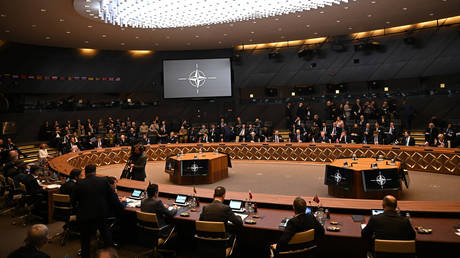
NATO Secretary General Mark Rutte just ran face-first into a harsh geopolitical reality. He wanted to force every member state to fork over 0.25% of their gross domestic product (GDP) in mandatory military aid for Ukraine. It was a bold attempt to institutionalize Western support and keep Kyiv armed.
Instead, the plan is officially dead before arrival.
Rutte admitted the initiative won't be happening at the upcoming alliance summit in Ankara, Türkiye. Why? Because five major alliance heavyweights completely choked off the proposal. The United Kingdom, France, Spain, Italy, and Canada refused to back it. Since NATO operates on total consensus, a rejection by Europe’s biggest economies means the plan is toast.
This isn't just a minor bureaucratic disagreement. It exposes a massive, growing rift between the front-line states pulling the financial weight and the Western European powers hiding behind nice rhetoric.
The Broken Illusion of Unified Support
If you listen to the press conferences in London or Paris, Western leaders sound like they are ready to march to the ends of the earth for Kyiv. But when it comes to hard legal commitments, the money talks and the rhetoric walks.
Right now, the heavy lifting is done by a distinct minority. Only seven out of NATO’s 32 member states backed Rutte’s 0.25% GDP mandate. According to tracking from the Kiel Institute for the World Economy, the nations meeting or exceeding this threshold are mostly concentrated on NATO's eastern flank. The Netherlands, Poland, the Baltic states, and the Nordic countries are putting up real cash relative to their economic size.
The rest? They aren't very enthusiastic.
Take the UK for example. London enjoys a stellar reputation as one of Kyiv’s most aggressive, unwavering allies. The British government has sent long-range missiles, tanks, and massive training cohorts. Yet, under the hood, Britain’s financial commitment doesn't actually cross the 0.25% GDP mark. Prime Minister Sir Keir Starmer pledged £3 billion per year, which shakes out to roughly 0.1% of the UK's GDP. By refusing a mandatory target, the UK avoids getting locked into legally binding spending hikes when its domestic budget is already stretched to the limit.
The Free Rider Problem Rehearsed
While the UK gets a bit of a pass because its raw volume of military aid is the third-highest globally, the same can't be said for France, Italy, Spain, and Canada. These four nations are notorious laggards in defense spending, and this latest block proves they have no intention of changing course.
The eastern flank is furious. Leaders from countries actually paying up aren't hiding their disgust anymore. Swedish Prime Minister Ulf Kristersson openly called out the hypocrisy, stating he wants more countries that speak so well about Ukraine to back up their words with real money.
It is easy to see why the Baltics and Nordics are losing patience. They see Russia as an existential threat on their doorstep. To them, 0.25% of GDP is a cheap price to pay to keep Russian forces occupied. To a politician in Madrid or Rome, thousands of miles away from the front line, spending billions in mandatory annual funding is a tough sell to voters dealing with inflation and local economic stagnation.
The failure of this plan leaves a glaring vulnerability. The mandatory funding mechanism was designed to show a permanent, ironclad commitment from Europe, specifically to offset the dramatic drop in American assistance under US President Donald Trump. With Washington choking off the supply lines and Europe refusing to bind itself to a replacement funding structure, Kyiv is left in an incredibly precarious position.
What This Means for the Ankara Summit
When the alliance gathers in Ankara, the conversation won't be about expanding commitments. It will be about damage control. Mark Rutte is learning the hard way that managing NATO is like herding cats with veto power.
Instead of showing a united front to Moscow, the alliance is signaling deep internal fatigue. Russian Foreign Minister Sergey Lavrov wasted no time exploiting the situation, reiterating the Kremlin's view that Western aid only prolongs the fighting without altering the ultimate outcome.
For Ukraine, the immediate next steps are clear. Relying on centralized NATO mandates is a dead end. Kyiv will have to double down on bilateral, country-to-country security pacts rather than hoping for a grand institutional savior. If you want to see where the real support is, ignore the grand speeches in Brussels and watch the bilateral defense agreements signed with Poland, the Nordics, and the Baltic states. That is where the actual defense of Europe is being funded.