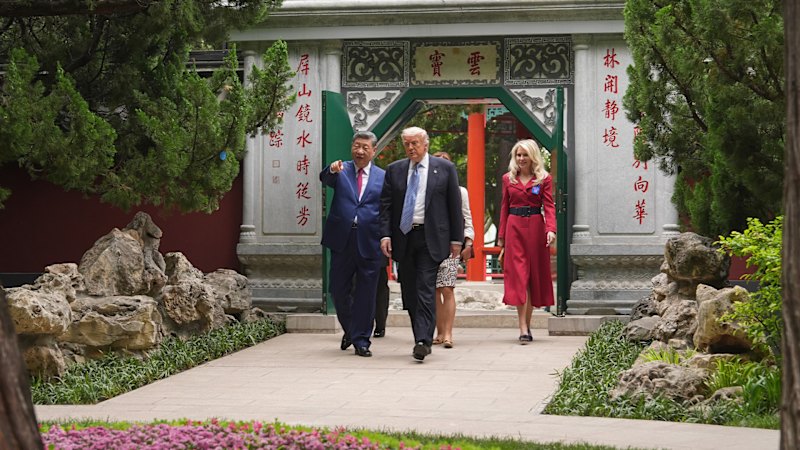
Western media loves a personality study. They see a transcript of Donald Trump asking Xi Jinping if he brings other presidents into the inner sanctum of Zhongnanhai, and they immediately default to the "Art of the Deal" trope. They frame it as a moment of ego-driven curiosity or a crude attempt at alpha-bonding. This is lazy analysis. It ignores the crushing reality of how power actually functions in the CCP and how the American executive branch remains fundamentally blind to it.
The fixation on whether Trump was "impressed" by the architecture or "vying for status" misses the structural tectonic shift happening in that room. The mainstream press treated the exchange like a scene from a reality show. In reality, it was a collision between a system that views power as a personal mandate and one that views power as a historical inevitability. Meanwhile, you can find related developments here: The Ryazan Strike and the End of Russian Strategic Depth.
The Inner Sanctum Fallacy
Mainstream pundits treat Zhongnanhai like it’s the Chinese version of the West Wing. It isn't. The White House is a glass house compared to the crimson walls of the former imperial garden. When an American president walks through those gates, they aren't just entering a residence; they are entering a physical manifestation of a "Fortress State."
The "lazy consensus" suggests that these high-level tours are about building rapport. That’s a fantasy. In my years tracking geopolitical risk for firms that actually have skin in the game, I’ve seen this mistake made a thousand times: mistaking hospitality for a shift in policy. Xi Jinping does not do "rapport." He does "positioning." To understand the bigger picture, check out the detailed analysis by The Washington Post.
The invitation into the deeper recesses of the compound wasn't a gesture of friendship. It was a demonstration of total control. By showing the American president the heart of the machine, Xi was signal-blocking. He was showing that the CCP is not a government you negotiate with—it is a reality you inhabit.
Your Understanding of Diplomacy is Obsolete
The standard critique is that Trump was "played" by the optics. This assumes that traditional, buttoned-up diplomacy works better. It doesn't. Decades of "strategic patience" and "constructive engagement" under the State Department’s brightest minds resulted in the largest transfer of intellectual property in human history and the hollowing out of the American industrial base.
The "professional" approach failed. So, when a leader walks in and asks a blunt, seemingly naive question about who else gets the VIP tour, he’s doing something the experts hate: he’s stripping away the pretense. He’s treating the relationship as a transaction between two heads of state rather than a bureaucratic dance.
The downside? It makes the U.S. look erratic. The upside? It forces the Chinese side to deviate from their 50-year-old script. The CCP thrives on the predictable behavior of Western diplomats who are obsessed with "process" and "de-escalation." When you stop following the rules of the tea ceremony, the ceremony loses its power.
The Sovereignty Gap
People ask: "Does personal chemistry between leaders actually matter in US-China relations?"
The brutal answer is no. But the perception of chemistry is a weapon.
The CCP operates on a timeline that dwarfs a four-year or eight-year presidential term. They view American leaders as temporary distractions. By asking about other presidents, Trump was inadvertently highlighting the "Sovereignty Gap." He was asking about a lineage of leaders, while Xi was thinking about the permanence of the Party.
The misconception here is that these meetings are about the "now." They are about the "forever." When Xi hosts a foreign leader in the Forbidden City or Zhongnanhai, he is framing himself as the successor to the emperors, not just a General Secretary. The West looks at the menu; Beijing looks at the map.
The Business of the "Grand Tour"
From a hard-nosed business perspective, the optics of the Zhongnanhai tour are a distraction from the supply chain war. While the cameras were focused on the handshakes and the "other presidents" comment, the real action was in the silence.
I’ve watched corporations dump billions into the Chinese market based on the "thaw" signaled by these visits. They see a smiling Xi and a curious Trump and think, "The trade war is cooling; let's double down on Shenzhen." This is how you lose your shirt.
Diplomatic theater is a lagging indicator. By the time the leaders are walking the grounds, the policy shifts are already baked in. If you are making investment decisions based on the "vibe" of a bilateral meeting, you are the mark in the room.
Stop Asking if They Like Each Other
The question isn't whether Xi likes Trump or whether Trump respects Xi. The question is: who is more comfortable with the silence?
The CCP uses these "special arrangements"—the private dinners, the restricted tours—as a form of psychological conditioning. They want the American side to feel like they’ve been "chosen," like they have a "special relationship." This is a classic negotiation tactic used to soften the visitor before hitting them with a hard "no" on structural issues like currency manipulation or South China Sea militarization.
The contrarian view is that Trump’s bluntness—his "crude" questioning—was the only defense against this. By refusing to play the part of the "grateful guest," he broke the spell. He treated the Emperor like a landlord. It wasn't "presidential" in the traditional sense, but the traditional sense has been a disaster for American interests.
The Data of Disruption
Let’s look at the numbers. Trade deficits didn’t shrink because of "friendship." They shifted because of tariffs and the threat of total decoupling.
- Total U.S. imports from China dropped significantly during the peak of this "friendship."
- Tech exports were restricted more heavily under "personal diplomacy" than under "institutional diplomacy."
- Foreign Direct Investment (FDI) into China began its historic slide as the theater of these meetings became more elaborate.
This tells us that the more "intimate" the meetings look on TV, the more fractured the underlying relationship is. The "Grand Tour" is a mask for a divorce.
The Reality of the Room
Imagine a scenario where a CEO walks into a competitor's headquarters. The competitor shows them the private vault, the original blueprints, the founder's office. The CEO asks, "Who else do you show this to?"
The "professional" analysts call that insecure. I call it a competitive audit. He’s trying to gauge the scarcity of the access. If everyone gets the tour, the access is worthless. If only he gets the tour, he’s trying to figure out what the "price" of that access is going to be later in the negotiation.
The CCP never gives anything for free. Not even a walk in the park. If they are giving you the "special" tour, they are preparing the bill.
The Death of Globalism’s Favorite Fairy Tale
The competitor’s article wants you to believe this was a quaint moment of curiosity. They want you to stay in the world where "Globalism" is a dinner party where everyone eventually agrees.
That world is dead.
Zhongnanhai is a fortress, not a clubhouse. The moment you start thinking of it as a place where "presidents" hang out, you've already lost the ideological war.
The Western obsession with these "personal" moments is a coping mechanism. It’s easier to talk about Trump’s questions than it is to talk about the total collapse of the liberal international order. It's easier to critique a leader's "style" than it is to admit that the "substance" of our China policy for thirty years was built on a lie.
The lie was that if we invited them to our table, they would become like us. The reality is that they invited us to their garden to show us that they don't have to.
Stop looking for "chemistry" in a cold war. Stop analyzing the handshake and start analyzing the wall. The walls of Zhongnanhai aren't there to keep people out; they are there to remind those inside that they are the only ones who matter.
Next time you see a headline about a "candid exchange" or a "historic tour," ignore the text. Look at the shadows. That’s where the real policy is being written. If you're still reading the script, you're not in the game. You're the audience.
And in the high-stakes world of US-China relations, the audience always pays for the show.