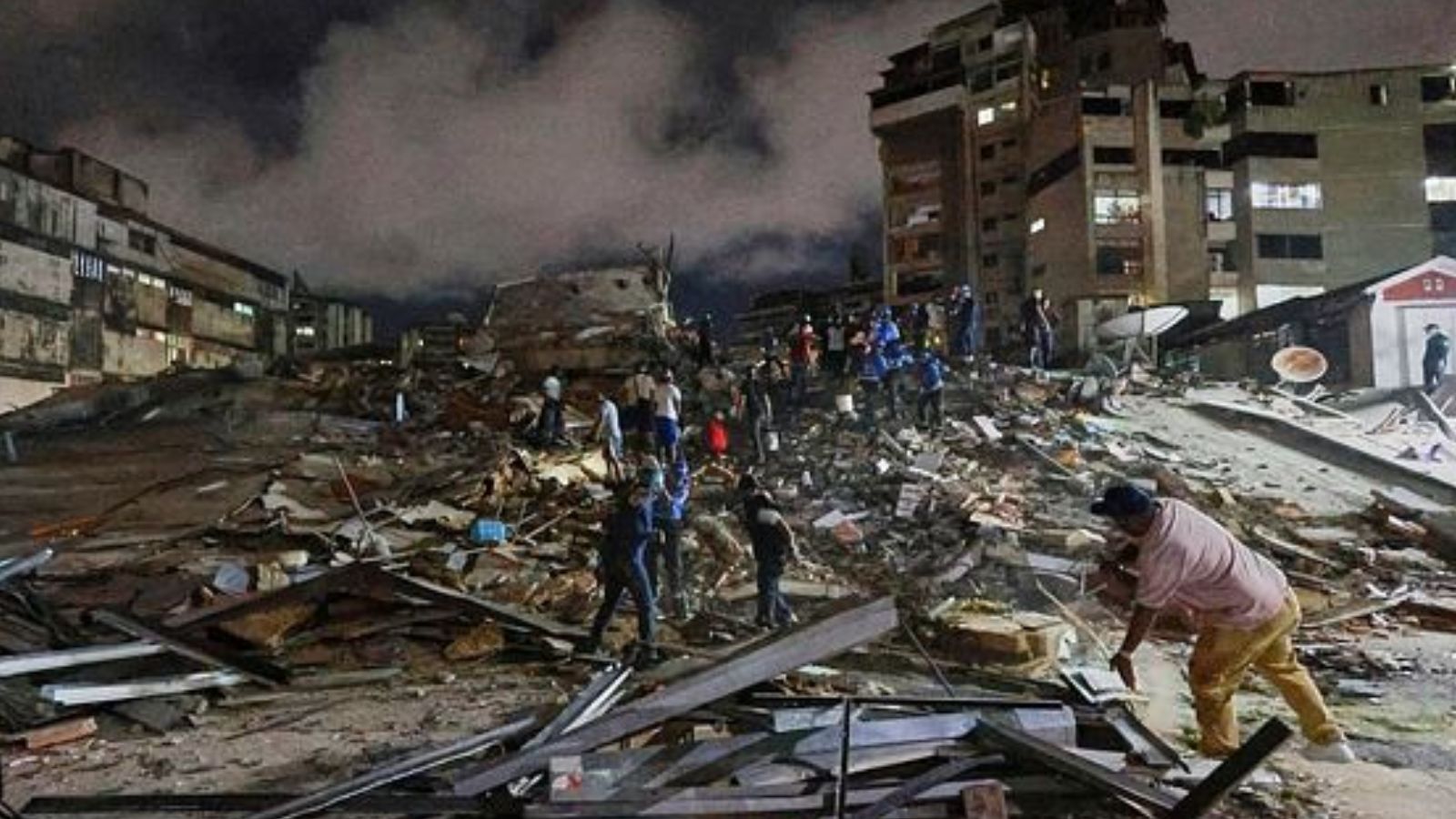
Mainstream news outlets are regurgitating the same exhausting script after the massive 7.2 and 7.5 magnitude doublet earthquakes struck northern Venezuela. They point at the tectonic map, isolate the Caribbean and South American plates, and shrug their shoulders. “It was an act of God,” the reporting implies. “A rare doublet sequence that caught everyone off guard.”
They show you looping videos of collapsed facades in Altamira, dust clouds swallowing streets, and panicked citizens fleeing toward open plazas. They tell you the panic is a natural psychological reaction to an unprecedented physical phenomenon.
They are lying to you. Or, at best, they are missing the entire point.
Nature did not flatten those buildings in Caracas. Decades of institutional rot, criminal non-compliance with building codes, and a blind reliance on unreinforced masonry did the job. The seismic energy released near Morón was simply the audit.
I have spent years analyzing urban structural failures across Latin America. When a building collapses while its neighbor stands perfectly intact, you are not looking at a natural disaster. You are looking at a crime scene. The lazy consensus focuses on the rare mechanics of back-to-back 7+ magnitude tremors. The real story is how the Venezuelan state systematically engineered a vulnerabilities trap that turned a standard, predictable geological reality into a mass casualty event.
The Doublet Fallacy: Blaming the Rare Sequence
Seismologists are rightfully fascinated by the 39-second gap between the two major ruptures along the Morón fault zone. It is classic stress transfer—the first rupture overloads an adjacent, already strained segment of the plate boundary, causing an almost immediate second fracture.
But let us dismantle the media narrative that this doublet sequence made destruction inevitable.
A well-engineered city can handle an earthquake doublet. Chile routinely absorbs consecutive major shocks without losing entire city blocks. Japan expects them. The physics of seismic design do not change because a second wave arrives 39 seconds after the first. If a structure is built with adequate ductility—the ability to deform plastically without brittle fracture—it absorbs the energy of both waves. It cracks, it sways, but it stays up.
The structures that collapsed in neighborhoods like Altamira, San Bernardino, and the port city of La Guaira did not fall because of the second shockwave. They fell because they were already structural ghosts, dead on their feet before the ground ever moved.
The Anatomy of a Concrete Crime Scene
To understand why Caracas crumbled, you have to understand how the city was built—and how it was abandoned.
Venezuela actually possessed sophisticated seismic engineering standards on paper. Following the deadly 1967 Caracas earthquake, the country updated its structural regulations, culminating in the COVENIN standards of the 1980s and 1990s. These codes mandated strict ductile detailing, shear walls, and proper confinement of concrete columns.
But a code is only as strong as the inspector who signs off on it.
Over the past two decades, the hyperinflationary collapse of the Venezuelan economy directly destroyed building safety. Think about the physical components of concrete. To achieve standard compressive strength (typically 25 to 30 MegaPascals for residential mid-rises), you need clean aggregate, precise water-to-cement ratios, and structural steel that meets international tensile specifications.
When the economy tanked, builders cut corners. They used sub-standard cement mixed with unwashed, salty beach sand from the coast—a recipe for internal chemical degradation known as concrete cancer. They swapped out specified rebar for cheaper, thinner steel. Worse, millions of citizens built informal, multi-story brick dwellings in the barrios clinging to the hillsides of Petare and Catia without a single blueprint or engineering calculation.
Consider this technical breakdown of the structural failure mechanism that actually downed these buildings:
[Seismic S-Waves Hit]
        │
        ▼
[Brittle Shear Failure in Columns] ──► (Lack of closely spaced steel stirrups/ties)
        │
        ▼
[Soft-Story Collapse]              ──► (Ground floors converted to open parking/retail)
        │
        ▼
[Pancake Structural Failure]       ──► (Floors collapse directly onto one another)
Look closely at the footage of the six-story residential building that collapsed in Altamira. The floors are stacked flat on top of each other like a deck of cards. That is a textbook "pancake collapse" caused by soft-story failure. The ground floors were cleared out for open parking or retail storefronts, leaving them with significantly less lateral stiffness than the walled floors above. When the lateral ground acceleration hit, the unreinforced ground-floor columns snapped like dry twigs. The upper floors dropped cleanly, crushing anyone trapped inside.
The Infrastructure Blindspot
While the media panics over apartment walls, the real systemic threat is the invisible utility network. Acting President Delcy Rodríguez declared a state of emergency, citing the immediate shutdown of the Caracas metro, widespread power grid failures, and severe structural damage at Maiquetía International Airport.
This is where the contrarian truth gets ugly: the earthquake did not break the grid. The grid was already broken.
The electrical network in Venezuela has suffered from zero preventive maintenance for fifteen years. Substation transformers are unanchored. Control rooms lack functioning backup battery banks. The seismic vibrations did not require a catastrophic physical tearing of lines; the simple vibration was enough to trip uncalibrated, deteriorating relays and send a unstable grid into a total blackout.
The same applies to the water and gas infrastructure. Caracas relies on massive high-pressure aqueducts to pump water up from lower reservoirs. These lines are heavily corroded. A minor ground displacement that a modern ductile iron pipe would easily flex through will snap brittle, oxidized steel mains instantly. The secondary disaster in the coming weeks will not be aftershocks; it will be water scarcity and localized fires from ruptured gas lines that the government cannot track because they canceled localized utility monitoring years ago.
The Counter-Intuitive Truth About the Panic
The competitor articles paint a picture of sudden, unpreventable panic gripping the streets. They describe people hugging their pets, stranded without cell service, waiting in terror.
But panic is not an erratic psychological glitch; it is a rational calculation based on a total lack of trust in institutional authority.
When a citizen in Tokyo experiences a 7.5 magnitude earthquake, they know their building has been engineered to sway. They know the automated gas shutoff valves will trigger. They know the emergency broadcast system will give them real-time data within ninety seconds. They stay inside or move methodically.
In Caracas, residents ran down crumbling stairwells because they knew, deep down, that the concrete surrounding them was a gamble. They knew the state civil defense protocols were hollow PR scripts broadcasted on state television. When the interior minister tells the public that they are "acting according to protocols," everyone on the ground knows that those protocols lack the heavy machinery, trained rescue personnel, and medical supplies required to execute a large-scale urban search-and-rescue operation.
The systemic loss of communications also was not an unavoidable casualty of geology. Telecommunication towers collapsed or lost power because their backup diesel generators were long ago stripped of copper, fuel, or spare parts. The isolation that deepened the distress of millions of families wasn't caused by the plate boundary; it was caused by institutional decay.
Stop Funding "Rebuilding" — Demand Structural Accountability
The international community is already doing what it always does: mobilizing generic humanitarian aid, sending expressions of solidarity, and preparing to dump millions of dollars into "rebuilding" funds.
This approach is fundamentally flawed.
Pouring money into the current Venezuelan structural framework to rebuild the flattened sectors of Chacao, Baruta, or La Guaira is an exercise in futility. Without a complete overhaul of engineering oversight, materials procurement verification, and the physical eradication of unreinforced masonry construction, you are simply financing the next disaster.
The uncomfortable reality is that modern seismic engineering is a solved problem. We know exactly how to keep buildings standing during a 7.5 magnitude shock wave. The failure to implement these solutions is entirely political, economic, and systemic.
Stop looking at the seismic doublet as a freak freak of nature. Stop treating the collapsed walls as an inevitable consequence of living near a fault line. If you want to understand why Caracas broke, look past the shifting Caribbean plate and look directly at the decades of institutional neglect that turned a standard tectonic shifting into an urban graveyard.
The ground shook for less than two minutes, but the vulnerability was meticulously built over decades.