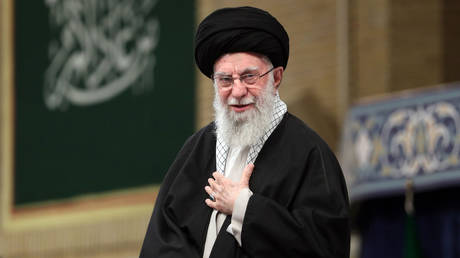
The Western media is currently obsessed with a ghost. For years, "intelligence experts" and DC think-tankers have salivated over a specific data point: the date of Ali Khamenei’s death. They frame it as the ultimate "black swan" event, a geopolitical reset button that will magically unravel forty-five years of Islamic jurisprudence and revolutionary fervor.
They are wrong. If you enjoyed this article, you might want to check out: this related article.
The obsession with the Supreme Leader’s pulse is the ultimate distraction. It treats Iran like a classic 20th-century autocracy—a fragile pyramid where pulling the top stone collapses the base. Iran isn't a pyramid. It is a biological organism, a decentralized network of vested economic interests, paramilitary conglomerates, and deeply entrenched bureaucratic inertia.
If you’re waiting for a "Tehran Spring" triggered by a funeral, you haven't been paying attention to how power actually aggregates in the Middle East. You’re looking for a revolution in a country that has already perfected the art of the counter-revolution. For another look on this development, see the latest coverage from NBC News.
The Succession Fallacy
The lazy consensus suggests a binary outcome: either a smooth transition to a hand-picked successor like Mojtaba Khamenei, or a bloody, chaotic power struggle that brings down the house.
Both narratives miss the point. The "struggle" has already happened. It’s been happening for a decade in the boardrooms of the Setad and the barracks of the Islamic Revolutionary Guard Corps (IRGC).
The Office of the Supreme Leader is no longer just a religious or political seat. It is the CEO position of a massive, multi-billion-dollar holding company. The Assembly of Experts—those eighty-odd clerics tasked with choosing the next leader—are not debating theology. They are rubber-stamping a deal that has likely already been brokered between the IRGC’s intelligence wing and the clerical elite.
We see the same mistake made with the Soviet Union in the 80s or North Korea today. Analysts mistake the face on the poster for the source of the power. In reality, the Supreme Leader exists to mediate between the IRGC and the traditional clergy. He is a balancer. When Khamenei goes, the system doesn't break; it simply recalibrates to protect the bottom line.
The IRGC is the State
To understand why the "What’s Next" question is flawed, you have to stop viewing the IRGC as a military branch. It is a venture capital firm with tanks.
They control somewhere between 20% and 50% of Iran’s GDP. They own construction firms, telecommunications giants, and shipping lines. They run the airports. They manage the smuggling routes that bypass sanctions.
For the IRGC, a total collapse of the state is bad for business. But a liberalizing, pro-Western reform movement is even worse. It would mean transparency, international accounting standards, and competition—all of which would strip the Guard of its monopoly.
Therefore, the IRGC has zero incentive to allow a power vacuum. They don’t need a "strong" Supreme Leader; they need a compliant one. A weaker, less charismatic successor is actually preferable for the military elite. It allows them to transition from being the "defenders of the revolution" to being the literal owners of the nation.
The Reformist Mirage
Every time a major Iranian official dies or an election nears, the Western press begins its ritualistic search for the "Reformist Savior." It’s a tired trope that ignores the structural reality of the Guardian Council.
Reform in Iran is a pressure valve, not a path to change. The system allows a certain amount of "moderate" rhetoric to bubble up when the economy is screaming, only to tighten the noose the moment the regime feels secure.
Thinking that Khamenei’s death opens a door for the "moderates" is a fundamental misunderstanding of the Velayat-e Faqih ($Velayat-e\ Faqih$). The constitution is designed to be self-correcting. Any candidate who actually poses a threat to the core tenets of the 1979 revolution is disqualified long before they reach a ballot.
I’ve watched Western investors lose millions betting on "thaws" in Iranian relations. They see a smiling foreign minister and assume the DNA of the regime has changed. It hasn't. The hostility toward the West isn't just an ideological quirk; it’s a foundational requirement for the regime’s existence. Without an external "Great Satan," the IRGC cannot justify its massive budget or its brutal suppression of domestic dissent.
The Real Crisis is Not Political
If you want to know what actually kills the Islamic Republic, stop looking at the succession and start looking at the water table.
Iran is facing an existential environmental crisis. Lake Urmia is disappearing. Land subsidence in Isfahan is literally swallowing buildings. The currency, the Rial, has been in a death spiral for years, with inflation rates that make standard retirement planning a joke.
The "People Also Ask" sections of the internet want to know who the next leader is. The better question: Can any leader manage a country that is physically drying up while its youth population—over 60% of whom are under 30—is digitally connected and culturally alienated?
The regime’s survival strategy has been "Strategic Patience." They wait out US presidencies. They wait out sanctions. But you cannot wait out a drought. You cannot wait out a demographic shift that has turned the majority of your population into internal enemies.
The Economic Ghost in the Machine
The status quo assumes that sanctions have crippled the regime to the point of imminent failure. This is a profound misunderstanding of how "Resistance Economics" works.
Sanctions didn't kill the Iranian economy; they just drove it underground and into the hands of the most radical elements. When you cut off a country from the SWIFT banking system, you don't stop the money; you just ensure that only the people with the guns can move it.
The post-Khamenei era will see a further "securitization" of the economy. We are likely to see the rise of a "Chinese Model" with Iranian characteristics: fierce social control, a heavy military hand in the markets, and a total abandonment of the pretense of clerical "poverty."
Why the Transition Will Be Boring
The most counter-intuitive truth about the day after Khamenei is that it will likely be incredibly dull.
The streets won't fill with celebratory crowds—they’ll be filled with Basij militia members and riot police before the news even hits the wires. The internet will go dark. The Assembly of Experts will meet in a closed-door session, and within 48 to 72 hours, a new name will be announced.
The "chaos" the West expects is exactly what the IRGC has been practicing to prevent since the 2009 Green Movement. They have mapped every street, identified every dissident, and secured every communication node.
The transition is a technicality. The regime is a machine, and the machine has plenty of spare parts.
Stop Asking the Wrong Question
The world keeps asking: "Who follows Khamenei?"
The world should be asking: "How does the West handle a nuclear-armed Iran led by a military junta that no longer feels the need to hide behind a turban?"
The clerical element of the Iranian government is the skin. The IRGC is the bone. As the skin thins and eventually tears away with the passing of the old guard, the bone remains. Dealing with a religious theocracy is difficult; dealing with a hyper-nationalist, nuclear-capable military dictatorship that controls a third of the world's energy transit routes is a different beast entirely.
If you’re waiting for the "What's Next" to be a move toward democracy, you’re hallucinating. The "What's Next" is a more efficient, more brutal, and more corporate version of what we see today.
The king is dead. Long live the Board of Directors.