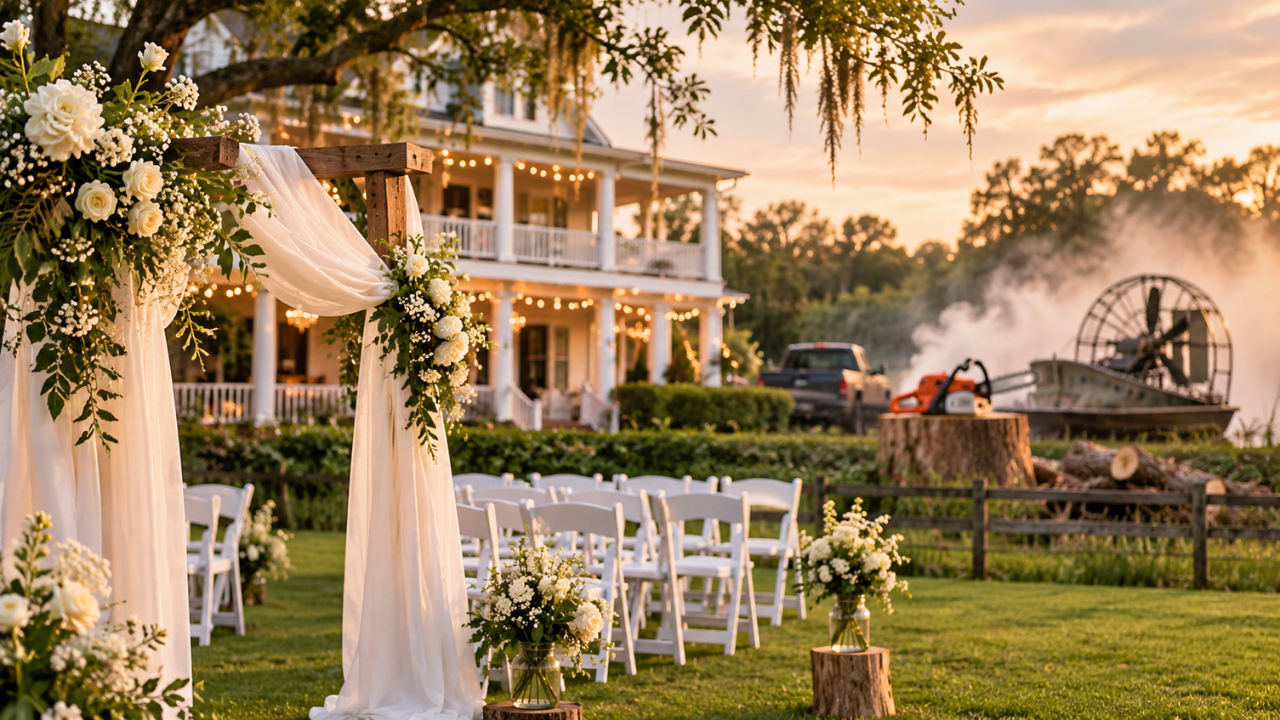
Silence is expensive.
Ask anyone who has ever saved for three years to pay for a string quartet, an open-air garden, and sixty seconds of breathless anticipation before a bride walks down an aisle. You are not paying for flowers. You are not paying for chairs. You are buying the right to control the atmosphere of a single afternoon, hoping that the rest of the world will politely hold its breath while you make a promise.
Now imagine the sound of a leaf blower firing up twenty feet away. Or a heavy bassline rattling the champagne flutes. Or the unmistakable, aggressive roar of a lawnmower engine idling right at the property line just as an officiant asks if anyone objects.
In Florida, that exact collision between commerce, celebration, and the relentless reality of living next door to someone else just became the center of a fierce legal battle. A Florida appeals court stepped into a bitter dispute involving a wedding venue and its neighbors, lifting lower-court restrictions that had clamped down on what happened next door after the venue alleged that noisy neighbor disruptions were ruining its events.
On paper, it reads like a dry municipal squabble over decibels and property lines. In reality, it is a story about what happens when two incompatible versions of the American dream share a fence.
The Architecture of a Ruined Afternoon
To understand why this appellate decision sends ripples far beyond a single county line, consider a hypothetical afternoon at an outdoor estate venue—let us call it Magnolia Run.
Picture Elena, a wedding planner who has spent fourteen months coordinating every variable within her control. She checked historical rainfall averages. She timed the sunset to the exact minute so the photographer could catch the amber light filtering through the live oaks. She briefed the catering staff on how to clear plates without clinking silverware during the father-of-the-bride toast.
She controlled everything except the man living on the other side of the privet hedge.
Let us call him Arthur. Arthur bought his acreage twenty years ago when the road was still mostly gravel and the loudest thing after five o'clock was the cicadas. He likes restoring vintage engines. He likes listening to classic rock while he works on his patio. He did not sign a contract with Elena. He did not agree to turn his Saturday afternoon into a silent movie set just because eighty strangers in pastel suits decided to drink prosecco fifty yards from his back door.
When the ceremony begins, Arthur starts his circular saw.
Elena feels her stomach drop into her shoes. The bride’s mother shoots her a look that could curdle milk. The videographer frantically waves his arms, signaling that his directional microphones are picking up nothing but high-pitched whining steel. Forty thousand dollars of careful choreography evaporates in ten seconds of sawdust and spite.
Is Arthur breaking the law? Or is he simply living on his own land?
That question is the razor wire running right through the middle of modern property law. When a commercial wedding venue sets up shop in a semi-rural or residential buffer zone, it brings tremendous economic energy—florists, photographers, caterers, local hotels—along with Friday and Saturday night traffic, amplified reception music, and guests who treat a quiet neighborhood road like a resort driveway. Neighbors push back. Sometimes they complain to code enforcement. Sometimes they file nuisance suits. And sometimes, as the Florida venue alleged in its own legal filings, neighbors fight noise with noise, turning their own backyards into acoustic counter-offensives.
Why Courts Hate Telling People to Be Quiet
When a dispute like this reaches a trial judge, the immediate instinct is often to stop the bleeding. A lower court looks at the evidence, sees a business claiming imminent financial ruin from deliberate disruptions, and issues an injunction—a legal muzzle ordering the neighbor to cease specific noisy activities during scheduled events.
It feels like common sense. Stop the sabotage, let the weddings happen, sort out the damages later.
Except appellate courts do not run on immediate emotional sympathy. They run on constitutional guardrails, procedural rigor, and a deep, centuries-old suspicion of prior restraint.
Think of a temporary injunction like an emergency tourniquet. If a surgeon ties one too tight or puts it on the wrong limb without following strict medical protocol, the cure causes more permanent damage than the wound. When a Florida appeals court lifts restrictions imposed by a lower court, it is rarely saying that loud, disruptive behavior is admirable. Instead, the appellate judges are usually pointing out that a trial court overstepped its legal bounds—either by failing to prove irreparable harm that money cannot fix, by drafting an order so vague that a homeowner cannot tell what ordinary daily life is suddenly illegal, or by restricting speech and conduct before a full trial has actually proven wrongdoing.
Consider the sheer difficulty of enforcing a behavioral injunction across a property line.
If a judge orders a neighbor not to make "unreasonable noise" during wedding hours, what does that mean in practice? Can the neighbor mow their lawn at two in the afternoon on a Saturday, the exact hour most homeowners do yard work? Can their kids play basketball in the driveway? Can they host their own backyard barbecue with a Bluetooth speaker? When a court uses its power to freeze a neighbor's ordinary property rights to protect a private business's commercial schedule, the law tilts dangerously toward turning private homeowners into unpaid stagehands for someone else's profit margin.
The Invisible Stakes of the Acoustic Arms Race
I have stood on the edge of outdoor event spaces when an unscripted sound invades the frame, and the physical tension in the air is unmistakable. People do not get mildly annoyed; they get panicked. Weddings carry an absurd psychological weight in our culture. We treat a single rainy squall or an unexpected siren as an omen, a permanent stain on a memory that is supposed to be pristine.
Venues know this. Their entire business model rests on selling an illusion of total sanctuary.
When a venue alleges that a neighbor is intentionally disrupting events, the financial threat is existential. One viral video of a ceremony drowned out by a revving engine or an air horn can tank a venue's reputation on wedding planning platforms overnight. Brides cancel deposits. Event insurance rates spike. Lenders get nervous. From the venue owner's perspective, they invested millions into restoring a historic property, obtained their permits, and are now being held hostage by a neighbor weaponizing leaf blowers.
Look across the fence, though, and the stakes are just as visceral.
Home is the one place on earth where you are not supposed to perform for an audience. You pay your mortgage and your property taxes for the sanctuary of being unbothered. When a quiet residential lane transforms into a weekend event corridor, the homeowner absorbs all the friction—the headlights sweeping across bedroom windows at midnight, the bass thumping through drywall, the stranger accidentally turning around in their driveway—while capturing none of the revenue.
When a court steps in and tells that homeowner they are legally barred from making noise on their own property during peak weekend hours, the resentment becomes atomic. You are not just restricting their decibels; you are telling them they are second-class citizens on their own deed.
The Myth of the Quiet Buffer Zone
We like to believe that zoning maps draw clean, civilized lines between commerce and home. Residential goes here. Commercial goes there. Industrial goes out by the highway.
Florida—and much of the rapidly growing American South—destroyed that neat separation years ago.
As cities sprawl outward into former agricultural land, the edges blur. County commissions, hungry for tax revenue and eager to preserve green space without buying it themselves, increasingly approve "agrarian tourism" or special-exception permits for event barns, botanical gardens, and historic estates tucked inside low-density residential zones. On paper, it looks like a win-win: preserve the trees, support local entrepreneurs, keep developers from building three hundred identical tract homes.
Nobody puts the acoustic physics into the zoning ordinance.
Sound does not respect a surveyor's iron pin driven into the dirt. Low-frequency bass travels effortlessly across open pastures and reflects off water features. Conversely, the sharp, high-frequency whine of yard equipment carries straight through decorative hedges that look thick to the eye but offer almost zero acoustic mass.
By the time the first wedding season hits full swing, the zoning board has moved on to other agenda items, leaving two neighbors locked in a zero-sum war over who owns the air between them.
What Happens When the Legal Guardrails Come Off
When an appeals court vacates restrictions against a neighbor, the immediate aftermath is rarely peace. It is a reset to a tense, hyper-vigilant stalemate.
For the venue, lifting the restrictions means losing an instant legal shield. They can no longer call the sheriff's office with a court order in hand demanding immediate compliance before the bridal march begins. Instead, they are forced back onto the slower, harder path of standard civil litigation and local code enforcement. If a neighbor crosses the line from living their life into genuine, malicious nuisance, the venue has to document every incident—decibel readings, timestamps, witness affidavits, proof of financial loss—and prove it at a full trial on the merits.
For the neighbor, the appellate ruling is a vindication of property autonomy, though a precarious one. Lifting a preliminary restriction is not a blank check to harass a business. Nuisance law still exists. Intentional interference with business relationships still exists. Local noise ordinances still apply equally to everyone on the block. If a homeowner crosses from mowing their grass at noon to aiming speakers at a wedding altar and blasting white noise on a loop, a trial court can still hold them financially liable for every refunded deposit and ruined contract.
The difference is timing and burden of proof. In our legal system, you generally do not get to punish someone—or strip away their rights—before you have actually proven your case in full.
Living With the Noise
There is a hard truth buried inside every property dispute like this one, and neither side wants to hear it when tempers are hot.
No judge can write an order nuanced enough to make two hostile neighbors respectful.
Courts can draw boundaries. They can award money damages. They can strike down overbroad injunctions that trample due process. What they cannot do is manufacture the quiet, unspoken grace that allows human beings to live thirty feet apart without driving each other crazy.
A venue that wants true isolation has to buy the buffer land itself, build real acoustic walls, or move its ceremonies indoors when the neighbors are awake. A homeowner who lives next to an approved business has to accept that the world around their fence has changed, and that spite is a terribly expensive hobby once the lawyers start billing by the tenth of an hour.
Until both sides figure that out, the microphones will keep rolling, the engines will keep idling, and the music will always sound just a little bit fragile.