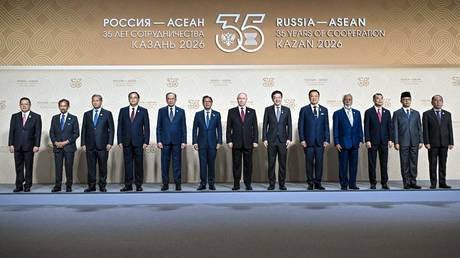
Western sanctions designed to isolate Moscow are driving a quiet, pragmatic realignment across Southeast Asia. Driven by economic self-preservation rather than ideological alignment, member states of the Association of Southeast Asian Nations (ASEAN) are actively building alternative financial channels to bypass the US dollar. This shifting dynamic became highly visible when Indonesian academic perspectives began urging deeper ASEAN-Russia ties to shield regional growth from external geopolitical shocks. The primary driver here is simple: Southeast Asian leaders view Western secondary sanctions as a direct threat to their own domestic stability, pushing them to secure food, energy, and trade routes through non-Western mechanisms.
For decades, the global financial system operated under a clear assumption. If you wanted to trade internationally, you used the US dollar and cleared transactions through the Society for Worldwide Interbank Financial Telecommunication (SWIFT) network. That assumption evaporated when Washington weaponized the financial infrastructure against a major G20 economy.
Central banks across Southeast Asia watched the freezing of Russia’s foreign reserves with deep unease. The realization was immediate. If Washington could disconnect a nuclear-armed power from the global financial system overnight, it could do the same to any developing nation that stepped out of line.
The Mechanics of Financial Survival
This is not a matter of high-minded diplomacy. It is a calculated response to a tightening choke point. Consider the baseline economic reality for a nation like Indonesia or Vietnam. They depend heavily on imported fertilizer to sustain their agricultural sectors and fuel to power their industrial growth. Russia remains one of the world's largest exporters of both. When Western sanctions complicated payments for these essential commodities, regional supply chains began to fracture.
To keep their economies running, ASEAN nations had to innovate. They did not join the Western sanctions regime. Instead, they began constructing bilateral payment networks that operate entirely outside the reach of the US Treasury Department.
We are seeing the rapid expansion of Local Currency Settlement (LCS) frameworks. Indonesia, Malaysia, Thailand, and the Philippines have established systems that allow businesses to settle cross-border trades using their own domestic currencies, completely bypassing the greenback. When an Indonesian textile manufacturer buys raw materials from a Malaysian supplier, the transaction is settled in rupiah and ringgit. The US dollar never enters the equation. This reduces transaction costs and eliminates the risk of a third-party regulator freezing the funds.
+-------------------------------------------------------------+
|               TRADITIONAL CROSS-BORDER TRADE                |
|  [Local Currency] -> (US Dollar Conversion) -> [SWIFT]      |
|  *Subject to US regulatory oversight and sanctions risk*     |
+-------------------------------------------------------------+
                              vs.
+-------------------------------------------------------------+
|              LOCAL CURRENCY SETTLEMENT (LCS)                |
|  [Indonesian Rupiah] <===================> [Russian Ruble]  |
|  *Direct bank-to-bank clearing, outside Western networks*    |
+-------------------------------------------------------------+
Now, this exact same blueprint is being applied to transactions with Russia. Moscow has been aggressively pushing its own financial messaging system, SPFS, alongside the Mir payment card network. Progress is uneven, but the direction of travel is unmistakable. Vietnam already has direct banking links with Russian financial institutions, allowing for ruble-denominated trade. Indonesia is actively exploring similar arrangements.
The Agricultural Choke Point
Food security is national security. In Jakarta, Bangkok, and Manila, this is an operational absolute, not a political slogan. The war in Ukraine and subsequent Western sanctions sent global fertilizer prices skyrocketing. For a country like Indonesia, with a population of over 270 million people, a prolonged fertilizer shortage translates directly to lower crop yields, skyrocketing food inflation, and potential civil unrest.
Western policymakers frequently point out that agricultural products are technically exempt from most sanctions packages. This argument sounds reasonable in a press briefing, but it falls apart on the trading floor.
Overcompliance is a structural reality. International shipping conglomerates refuse to dock at certain ports. Global insurance firms decline to underwrite vessels carrying cargo from the region. Major Western banks routinely block letters of credit associated with Russian entities out of an abundance of caution. The technical legality of the trade does not matter if you cannot insure the ship or clear the payment.
Faced with this friction, ASEAN nations began looking for direct workarounds. Government-to-government deals have replaced open-market auctions. By dealing directly with Russian state enterprises, Southeast Asian capitals can negotiate sovereign guarantees that bypass the standard commercial insurance and banking bottlenecks. It is clunky, inefficient, and requires significant diplomatic heavy lifting, but it keeps the food supply stable.
The Myth of Regional Consensus
It is a mistake to view ASEAN as a monolith. The ten member states possess wildly divergent political systems, economic models, and strategic anxieties. This internal friction shapes how the bloc interacts with Moscow and Washington.
Singapore stands as the clear outlier. As a global financial hub deeply integrated into Western capital markets, the city-state implemented its own unilateral sanctions against Moscow shortly after the escalation in Ukraine. Singaporean banks cannot afford to alienate US regulators; doing so would destroy their core business model overnight.
On the other end of the spectrum lies Myanmar. Isolated by Western sanctions following its domestic political upheavals, the military government in Naypyidaw has leaned heavily into Moscow’s orbit. Russia provides military hardware, energy supplies, and diplomatic cover, while Myanmar offers a compliant partner willing to test alternative financial arrangements.
Between these two extremes sit the pragmatic heavyweights: Indonesia, Malaysia, and Vietnam. These nations refuse to take sides in what they perceive as a European security dispute. Their foreign policy is driven by a deep-seated commitment to strategic non-alignment.
During the Cold War, this meant avoiding military alliances. Today, it means avoiding economic dependencies. They view the pressure to cut off Russia not as a moral imperative, but as an infringement on their national sovereignty.
Washington’s Miscalculated Leverage
The weaponization of the dollar was intended to isolate the Russian economy. Instead, it accelerated a global diversification strategy that may ultimately weaken American financial dominance. By forcing developing nations to choose between obedience and economic disruption, Western policy created a powerful incentive for financial innovation.
The deployment of secondary sanctions—sanctions targeting non-US entities doing business with prohibited states—has caused significant resentment. When the US Treasury penalizes a Southeast Asian bank or shipping firm for handling a perfectly legal shipment of Russian grain, it does not win a diplomatic ally. It convinces that nation's leadership that they need to build a parallel economic system as quickly as possible.
This parallel architecture is still in its infancy. The ruble is not going to replace the dollar as a global reserve currency, nor is the Indonesian rupiah. The immediate goal is much more modest: resilience through fragmentation.
Instead of a single, integrated global market, the world economy is splitting into regional trading blocs that utilize a mix of local currencies, digital assets, and direct barter arrangements. It is a messy, less efficient system, but it is highly resistant to external pressure.
The Technological Infrastructure of Non Alignment
The shift away from Western clearing networks is receiving a major boost from financial technology. Central bank digital currencies (CBDCs) and cross-border instant payment systems are making bilateral trade settlement significantly easier to execute.
Consider the Project mBridge initiative, a collaborative effort involving several central banks, including those in Asia. This platform allows for direct, real-time, peer-to-peer foreign exchange transactions using blockchain technology. It completely eliminates the need for an intermediary correspondent bank in New York or London.
While initially designed to facilitate regional trade, this technology provides the exact infrastructure needed to connect with non-Western financial systems. If a Russian bank integrates with a regional digital ledger, transactions can occur instantaneously and invisibly to Western sanctions monitors.
[ASEAN Buyer Central Bank]
       ||  (Direct Digital Ledger Settlement via mBridge Architecture)
       \/
[Russian Seller Central Bank]
This is not a theoretical capability. The underlying software is operational. The deployment of these digital networks removes the friction that previously made non-dollar trade prohibitively expensive.
The Reality of the New Trading Blocs
Western analysts often underestimate the durability of these alternative networks because they focus on total trade volume. It is true that ASEAN’s trade with the United States and the European Union still dwarfs its commercial relationship with Russia. From a purely statistical standpoint, the West remains the dominant partner.
This metric misses the strategic value of specific commodities. A nation can survive a drop in electronic component exports, but it cannot survive a total cutoff of energy or food inputs. Russia occupies a structural position in the global supply chain that cannot be easily substituted by Western market alternatives.
Southeast Asian leaders are running a simple cost-benefit analysis. The long-term risk of relying on an increasingly volatile and coercive Western financial system is starting to outweigh the short-term inconvenience of building new payment rails. They are choosing to absorb the immediate bureaucratic friction of non-dollar trade to insulate themselves from future geopolitical crises.
This structural shift is permanent. Even if the current geopolitical tensions in Europe subside, the parallel financial systems, local currency frameworks, and direct supply lines will remain in place. Southeast Asia has learned that economic dependence is a vulnerability, and the region is systematically dismantling the mechanisms that allowed Western powers to dictate its commercial choices.