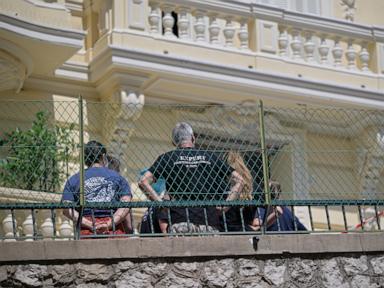
A sophisticated backpack bomb exploded at the entrance of a luxury residential building on Rue Révérend-Père-Louis-Frolla in Monaco on Monday night, critically injuring Ukrainian-born construction magnate Vadym Iermolaiev and his family. The blast, which occurred just feet from the open border with France, sent shockwaves through an enclave that prides itself on absolute surveillance and safety. While initial media reports scrambled to label the incident a random act of terror, Monaco prosecutors confirmed that this was a cold, calculated attempted assassination. The lone attacker, captured on security cameras waiting patiently for the family to return home, fled on foot into the French border town of Beausoleil and remains at large.
The target was not chosen by chance.
For decades, the billionaire playground of the French Riviera has served as a gilded sanctuary for Eastern European oligarchs seeking shelter from both judicial scrutiny at home and geopolitical fallout abroad. Iermolaiev, a dominant real estate and industrial kingpin from the industrial city of Dnipro, thought he had bought his safety when he traded his Ukrainian passport for Cypriot citizenship years ago. The Monday night detonation proved that in the modern underworld of corporate warfare and wartime retribution, international borders and private security detail offer little more than psychological comfort.
The Illusion of the Mediterranean Safe Haven
Monaco operates under an invisible canopy of total surveillance. There is roughly one police officer for every seventy residents, and high-definition facial recognition cameras blanket every square meter of the principality. Yet, the physical architecture of the region contains a massive vulnerability that professional syndicates understand completely. The border between Monaco and France is entirely open, marked only by changes in pavement and street signs.
A professional contract killer does not need a complex escape plan when they can drop a lethal payload and cross an international boundary on foot within ninety seconds.
Surveillance footage recovered by Monegasque and French authorities reveals the chilling discipline of the operative. The suspect spent hours pacing the immediate perimeter of the residential complex, masquerading as a casual pedestrian while monitoring the arrival patterns of the residents. When Iermolaiev, his wife Anna, and their thirteen-year-old son approached the threshold of their apartment building around nine in the evening, the suspect deposited a heavy canvas backpack and retreated.
The detonation was instantaneous.
The device was engineered not merely to destroy property, but to inflict catastrophic bodily harm. Packed with heavy industrial bolts, buckshot, and coarse metal fragments, the shrapnel sliced through the entryway with terrifying velocity. Anna Iermolaieva bore the brunt of the blast; emergency medical teams rushed her to a specialized trauma unit in Nice, where surgeons performed emergency bilateral leg amputations to save her life. Iermolaiev sustained severe blast burns and shrapnel punctures, while their teenage son suffered less critical but deep physical injuries.
Prince Albert II quickly broke protocol to condemn the attack, labeling it an odious crime that shattered the collective psyche of the community. For a micro-state that sells its sovereignty on the explicit promise of absolute security for the ultra-wealthy, a pipe bomb packed with shrapnel is a existential threat to its primary business model.
The Dnipro Connection and the Call Center Wars
To understand why a bomb went off in the quiet streets of Monaco, investigators are looking a thousand miles away to the sprawling industrial city of Dnipro. Before the full-scale conflict reshaped Ukraine, Iermolaiev built a sprawling empire under the banner of the Alef Group. His holdings dominated commercial real estate, agricultural production, and manufacturing, consistently placing him in the upper echelons of the domestic Forbes wealth rankings with an estimated net worth exceeding two hundred million dollars.
In the chaotic economic ecosystem of south-central Ukraine, real estate dominance requires a harsh degree of political leverage and territorial control.
Intelligence sources within Ukrainian law enforcement have dropped a highly specific line of inquiry into the laps of Monegasque investigators. The attack may be directly linked to a brutal, escalating turf war over illegal scam call centers operating out of Dnipro. Over the last several years, Dnipro earned a reputation as the capital of fraudulent European call operations. These are highly organized corporate-style networks that systematically defraud elderly Western European citizens and milk millions through fake cryptocurrency investments and banking scams.
The real estate footprint required to house these vast, illicit digital boiler rooms is immense. Syndicates lease entire commercial office blocks, often operating under the protective cover of legitimate tech firms or real estate developers. When multi-million-dollar criminal networks rely on specific commercial properties, a landlord is rarely just a landlord. He becomes an unwitting or hyper-aware stakeholder in the logistics of organized crime. If a massive financial dispute erupts between rival factions or the protection networks shielding these operations collapse, the retribution is swift, global, and bloody.
Sanctions and the Perils of Playing Both Sides
The call center hypothesis is only one layer of a muddy corporate history. Iermolaiev represents a specific class of post-Soviet tycoon that has increasingly found itself caught between the grinding wheels of wartime patriotism and historical business ties. In late 2023, Ukrainian President Volodymyr Zelenskyy signed a sweeping executive decree slapping a ten-year package of severe economic sanctions directly on Iermolaiev.
The official accusation from Kyiv was uncompromising. The state alleged that Iermolaiev, despite his public distance, continued to maintain active, profitable commercial operations inside Russian-occupied territories, specifically within the Crimean peninsula, which was forcibly annexed by Moscow years prior.
The sanctions effectively froze his domestic assets, stripped him of his corporate licenses, and turned his remaining Ukrainian business structures into toxic liabilities. For a man who openly admitted to trading his Ukrainian nationality for a Cypriot passport specifically to escape what he called an unobjective domestic tax and judicial system, the sanctions were a catastrophic blow to his long-term financial survival.
When a tycoon is sanctioned by his home country during a war of survival, the historical protection mechanisms disappear. The gray zone where these billionaires used to operate safely—keeping one foot in the Western banking system and another in the murky markets of the East—has turned into a minefield.
The Flaw in Western European VIP Protection
The tracking of the suspect highlights a systemic failure in how European border security intersects with high-end private security. Private bodyguards are trained to scan for immediate physical threats, such as an aggressive stalker or an armed assailant approaching a vehicle. They are fundamentally unequipped to counter a static, unattached improvised explosive device left in a public right-of-way by an individual who looks like any other tourist or delivery worker.
The attacker knew the exact geometry of the building entryway. He knew that the architecture of the building created a natural bottleneck, forcing anyone entering to slow down and stand completely exposed for a brief, predictable window of time.
[Rue Révérend-Père-Louis-Frolla Public Sidewalk]
              |
              | (Suspect drops backpack bomb)
              v
[Bottleneck Entryway / Residential Lobby] <--- (Explosion Zone)
              ^
              | (Victims arrive on foot)
      [Vehicle Drop-off]
French national police have joined the manhunt with massive numbers of personnel, focusing their efforts on the transit corridors leading out of Beausoleil toward Italy and deeper into the French interior. Because there are no permanent passport checkpoints between Monaco, France, and Italy under the Schengen zone rules, the attacker could easily be in a different country before the smoke even cleared from the lobby. The ease with which the perpetrator vanished demonstrates that the security of Europe’s elite neighborhoods is entirely structural, relying on the assumption that criminals will respect the social contract. When that assumption is discarded, the entire system breaks down.
The family remains under heavy guard inside an undisclosed medical facility, cooperating with cross-border detectives who are attempting to piece together the financial trails, recent threats, and litigation documents that preceded the blast. The physical damage done to the family is irreversible, but the economic damage to the reputation of the Mediterranean coast as an untouchable sanctuary for international wealth may be far more permanent. This was not a random crime of opportunity; it was a loud message delivered to the global elite that the past always finds a way across the border.