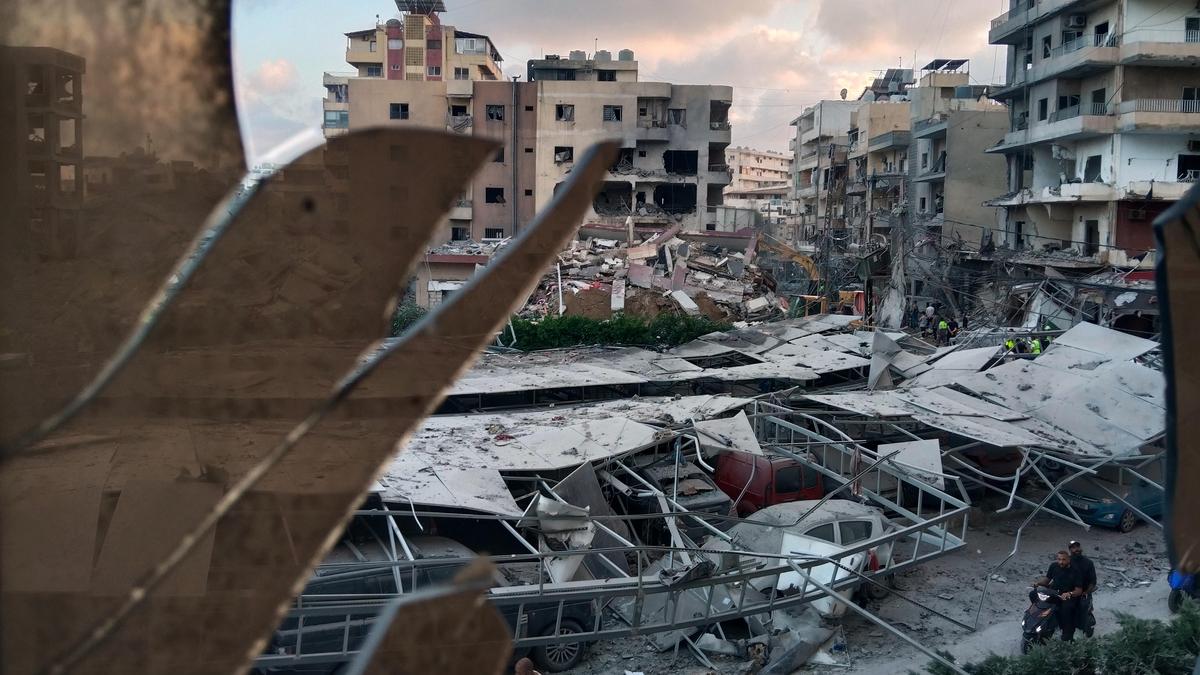
The dust in Beirut does not settle; it just waits. For months, it has hung suspended in the humid Mediterranean air, kicked up by supersonic booms and the violent collapse of concrete. People in the southern suburbs had learned to read the sky the way farmers read the weather, looking for the telltale signature of an impending strike. They lived in the spaces between the sirens.
Then, a piece of paper changed the weight of the air.
When the U.S. Embassy in Lebanon confirmed that Hezbollah had accepted a American-mediated proposal for a "mutual cessation of attacks," the announcement did not arrive with a fanfare. It arrived on screens, filtered through WhatsApp groups and breaking news tickers, a sudden, jarring halt to a rhythm of destruction that had come to feel permanent. To the outside world, it was a diplomatic breakthrough, a chess move in a brutal regional conflict. But on the ground, it was something entirely different. It was the collective, ragged exhale of millions of people who had forgotten how to breathe.
To understand what this cessation means, you have to step away from the maps with their red-shaded zones of control and look at a single balcony in Tyre.
Rima, a schoolteacher who spent the last three months sleeping on a thin mattress in a crowded classroom-turned-shelter, represents the human ledger of this war. She is not a combatant. She is someone who knows the exact acoustic difference between an outgoing rocket and an incoming drone. When the news broke, she did not celebrate. She sat on the steps of the school and looked at her hands.
For people like Rima, the U.S. proposal is not an abstract triumph of international law. It is the possibility of going home to see if her grandmother’s olivewood dresser is still standing, or if it has been reduced to splinters and ash.
The mechanics of the agreement are complex, hammered out through grueling backchannel diplomacy involving Washington, Beirut, and Jerusalem. The core of the deal hinges on a mutual halt—a fragile, synchronized pause where both sides agree to pull back from the brink. Hezbollah’s acceptance marks a significant shift, a concession to the reality of a country bleeding from every pore. Lebanon was already buckled under an economic collapse that had turned the local currency into scrap paper; the war simply accelerated the ruin.
But diplomacy in the Middle East is never just about what is written on the parchment. It is about the ghosts that sit at the negotiating table.
Every ceasefire proposal carries the weight of history, specifically the memory of 2006, the last time a full-scale war tore through these same valleys and hills. For twenty years, the region lived under the illusion of a status quo, a tense, heavily armed peace that everyone knew would eventually snap. When it did, the escalation was relentless.
Consider the mathematics of the modern battlefield. We are no longer in an era of simple cross-border skirmishes. The intensity of the recent strikes meant that a single afternoon could witness the displacement of tens of thousands of families. Roads leading north toward Beirut became choked rivers of cars, mattresses lashed to roofs, children staring blankly out of rear windows. The U.S. proposal had to address not just the military hardware, but this mass human displacement. A cessation of attacks is meaningless if the people cannot return to the land.
The skepticism on the streets of Beirut is thick enough to choke on. Trust is a luxury that vanished long ago. When you speak to shopkeepers in the capital, men who have boarded up their windows three times in a single year, they do not talk about peace. They talk about the "breathing room." They know that a mutual cessation is not a permanent treaty; it is a fragile glass bridge built over a canyon of grievances. One misfire, one rogue commander, one miscalculated drone trajectory, and the glass shatters.
The true test of the American proposal lies in the implementation, the invisible scaffolding that must now be erected to keep the peace from collapsing. It requires monitoring, verification, and a willingness from both adversaries to accept a partial victory rather than a total destruction. It requires Hezbollah to pull back its fighters and Israel to halt its sorties, a synchronized dance where neither side wants to be the first to lower their guard.
The silence that has followed the announcement is deafening. It is not the peaceful silence of a countryside at rest, but the tense, watchful silence of a theater before the curtain rises.
In the camps and shelters across Lebanon, families are already packing their few belongings into plastic garbage bags. They are not waiting for the final signatures or the bureaucratic green lights. The instinct to return home, to touch the soil, to look for survivors among the rubble, is an primal force that no diplomatic timeline can contain. They will walk back into the south, into the towns that have been hollowed out by fire, because the alternative—remaining a refugee in your own country—is a slow death of the spirit.
The coming days will reveal whether this document is a genuine turning point or merely a footnote in a longer, bloodier chronicle. For now, the drones have stopped their relentless hum over the rooftops of Beirut. The sky is just the sky again, blue and empty, offering neither threats nor promises, leaving a wounded city to reckon with what remains.