Every time inflation spikes, the same zombie consensus crawls out of the economics department. Central bankers dust off Milton Friedman, quote his line about inflation being "always and everywhere a monetary phenomenon," and pretend the entire problem is a math equation waiting for a sufficiently aggressive interest rate hike.
They got the diagnosis half right and the cure almost entirely backward.
When people revisit "Money, Expectations and Institutions," they usually turn Friedman into a cardboard cutout—either an infallible prophet of hard money or a heartless monetarist villain. Both readings miss the actual structural flaw in how modern institutions apply his work. Friedman proved that expectations matter and that reckless money creation eventually destroys purchasing power. What he never solved—and what central banks still refuse to admit—is that you cannot anchor expectations inside institutions built to survive on cheap credit and political bailouts.
If you run a business, manage capital, or try to price risk over a five-year horizon, treating Friedman’s 1970s framework as an operating manual will get you crushed. The rules of money transmission broke decades ago. The institutions changed. The incentives mutated. Yet policy desks and financial commentators still talk about the money supply and inflation expectations as if we were living in 1974 with rotary phones and fixed reserve requirements.
The Lazy Consensus Around Monetary Rules
Open almost any retrospective on Friedman’s monetary theory and you will find the exact same comforting fairy tale. It goes like this: before Friedman, Keynesians thought they could trade a little extra inflation for permanently lower unemployment. Friedman and Edmund Phelps shattered that illusion with the natural rate of unemployment and adaptive expectations. Workers aren't stupid; once they realize rising wages are being eaten alive by rising prices, they demand higher pay upfront, pushing unemployment right back up while leaving inflation permanently higher.
So far, so good. That part of the history is accurate, and it remains one of the sharpest insights in twentieth-century economics.
Here is where the lazy consensus goes off the rails. Commentators routinely jump from Friedman’s critique of the Phillips Curve straight to the conclusion that central banks simply need a clear rule, an inflation target, and "credible commitment" to keep expectations anchored.
That sounds clean in a lecture hall. In actual markets, it is pure fiction.
I have watched corporate treasury teams and institutional fixed-income desks lose hundreds of millions of dollars over the past fifteen years because they took central bank forward guidance at face value. They believed the institutional credibility myth. They assumed that because the Federal Reserve had an explicit 2 percent target and a copy of Friedman’s A Monetary History of the United States on the shelf, monetary policy was operating on predictable, rule-bound tracks.
It wasn't. Because rules without hard institutional constraints are just suggestions.
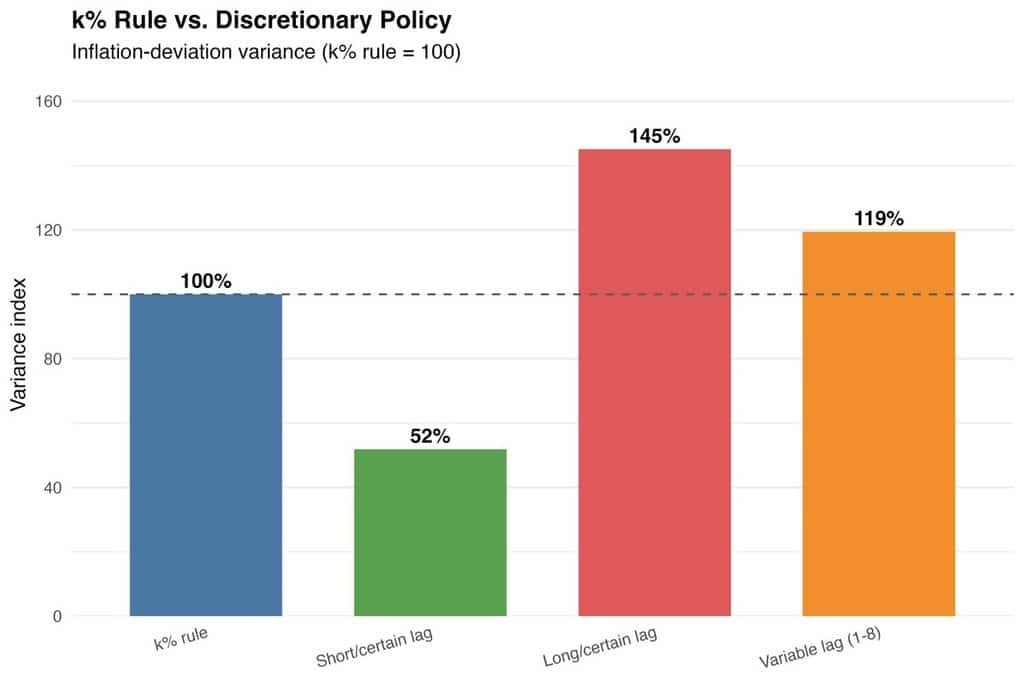
Friedman himself famously advocated for a constant money-growth rule—the k-percent rule—precisely because he distrusted central bankers to exercise discretion without caving to political pressure. Yet modern central banking kept the rhetoric of Friedman’s expectations theory while throwing his distrust of institutions straight into the shredder. Instead of binding policymakers to simple rules, we built massive, hyper-discretionary bureaucracies armed with trillions in balance-sheet firepower, paying interest on bank reserves, and intervening in corporate credit markets whenever volatility threatens asset prices.
Why "Money" Doesn't Mean What Friedman Measured
If you want to understand why mechanical monetarism fails in practice, look at what happened to the definition of money itself.
Friedman’s empirical case rested heavily on stable relationships between monetary aggregates—like M1 and M2—and nominal income. Change the growth rate of the money stock, wait for the "long and variable lags" of twelve to twenty-four months, and prices follow.
Try running a macro fund on M2 velocity today and see how long you keep your investors.
Financial innovation didn't just bend Friedman's money-demand function; it shattered it. Look at the plumbing of modern global finance:
- Eurodollars and offshore credit: Trillions of dollar-denominated liabilities are created outside the United States by foreign banks that never touch Federal Reserve reserve requirements.
- The repo market and shadow banking: Institutional cash pools treat Treasury bills, money market shares, and repurchase agreements as functional equivalents to checking deposits.
- Interest on Reserve Balances (IORB): Since 2008, the Fed severed the traditional link between bank reserves and commercial lending by paying banks directly to park cash at the central bank.
When central banks expanded base money aggressively after 2008, orthodox monetarists screamed that hyperinflation was six quarters away. It never arrived in consumer prices—not because Friedman was wrong about supply and demand, but because newly created reserves stayed trapped inside the financial plumbing, inflating asset multiples while commercial bank credit creation remained sluggish.
Then came 2020 and 2021. The exact same central banks expanded the balance sheet again, but this time fiscal authorities dropped trillions of dollars directly into household checking accounts via deficit spending monetized by the central bank. M2 exploded, velocity stopped falling, and consumer prices surged at the fastest pace in four decades.
The mechanism wasn't pure monetarism. It was fiscal dominance wearing a monetary mask.
The Expectations Trap Nobody Talks About
Modern central banks obsess over "inflation expectations" because of Friedman and the rational expectations revolution led by Robert Lucas. The theory holds that as long as households and businesses believe inflation will return to 2 percent, temporary price shocks won't spiral out of control.
Read that again and ask yourself a basic question: How do you measure an expectation that isn't backed by money?
Central banks rely on three flawed proxies:
- Consumer surveys (which mostly reflect what people paid for gas and eggs last Tuesday).
- Professional forecaster surveys (which mostly echo the central bank's own projections back to it).
- TIPS breakeven spreads (which are heavily distorted by liquidity premiums and central bank bond buying).
None of these measure true institutional expectations. True expectations show up in capital allocation, debt maturity structures, and union contract durations.
When corporate CFOs lock in ten-year fixed debt at rock-bottom yields, they aren't signaling confidence in price stability—they are hedging against the exact moment the central bank loses control. When sovereign governments pile up debt-to-GDP ratios above 120 percent while running primary deficits during peacetime expansions, bond markets don't need a survey to tell them how the story ends.
Imagine a scenario where a central bank publicly pledges to hold interest rates at 5 percent until inflation hits 2 percent, even if unemployment rises sharply. Now imagine the national treasury must roll over $9 trillion in maturing debt over the next twelve months while interest expenses surpass defense spending. What do market participants actually expect? They don't listen to the press conference. They look at the arithmetic. As Thomas Sargent and Neil Wallace demonstrated in their 1981 paper "Some Unpleasant Monetarist Arithmetic," when fiscal policy is permanently unsustainable, the central bank eventually loses its independence and must monetize the debt.
Friedman warned against discretionary fine-tuning, yet modern institutions turned "managing expectations" into the ultimate discretionary magic trick. They convinced themselves that jawboning markets through carefully worded FOMC statements could substitute for actual structural discipline. It works—right up until reality collides with the narrative.
Institutions Shape Incentives Not Speeches
The biggest blind spot in mainstream discussions of Friedman is treating institutions as neutral transmission belts for monetary policy.
They aren't. Institutions are collections of human beings responding to asymmetric career incentives.
Put yourself in the chair of a central bank governor. If you tighten policy too aggressively and trigger a recession, you get hauled before congressional committees, blamed for every lost job, and pilloried in the press within ninety days. If you keep policy too loose, asset prices boom, tax receipts look healthy, politicians praise your steady hand, and the inflationary bill doesn't arrive for two years—often after your term ends.
That asymmetry is baked into the institution itself.
Friedman understood public choice theory. He knew regulators and central bankers aren't philosopher-kings floating above politics. Yet the institutional reforms inspired by his era—central bank independence, inflation targeting, transparent committee votes—created a different pathology. Instead of eliminating political pressure, central bank independence created a moral hazard engine.
Because markets believe the central bank will always step in as the dealer of last resort to prevent systemic financial collapse, large financial institutions take on systemic leverage. Politicians pass unfunded spending bills because they know the central bank will keep sovereign bond yields from spiraling out of control during a crisis.
You cannot separate money from the institutions that issue and regulate it. When institutional survival depends on preventing debt deflation at all costs, the long-run bias of the system is permanently inflationary—punctuated by violent liquidity crunches whenever leverage outruns collateral.
What People Get Wrong About Friedman and Gold or Rules
Whenever this flaw gets exposed, two predictable questions pop up in financial circles: Should we return to a strict monetary rule? or Would a commodity standard like gold fix the institutional problem?
Both questions miss the real constraint.
Why a Strict Monetary Rule Fails Today
A mechanical rule—whether Friedman’s k-percent money growth rule or John Taylor’s interest-rate rule—requires two things that no longer exist: a stable definition of money and a political consensus willing to endure severe recessions without blinking. The moment a rigid rule demands 8 percent interest rates during an election year or amid a regional banking crisis, the rule gets suspended. A rule that gets waived during emergencies isn't a rule; it's peacetime decoration.
Why a Hard Commodity Standard Doesn't Solve Politics
Hard-money purists love to point out that gold prevents central banks from printing money at will. True—until a major war, depression, or banking panic hits. History is unambiguous on this point: governments abandon convertibility the second gold constraints threaten political survival. In 1933, Franklin D. Roosevelt didn't let the gold standard stop domestic monetary expansion; he confiscated private monetary gold and devalued the dollar. In 1971, Richard Nixon closed the gold window because foreign central banks were draining U.S. reserves to pay for American deficits.
Institutions don't obey paper rules or shiny metals when their own survival is on the line. They rewrite the rules.
The Uncomfortable Downside of Rejecting the Consensus
Before you build an investment strategy or business model entirely around permanent institutional debasement, you need to respect the trap on the other side.
Contrarians who bet purely on runaway inflation get wiped out just as often as consensus thinkers who blindly trust central bank targets. Why? Because modern credit systems are structurally deflationary until policy intervenes.
Global aging demographics, high debt loads, and technological productivity constantly push prices down and drag organic growth lower. When credit contracts—as it did in 2008 or March 2020—the immediate result isn't Weimar hyperinflation. It is a violent scramble for cash, collapsing collateral values, and sudden deflationary shockwaves.
If you position your balance sheet exclusively for inflation without surviving the deflationary liquidity squeezes that trigger policy bailouts, you go bust before the money printer even warms up. That is the tightrope every serious operator has to walk.
How to Operate When Institutions Can't Anchor Expectations
Stop building your strategy around what central bankers say their target is. Start building it around how institutions actually behave under stress.
- Track fiscal deficits alongside central bank balance sheets. Monetary policy no longer operates in a vacuum. When sovereign deficits exceed 5 or 6 percent of GDP during non-recessionary periods, monetary tightening hits a brick wall because higher rates directly swell government interest payouts—injecting more cash back into the private sector via bond coupons.
- Watch credit spreads, not press conferences. Forward guidance is cheap talk. High-yield corporate spreads, commercial paper rates, and Treasury market liquidity tell you the exact moment institutional pain forces a policy pivot. Central banks don't pivot when inflation hits their target; they pivot when Treasury market plumbing starts to seize.
- Price duration risk ruthlessly. In a world where institutions use periodic inflation bursts to erode unsustainable public and private debt burdens, long-duration nominal fixed income is a structural loser over full cycles unless yields carry a genuine real-rate premium.
- Build liquidity buffers for deflationary air pockets. Because discretionary institutions wait until something breaks before intervening, every cycle features a sharp liquidity vacuum before the rescue package arrives. Cash and short-term sovereign bills aren't dead weight—they are dry powder for forced liquidations.
Friedman’s great triumph was proving that inflation isn't an act of God; it is an institutional choice. His great tragedy is that modern central banks adopted his vocabulary while perfecting the exact discretionary interventions he spent fifty years warning against. Stop waiting for the rules to save the system. Price the incentives of the people holding the levers.


