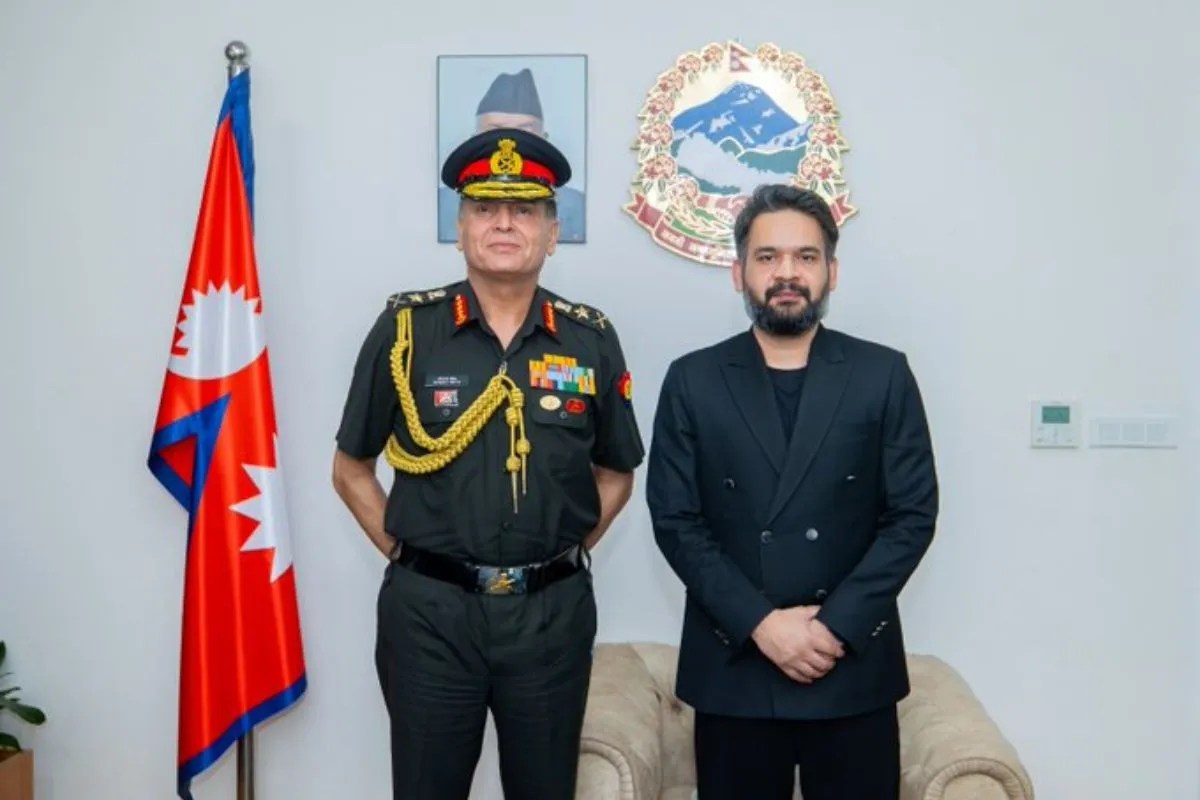
The recent engagement between Indian Army Chief General Dhiraj Seth and Nepali Prime Minister Balen Shah in Kathmandu serves as a calibrated exercise in strategic signaling. While public discourse often interprets such interactions through the lens of protocol or symbolism, the meeting represents a functional attempt to decouple professional defense cooperation from volatile political friction. By bypassing established bureaucratic insulation—specifically the Prime Minister’s self-imposed restriction on direct, one-on-one meetings with foreign envoys—the engagement suggests that the current security environment necessitates direct executive intervention.
The Mechanics of Institutional Continuity
At the core of this interaction lies a century-old mechanism: the exchange of honorary General ranks between the two nations. Since 1950, this practice has functioned as a fail-safe against the variability of democratic politics. When political leaders shift, the military-to-military relationship serves as a structural constant.
The logic of this arrangement is twofold:
- Interoperability Benchmarking: By aligning organizational structures, doctrine, and training regimes, the two armies maintain a degree of institutional muscle memory that persists even during periods of diplomatic turbulence.
- Professional Camaraderie as Risk Mitigation: The recruitment of Nepal-domiciled Gorkha soldiers into the Indian Army acts as a human bridge. This creates a shared stakeholder group that is insulated from the immediate pressures of border disputes or parliamentary grandstanding.
Defining the Current Friction Point
The political climate in Nepal is currently defined by the opposition's pressure regarding statements on territorial claims—specifically involving the Lipulekh, Limpiyadhura, and Kalapani regions. These claims introduce a high-variability variable into the bilateral equation.
The Prime Minister’s decision to meet General Seth signifies a tactical shift. By engaging directly, the Nepali leadership acknowledges that defense cooperation and territorial diplomacy are currently bifurcated streams. The Prime Minister functions as both head of state and Minister of Defense, meaning this meeting serves as both a symbolic gesture of continuity and an operational clearance for ongoing military modernization efforts.
The Cost Function of Third-Party Involvement
A recurring theme in recent rhetoric has been the potential for internationalization of the border issue. Kathmandu has alluded to communications with external actors, including China and the United Kingdom, regarding its territorial outlook.
From an analytical standpoint, India’s response to this is binary:
- The Principle of Bilateralism: India maintains that border discrepancies are inherently bilateral. External involvement is viewed as a systemic destabilizer that inflates the complexity of the negotiations without providing a corresponding increase in resolution probability.
- Security Signaling: The presence of the Indian Army Chief in Kathmandu, supported by the Indian Ambassador, effectively demonstrates that military cooperation is robust and unaffected by the posturing occurring in the legislature. It serves to remind all stakeholders that the professional relationship between the security apparatuses remains the most significant lever of influence.
Strategic Implications for Regional Stability
The visit is not merely about maintenance; it is an exercise in resource and influence management.
- Doctrine Alignment: Modernization efforts supported by the Indian Army provide Nepal with a specific operational toolkit. This binds the two forces through logistics, training, and equipment supply chains, creating high barriers to exit for either party.
- Predictability: By reaffirming these ties, both nations lower the probability of miscalculation during periods of political noise. A military that understands the operational framework of its neighbor is less likely to interpret routine exercises or troop movements as provocations.
The Next Strategic Play
The utility of this engagement will be measured by the subsequent behavior of the Nepali executive in the lower house. If the Prime Minister utilizes this recent dialogue as a basis for cooling domestic political temperature regarding territorial claims, it demonstrates that military diplomacy has successfully bought space for diplomatic compromise.
Conversely, should the political rhetoric intensify despite this interaction, the military-to-military link will transition from a bridge to a container—a structure designed to hold the relationship together while preventing the collapse of the broader bilateral arrangement. The priority for Indian strategists remains clear: maintain the professional institutional bond as the primary anchor, effectively rendering political fluctuations secondary to the long-term security architecture of the region. The focus now shifts to the operationalization of joint exercises and the management of recruitment pipelines, which remain the definitive indicators of structural health in this bilateral relationship.