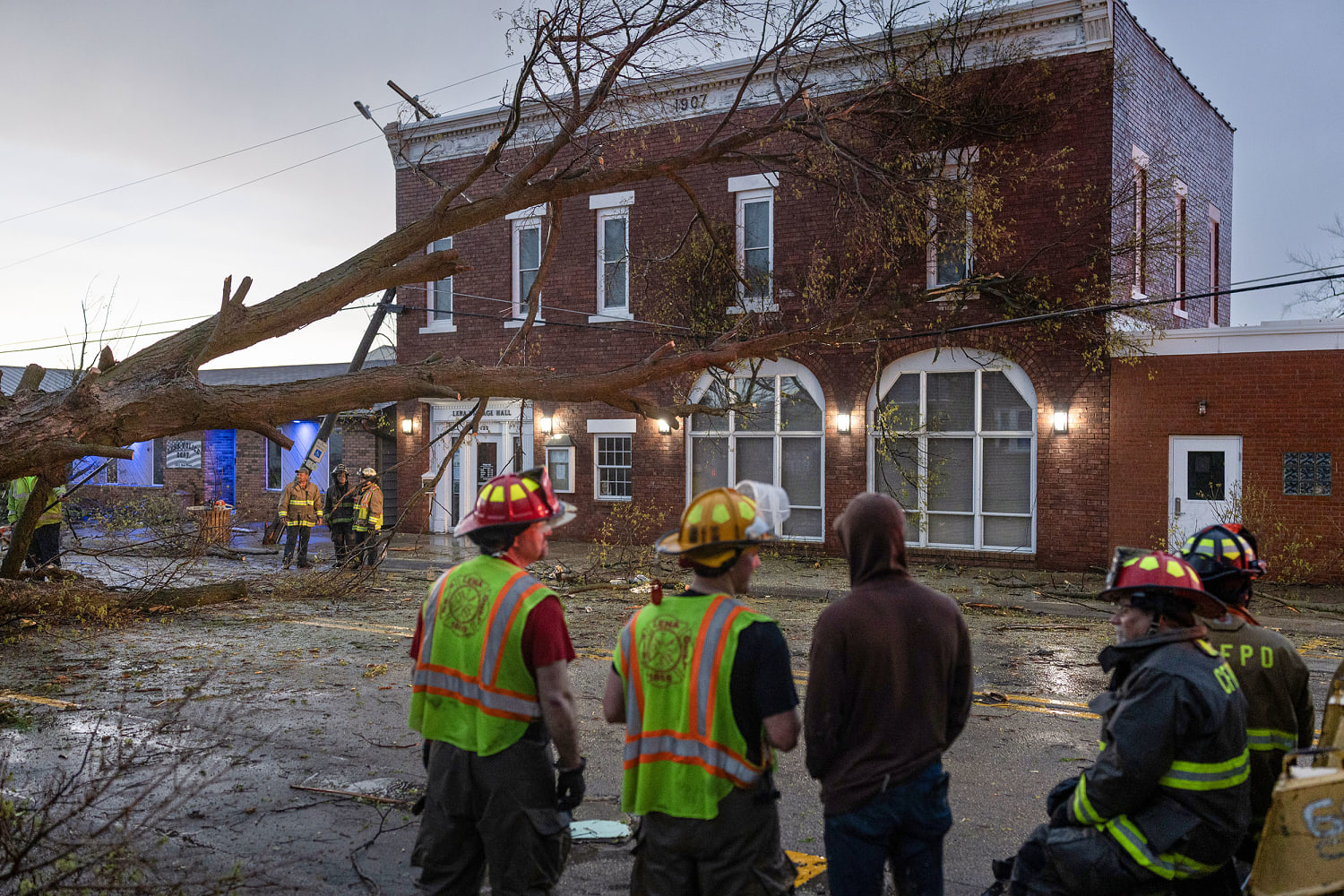
The recent swarm of tornadoes across the Midwest followed a familiar, terrifying pattern. Local sirens wailed, skies turned a bruised purple, and within minutes, neighborhoods were reduced to splinters and twisted metal. Early reports suggest that despite the massive property damage, the death toll remains remarkably low—a testament to improved early warning systems. However, looking at the debris fields in states like Iowa, Nebraska, and Kansas through the lens of simple luck or "weathering the storm" misses a much larger, more dangerous story.
The survival of these communities wasn't just a win for meteorology. It was a reprieve. As these extreme weather events become more frequent and more intense, the gap between our high-tech forecasting and our crumbling physical reality is widening. We are getting better at telling people a storm is coming, but we are doing almost nothing to ensure the world they inhabit can actually stand up to it.
The Illusion of Safety in the Warning Gap
For decades, the gold standard of success in severe weather management was lead time. How many minutes of warning can we give a family before a twister hits their front door? Thanks to dual-polarization radar and sophisticated modeling, that number has climbed significantly. People generally have enough time to get to a basement or a reinforced shelter. This is why we see headlines celebrating "no deaths" even when entire towns are leveled.
But we have hit a plateau.
Giving a person twenty minutes of warning doesn't help if they live in a mobile home park with no community shelter. It doesn't help if the local power grid is so fragile that the first gust of wind knocks out the very communications infrastructure meant to transmit the warnings. We have focused so heavily on the software of disaster management—the apps, the sirens, the radar—that we have completely ignored the hardware. The physical structures where we live and work are increasingly mismatched against the atmospheric reality of the 21st century.
The Engineering Failure of Modern Suburbs
Walk through a subdivision hit by an EF-3 tornado and you will see a recurring theme in the wreckage. You’ll see "stick-built" homes where the roof was simply nailed to the walls, rather than secured with metal hurricane ties or bolts. You will see oriented strand board (OSB) that peeled away like wet cardboard. These houses are built to the minimum legal standard, which is often decades behind what we know about wind loads and structural integrity.
Builders prioritize speed and cost over resilience. In many Midwestern jurisdictions, building codes are a patchwork of outdated regulations or, in some rural areas, virtually non-existent. When a storm rips through, it isn't just an act of God; it is a structural audit that most of our housing stock fails.
The industry knows how to build better. We have the technology to create "hardened" structures using insulated concrete forms (ICF) or reinforced masonry that can survive significant wind events with minimal damage. Yet, these methods are rarely used in residential construction because they add 5% to 10% to the initial cost. We are effectively betting the lives and livelihoods of entire zip codes on the hope that the next "big one" misses the target.
The Grid is the Single Point of Failure
Beyond the immediate destruction of homes lies a systemic threat that stays dark long after the clouds clear. Our electrical grid is an aging, overhead mess that acts as a giant sail for high winds. When tornadoes or straight-line winds (derechos) hit, the power goes out. This isn't just an inconvenience. It is a secondary disaster.
Modern life requires electricity for everything from pumping water to maintaining cell towers. During the most recent Midwest outbreaks, thousands of people were left without communication or climate control for days. As we push toward the electrification of everything, from our cars to our heating systems, this vulnerability becomes an existential threat.
Moving power lines underground is expensive. Utilities often claim the cost is prohibitive, frequently quoted at nearly $1 million per mile. But they rarely talk about the "avoided cost" of not having to rebuild the entire overhead system every time a supercell forms. We are paying for a resilient grid in increments of disaster relief and insurance premiums, but we aren't actually getting the resilience.
The Insurance Industry is the Only Entity Keeping Score
If you want to know the true state of weather risk in the Midwest, don't look at government data. Look at the actuarial tables of the major insurance carriers. They are the only ones being honest about the "why" behind the damage.
For years, the industry treated tornadoes as "perils" that could be averaged out. That is no longer the case. The sheer volume of "small" events—hailstorms, 80-mph straight-line winds, and localized tornadoes—is bleeding the industry dry. In response, premiums are skyrocketing, and in some high-risk corridors, insurers are simply pulling out.
This creates a "risk desert." When people can no longer afford insurance, or when the deductible for wind damage is higher than their life savings, the economic recovery of a town after a storm becomes impossible. The "no deaths" headline hides a slower, more painful demise: the death of the local economy. A town that can't be insured is a town that can't be rebuilt.
Rethinking the Heartland Geography
There is a growing body of evidence suggesting that "Tornado Alley" is shifting or expanding. While the Great Plains remain a hotspot, we are seeing a significant increase in tornadic activity in the Southeast and the mid-Mississippi Valley. These areas are often more densely populated and have more tree cover, making storms harder to spot and more lethal when they hit.
The Midwest is now dealing with a "double whammy" of traditional spring tornadoes and late-season events fueled by unseasonably warm air from the Gulf of Mexico. Our infrastructure was built for a climate that no longer exists. Our bridges, our power stations, and our schools were designed for a 50-year storm cycle that has compressed into a 5-year cycle.
We treat these outbreaks as anomalies. We call them "historic" or "unprecedented." But when a "100-year event" happens every third Tuesday, the terminology is useless. We have to stop reacting and start retrofitting.
The High Cost of the Status Quo
The federal government spends billions every year on disaster recovery through FEMA. Most of that money goes toward putting things back exactly the way they were before the storm. It is a cycle of insanity. We are subsidizing the rebuilding of fragile structures in high-risk zones, essentially setting money on fire and waiting for the next spark.
True investigative inquiry reveals that the "heavy damage but no deaths" narrative is a dangerous sedative. It makes us feel like the system is working. It isn't. The system is just barely holding on. Every time a major storm misses a high-density area or a hospital, we claim a victory for "preparedness." In reality, we are just winning a game of Russian Roulette.
We need a massive, coordinated pivot toward physical hardening. This means federally mandated building codes for wind resistance. It means aggressive investment in microgrids and undergrounding of critical power lines. It means acknowledging that a "successful" storm response isn't just one where everyone survives the night, but one where the community is back at work the next morning because the lights stayed on and the roofs stayed attached.
Stop looking at the radar and start looking at the foundation of your house. The wind is only going to get faster.