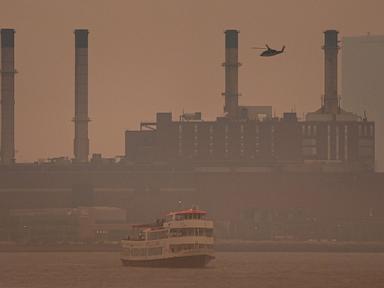
Large-scale wildfire smoke transport is not an environmental anomaly; it is a structural failure of geographical containment. When wildland fires breach critical thresholds, they transition from localized ecological events into transboundary atmospheric crises. The resulting smoke plumes, laden with fine particulate matter, travel thousands of miles across state and national borders, rendering localized air quality management policies ineffective. Understanding this phenomenon requires moving past sensationalized weather reports and dissecting the precise physical, physiological, and economic mechanisms that govern transboundary smoke crises.
The Physics of Dispersion and Transport Mechanics
The distribution of wildfire smoke across vast distances is dictated by three primary atmospheric variables: injection height, synoptic-scale wind patterns, and the dynamics of the planetary boundary layer.
1. Plume Rise and Injection Height
The thermal buoyancy generated by intense wildfires creates powerful updrafts. If a fire burns with sufficient intensity, it produces pyrocumulonimbus clouds, which inject smoke directly into the upper troposphere or lower stratosphere.
- Tropospheric Injection: At these higher altitudes, smoke escaping the friction of the Earth's surface encounters high-velocity jet streams. This allows particulates to travel thousands of kilometers before settling.
- Boundary Layer Trapping: Conversely, when smoke remains within the planetary boundary layer—the lowest part of the atmosphere—it becomes subject to diurnal temperature inversions. During an inversion, warm air caps cooler air near the surface, trapping high concentrations of particulates close to the ground and preventing vertical mixing.
2. Meteorological Transport Corridors
Once particulates are airborne, their trajectory is determined by pressure gradients and frontal systems. High-pressure systems can stall over regions, creating subsidence—sinking air that compresses and concentrates smoke near the surface. Low-pressure systems, conversely, act as transport engines, pulling smoke along frontal boundaries and depositing it far from the source of ignition.
3. Dry and Wet Deposition Dynamics
The residence time of particulate matter in the atmosphere is governed by its size. Coarse particles ($PM_{10}$) settle rapidly due to gravitational settling (dry deposition). Fine particulate matter ($PM_{2.5}$), however, remains suspended for days or weeks. Its removal relies heavily on wet deposition, where precipitation scavenges particles from the air column. In the absence of rain, $PM_{2.5}$ accumulates continuously, compounding exposure risks over time.
The Physiological Cost Function of PM2.5 Inhalation
The primary threat to human health from wildfire smoke is $PM_{2.5}$—particulate matter with an aerodynamic diameter of less than 2.5 micrometers. Because of their microscopic size, these particles bypass the natural filtration systems of the upper respiratory tract.
[Inhalation of PM2.5]
       │
       ▼
[Deep Alveolar Penetration]
       │
       ▼
[Systemic Inflammatory Response] ──► [Vascular Constriction & Oxidative Stress]
       │                                             │
       ▼                                             ▼
[Acute Respiratory Exacerbation]             [Myocardial Infarction / Stroke]
Pulmonary Penetration and Systemic Translocation
When inhaled, $PM_{2.5}$ travels deep into the lungs, reaching the alveoli where gas exchange occurs. The physical presence of these particles triggers a localized immune response, recruiting macrophages and releasing pro-inflammatory cytokines. Because some particles are small enough to cross the alveolar-capillary membrane directly, they enter the bloodstream. This translocation initiates a cascade of systemic cardiovascular effects:
- Endothelial Dysfunction: Particulates cause immediate oxidative stress, damaging the inner lining of blood vessels and reducing their ability to dilate.
- Autonomic Nervous System Imbalance: Inhaled irritants stimulate sensory receptors in the lungs, altering autonomic tone, increasing heart rate variability, and elevating blood pressure.
- Pro-coagulant State: Systemic inflammation increases blood viscosity and promotes plaque instability, directly elevating the acute risk of myocardial infarction and ischemic stroke.
Chemical Composition Discrepancies
Wildfire smoke is chemically distinct from urban, industrial air pollution. It contains a complex mixture of organic carbon, elemental carbon, aldehydes (including formaldehyde and acrolein), polycyclic aromatic hydrocarbons (PAHs), and trace minerals. When wildfires burn through wildland-urban interfaces, they consume synthetic materials, adding highly toxic chemical compounds to the plume. This makes wildfire-derived $PM_{2.5}$ significantly more inflammatory than equivalent masses of ambient urban dust.
The Economic Bottlenecks of Regional Air Quality Management
Local and state governments struggle to manage transboundary smoke events because their regulatory tools were designed for stationary, localized industrial sources. This mismatch exposes several systemic bottlenecks.
The Lagging Nature of the Air Quality Index
The Air Quality Index (AQI) is the primary metric used to communicate risk to the public. However, the standard calculation of AQI relies on a 24-hour rolling average of $PM_{2.5}$ concentrations. During a rapid smoke intrusion, real-time concentrations can spike to hazardous levels hours before the official AQI reflects the danger. This lag creates a false sense of security, delaying critical interventions such as school closures or outdoor work suspensions.
Infrastructure Deficits in Indoor Air Filtration
The assumption that staying indoors protects populations from wildfire smoke is only true if the indoor environment is structurally sealed and equipped with mechanical filtration.
- Infiltration Rates: Older residential and commercial buildings rely on passive ventilation. Without active pressurization, outdoor particulates infiltrate indoor spaces through micro-gaps in windows, doors, and building envelopes within hours.
- Filtration Limitations: Standard residential HVAC systems typically utilize low-efficiency filters designed to protect mechanical equipment from large dust particles, rather than high-efficiency filters capable of capturing sub-micron particles. Upgrading to higher-grade filters often restricts airflow, risking system failure if the HVAC unit is not designed for the higher static pressure.
Labor Productivity and Supply Chain Friction
The macroeconomic impact of prolonged smoke alerts extends far beyond healthcare costs.
- Outdoor Labor Force Attrition: Industries relying on outdoor labor—construction, agriculture, logistics, and utilities—experience immediate productivity drops as workers must take frequent rests or stop operations entirely to prevent acute respiratory distress.
- Supply Chain Slowdowns: Reduced visibility at airports and on major highway corridors forces transport delays. Marine ports face similar operational slowdowns when heavy smoke limits tugboat and crane operations.
An Operational Framework for Institutional Mitigation
To mitigate the systemic risks posed by chronic transboundary wildfire smoke, institutions must shift from reactive emergency responses to proactive operational frameworks.
Step 1: Deploying Real-Time, Localized Sensor Networks
Relying on sparse federal monitoring stations is insufficient for granular decision-making. Institutions should install dense arrays of low-cost optical particle counters across their facilities. These sensors provide real-time, localized data, allowing facility managers to detect smoke infiltration instantly and adjust building pressure systems before indoor air quality deteriorates.
Step 2: Implementing Dynamic HVAC Pressurization
To prevent outdoor smoke from migrating indoors, commercial facilities must transition to a positive-pressure configuration. By bringing in a controlled volume of outdoor air through high-efficiency filtration (minimum MERV 13, ideally MERV 16 or HEPA) and limiting exhaust rates, the interior pressure of the building remains slightly higher than the exterior. This positive pressure actively pushes clean air out through building micro-gaps, preventing untreated, smoke-laden air from seeping inside.
Step 3: Formalizing Trigger-Based Action Plans
Enterprises must establish clear, non-negotiable operational thresholds based on 1-hour PM2.5 averages rather than 24-hour AQI forecasts.
PM2.5 Threshold (1-Hour Avg)  ──►  Mandated Operational Response
─────────────────────────────────────────────────────────────────────────────
35.5 µg/m³ (Moderate)         ──►  Activate positive pressure on HVAC units.
                                   Increase indoor air recirculation rates.
─────────────────────────────────────────────────────────────────────────────
55.5 µg/m³ (Unhealthy/SENS)   ──►  Mandate N95 respirators for outdoor staff.
                                   Restrict high-exertion outdoor tasks.
─────────────────────────────────────────────────────────────────────────────
150.5 µg/m³ (Unhealthy)       ──►  Suspend all non-essential outdoor work.
                                   Deploy portable HEPA units to high-occupancy zones.
Step 4: Establishing Redundant Clean Air Refuges
Public health authorities must identify and retrofit municipal buildings with commercial-grade air scrubbers to serve as designated clean air shelters. These facilities must be strategically located in dense urban centers and low-income neighborhoods where residential housing stock lacks the physical integrity or HVAC capabilities to withstand prolonged particulate intrusions.
Strategic Forecast: The Intersection of Air Quality and Grid Reliability
The convergence of prolonged transboundary smoke events with extreme summer heatwaves presents a compounding vulnerability for regional power grids. During severe smoke events, solar radiation reaching the ground can drop by up to 30%, drastically reducing utility-scale and residential solar generation. Simultaneously, high ambient temperatures drive peak electricity demand for air conditioning, while indoor air filtration systems draw additional power. This simultaneous drop in clean energy generation and surge in demand exposes a systemic vulnerability in regional grid reliability.
Utility operators and state planners must factor smoke-induced solar depletion into their reserve margin calculations. Failing to account for this atmospheric feedback loop risks widespread load-shedding and rolling blackouts at the exact moments when populations require mechanical cooling and filtration to survive. Municipalities must prioritize the deployment of battery energy storage systems to buffer the loss of solar capacity during multi-day smoke events, ensuring that critical medical and air filtration infrastructures remain online.