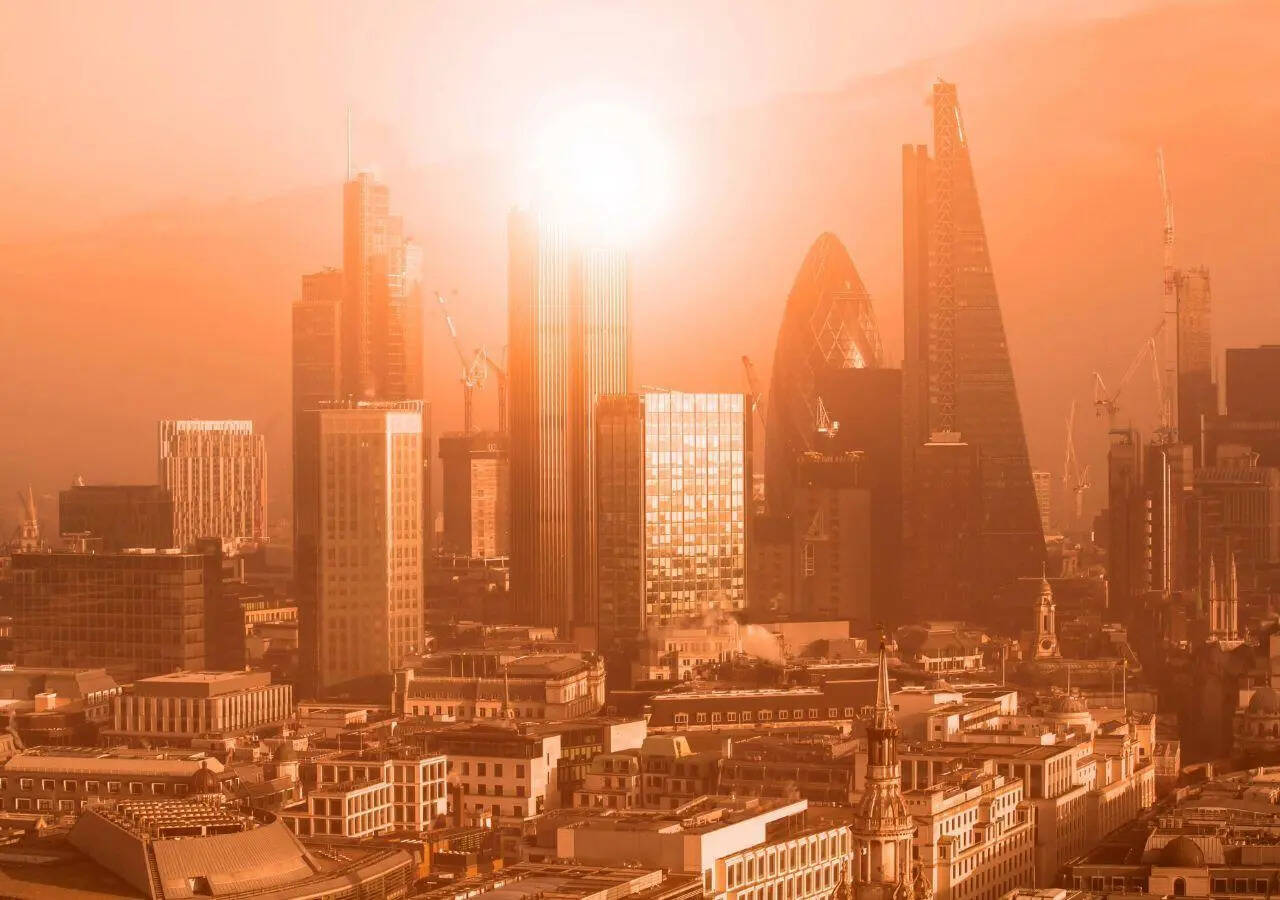
The tarmac on Oxford Street does not melt all at once. It softens gradually, turning from a matte gray stone into a glossy, viscous paste that clings to the rubber soles of thousands of unsuspecting commuters. By noon, the air above the pavement vibrates with a distorted, liquid shimmer.
Britain is not built for this.
We are a nation structurally and culturally engineered for drizzle, for heavy wool coats, and for the collective, comforting grumble about gray skies. Our homes are architectural flasks designed to trap every single stray calorie of warmth. Our transit systems are subterranean brick tunnels built in the Victorian era with zero ventilation. When a historic heatwave strikes, it does not feel like a holiday. It feels like a siege.
Today, the mercury shattered the ceiling for 2026, peaking at a grueling 35°C in London, Kent, and across the wider Southeast. To our Mediterranean neighbors, 35 degrees is a standard July afternoon—a cue for a siesta and a chilled glass of white wine. But in a damp, insulated island nation, that number is a biological and structural tipping point.
Let us look past the sterile meteorological data. Consider instead a hypothetical commuter named Maya, a thirty-something data analyst trapped on a Central Line tube carriage deep beneath the city streets.
Maya is not thinking about climate data or national records. She is thinking about oxygen. The air inside the carriage is thick, static, and tastes faintly of hot copper and old dust. The thermometer on her phone says 35°C outside, but down here, amplified by the friction of iron wheels and the radiating body heat of hundreds of packed passengers, the temperature pushes past 40°C.
Her linen blouse is ruined, plastered to her back. Her heart rate is elevated, her temples throbbing with the slow, dull ache of dehydration. Around her, the usual unwritten rule of British commuting—absolute silence and avoidance of eye contact—breaks down. Strangers exchange desperate, wide-eyed glances. A man offers his plastic bottle of lukewarm water to an elderly woman who looks dangerously pale.
This is the reality of a modern British heatwave. It is a shared, claustrophobic vulnerability.
The Island of Brick and Glass
The problem with a British heatwave is not just the sun; it is the geography of our infrastructure. Urban areas suffer from what scientists call the Urban Heat Island effect. Concrete, asphalt, and dark roofs absorb the sun’s energy all day, storing it like a battery.
While the rural fields of Kent offer a brief respite when the sun goes down, London stays trapped in a thermal prison. The buildings themselves begin to exhale heat long into the night.
Imagine your home turning against you.
The vast majority of British housing stock was built before the concept of climate adaptation existed. Terraced brick homes and high-rise apartments are masterclasses in heat retention. Without air conditioning—which is present in less than five percent of UK residential properties—interior spaces become ovens. By 3:00 PM, upstairs bedrooms reach temperatures that make sleep impossible, setting off a secondary crisis of widespread exhaustion across the workforce.
Out in the garden of England, the stakes shift from domestic misery to economic anxiety. In Kent, the fruit orchards and vineyards that dot the rolling hills face a brutal trial.
A farmer stepping out into his fields at midday does not see a beautiful summer day. He sees his livelihood baking on the vine. Berries soften into mush before they can be picked; water resources dry up under strict utility restrictions; livestock grow lethargic and distressed. The idyllic postcard of the British countryside begins to crack under the dry heat, revealing a fragile agricultural system operating on a knife-edge.
When Infrastructure Falters
We often take for granted the invisible systems that keep society moving until they begin to buckle under physical stress.
Our railways are a prime example. Steel rails are laid down and tensioned to withstand a specific range of average British temperatures. When exposed to hours of direct, blazing sunlight and ambient temperatures of 35°C, the metal expands beyond its physical limits. The tracks warp and bend into dangerous, serpentine curves.
Network Rail is forced to introduce widespread speed restrictions. Trains drop from 100 miles per hour to a cautious crawl, turning a routine forty-minute journey from the Kent coast into London into a multi-hour endurance test.
The delays ripple through the economy. Office workers stay home, leaving commercial districts eerie and quiet. Supply chains stutter. Delivery drivers, navigating the suffocating heat of un-air-conditioned vans, face exhaustion as they try to keep supermarkets stocked with suddenly scarce bags of ice and bottled water.
Then there is the electrical grid. As the afternoon peaks, millions of desk fans, retail cooling units, and industrial chillers hum to life simultaneously. The demand climbs steeply, straining transformers that are already operating in ambient temperatures far higher than their cooling systems were designed to handle. It is a invisible dance of supply and demand, managed by engineers watching glowing screens in air-conditioned control rooms, praying that a vital substation does not blow a fuse and plunge a scorching neighborhood into darkness.
The Human Cost
The true measure of a heatwave is not found in broken records or warped railway tracks. It is found in the quiet corridors of our hospitals.
For the young and the healthy, 35°C is an uncomfortable inconvenience, an excuse to seek out a shady beer garden or a patch of grass in Hyde Park. For the vulnerable, it is a direct threat to survival.
The human body cools itself through a magnificent, desperate process of evaporation. We sweat. Blood vessels near the skin dilate to radiate heat away from our core. But this process requires immense cardiovascular effort. The heart must pump faster and harder to move blood to the periphery.
For an elderly person with a pre-existing heart condition, or a toddler whose internal thermostat is not yet fully developed, this extra workload can be catastrophic.
Emergency rooms across London and the Southeast see a sharp influx of patients suffering from heat exhaustion, severe dehydration, and heatstroke. The air inside older hospital wards, often lacking modern climate control, becomes heavy and oppressive, forcing nurses to deploy portable fans and drape ice-cold towels over patients' foreheads. The medical staff, clad in synthetic scrubs and protective gear, fight their own battles against fatigue as they move from bed to bed.
It is a silent emergency. Unlike a flood or a winter storm, a heatwave does not leave behind dramatic footage of collapsed bridges or uprooted trees. Its destruction is invisible, occurring behind closed curtains and in the quiet desperation of overcrowded waiting rooms.
A Shift in the National Psyche
We are witnessing a fundamental transformation in how we relate to the summer season.
Historically, the arrival of hot weather was a cause for national celebration. Tabloid headlines shouted about "Scorcher!" and "Phew, What a Scorcher!" accompanied by photos of crowded beaches in Brighton and children splashing in public fountains. There was a sense of collective euphoria, a brief escape from the perpetual gray.
That cultural narrative is dying.
Now, when the forecast predicts mid-thirties, the reaction is laced with apprehension. We look at the clear blue sky not with appreciation, but with a creeping sense of unease. The sun, once a rare and welcome friend, increasingly feels like an adversary. We find ourselves tracking the path of shade across our living rooms, calculating how many hours of tolerable temperature we have left before the walls finish absorbing the day's heat.
This requires a massive psychological and structural pivot. We have to learn how to live differently.
We must learn the Mediterranean art of closing shutters and curtains against the morning sun, rather than throwing windows wide open to let the hot air in. We must accept that our cities need more green canopies and pocket parks to break up the endless expanse of heat-retaining concrete. We must invest heavily in retrofitting our homes, not just to keep the cold out during the winter, but to keep the heat out during the summer.
The sun finally begins its slow descent over the Thames, painting the London sky in bruised shades of orange and violet.
But the drop in light brings little relief. Walk down any residential street in South London or a quiet village lane in Kent tonight, and you will hear a distinct, ubiquitous soundtrack: the low, desperate rattle of thousands of cheap plastic fans spinning at maximum speed in open windows, pushing the stubborn, heavy air around rooms that refuse to cool down.
People sit on their front doorsteps, staring out into the twilight, waiting for a breeze that never arrives. The city holds its breath, radiating the day's anger back into the night sky, waiting for tomorrow.