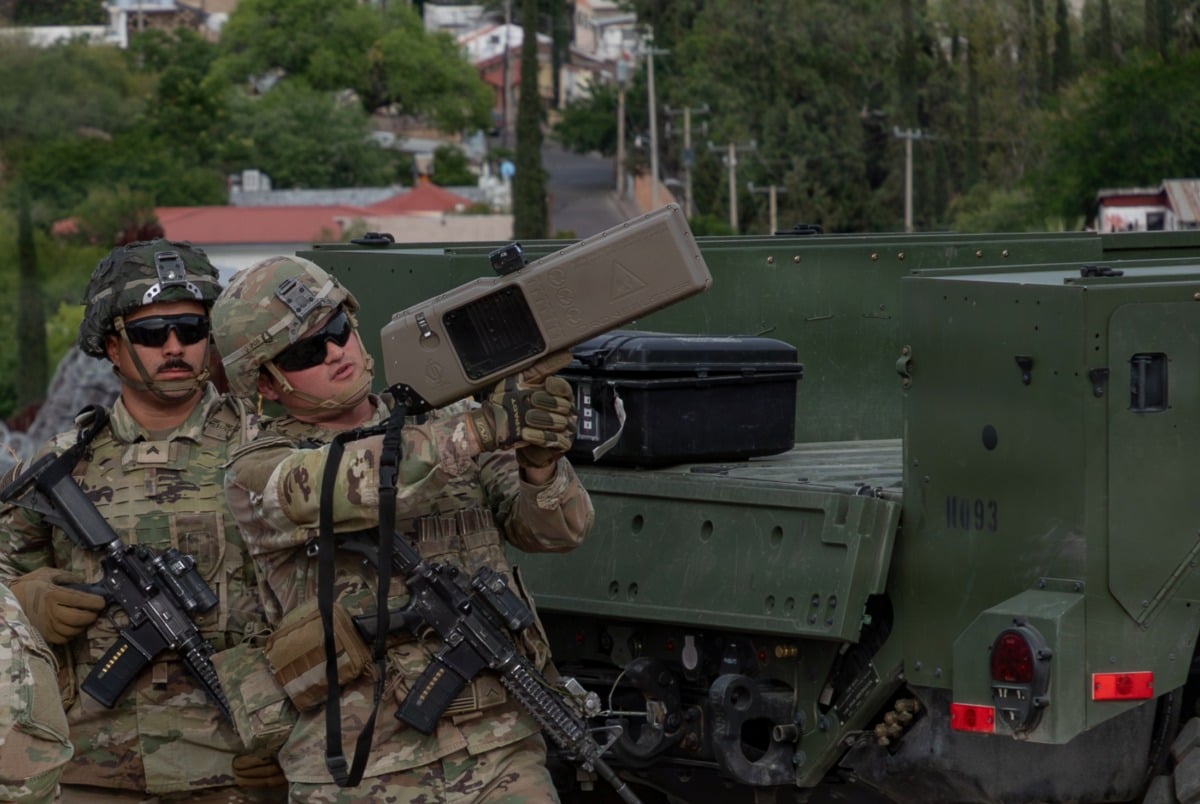
The physical security perimeter of United States strategic nuclear infrastructure is no longer defined by concrete barriers and motion-sensor fencing. The proliferation of low-cost, commercially available unmanned aerial systems (UAS)—commonly referred to as drones—has introduced a low-altitude asymmetric threat vector that bypasses traditional ground-based defense layers. When the U.S. Air Force procures handheld anti-drone systems (interdictor guns) for deployment at nuclear missile bases, such as F.E. Warren, Malmstrom, or Minot Air Force Bases, the acquisition represents a fundamental shift from passive deterrence to active, localized airspace denial.
To evaluate the operational efficacy of these deployments, one must analyze the specific vulnerabilities of Intercontinental Ballistic Missile (ICBM) fields, the technical mechanisms of localized radio frequency (RF) interdiction, and the systemic limitations inherent in manual, human-in-the-loop defense systems.
The Asymmetric Vulnerability Vector of ICBM Fields
Intercontinental ballistic missile fields present a unique security challenge characterized by extreme geographic dispersion. Unlike a concentrated naval base or a single airfield, an active missile wing controls hundreds of isolated underground launch facilities (LFs) and missile alert facilities (MAFs) scattered across thousands of square miles of rural terrain.
Traditional security doctrine relies on rapid-response forces traveling via ground vehicles or helicopters to intercept intruders. This doctrine assumes the adversary operates on the two-dimensional plane of the ground. The introduction of commercial UAS introduces three distinct tactical vulnerabilities that traditional security forces cannot mitigate through standard kinetic means:
- Surveillance and Intelligence Gathering: Low-altitude aerial platforms equipped with high-definition optical and thermal imaging sensors can map security routines, identify patrol vulnerabilities, and monitor maintenance operations at a launch facility without breaching the physical perimeter fence.
- Payload Delivery and Sabotage: Commercial heavy-lift drones can be modified to carry improvised explosive devices (IEDs) or RF-jamming equipment. Dropping a payload onto critical above-ground infrastructure—such as environmental control systems required to maintain missile electronics or communication antennas—can temporarily mission-kill a launch facility without penetrating the underground silo.
- Kinetic Harassment and Distraction: Persistent drone incursions force security teams to trigger alarm protocols, exhausting response forces through repeated deployments to remote sites, thereby creating operational friction and blinding the chain of command to simultaneous ground threats.
The cost asymmetry is stark. An adversary can procure a commercial quadcopter capable of GPS-guided autonomous flight for less than $2,000. Conversely, scrambling a security response team or maintaining a continuous helicopter orbit incurs massive operational costs. Handheld anti-drone guns represent a direct attempt to level this cost function by providing immediate, low-cost tactical denial at the point of contact.
Technical Mechanisms of Directed Energy Interdiction
The anti-drone guns procured for military installation defense do not fire physical projectiles. Instead, they are directional, high-gain antenna arrays integrated into a rifle-style chassis, functioning as localized electronic warfare platforms. The operational objective is the disruption of the target drone's command, control, and navigation links.
To understand how these systems neutralize an aerial threat, the process must be broken down into two primary mechanisms: radio frequency jamming and Global Navigation Satellite System (GNSS) spoofing or blocking.
Radio Frequency Command Link Disruption
Commercial drones typically operate on standardized, unlicensed industrial, scientific, and medical (ISM) radio bands, specifically 2.4 GHz and 5.8 GHz. The anti-drone weapon emits a concentrated electromagnetic signal on these identical frequencies. By utilizing a highly directional conical beam, the operator floods the drone's receiver with electronic noise.
The physics of this interaction depend entirely on the signal-to-noise ratio (SNR). When the jamming signal's power density at the drone's receiver exceeds the power density of the operator's handheld controller, the drone loses its command link.
The consequences of this link loss are determined by the drone's pre-programmed fail-safe logic, which generally falls into three profiles:
- Hover-in-Place: The drone maintains its current altitude and coordinates until the battery depletes, forcing a vertical landing.
- Return-to-Home (RTH): The drone attempts to retrace its flight path back to the exact GPS coordinates where it launched.
- Immediate Controlled Descent: The drone immediately cuts lateral propulsion and lands directly beneath its current position.
Navigation Satellite Signal Interdiction
Advanced anti-drone weapons also target the frequencies utilized by global navigation systems, including GPS (L1 and L2 bands), GLONASS, and Galileo. GNSS signals originating from satellites in medium Earth orbit are inherently weak by the time they reach the surface of the Earth. This makes them highly susceptible to interference.
When the interdictor gun floods the 1.2 GHz and 1.5 GHz bands, the drone loses its ability to calculate its spatial coordinates. Deprived of both the operator's command inputs and GPS stabilization, the drone loses its capacity for autonomous navigation or executing an RTH protocol. The system reverts to a basic attitude-stabilization mode, rendering it highly vulnerable to wind drift, often resulting in a drift-induced crash or an immediate vertical descent.
Operational Limitations and Structural Bottlenecks
While handheld anti-drone systems provide a rapid-deployment capability, treating them as a comprehensive solution introduces severe operational blind spots. A rigorous security analysis reveals three critical failure points within a manual interdiction framework.
The Human Sensor Bottleneck
A handheld weapon is entirely dependent on the human operator's ability to detect, identify, and track the target. Commercial quadcopters have a minimal radar cross-section, low acoustic signatures, and high visual camouflage properties when flying at altitudes above 300 feet.
By the time a ground-based security guard visually identifies or hears a drone, the platform may have already completed its reconnaissance mission or reached its optimal payload release point. Manual systems offer zero early-warning capability; they are reactive tools designed for line-of-sight engagement.
Environmental and Topological Attenuation
The effective range of an RF interdictor is not a fixed metric. It is governed by the Friis transmission equation, which dictates that signal strength degrades proportionally to the square of the distance. Furthermore, physical obstacles such as terrain undulating across a missile field, concrete structures, and dense vegetation attenuate the jamming signal.
If an adversary operates a drone from behind a ridgeline or uses terrain masking, the line-of-sight requirement of the anti-drone gun prevents the operator from establishing the necessary signal dominance to disrupt the aircraft.
Electromagnetic Fratricide
Deploying high-power RF jammers within a strategic military installation carries an inherent risk of self-interference, known as electromagnetic fratricide. Nuclear missile bases rely heavily on complex communication networks, including ultra-high frequency (UHF) links, satellite communications (SATCOM), and localized security radio nets.
If the frequency bands of the anti-drone weapon are poorly calibrated or if harmonic emissions bleed into adjacent channels, the act of jamming an enemy drone could simultaneously degrade the security forces' own tactical voice communications or interrupt telemetry feeds from remote sensors to the Missile Alert Facility.
A Comparative Framework of Airspace Denial Methodologies
To contextualize where handheld anti-drone guns sit within a mature defense architecture, it is necessary to compare them against alternative counter-UAS (C-UAS) technologies. Relying on a single modality introduces a systemic vulnerability that an organized adversary can exploit.
| C-UAS Modality | Detection Mechanism | Interdiction Vector | Primary Limitation |
|---|---|---|---|
| Handheld RF Jammers | Human Visual/Acoustic | Directional ISM/GNSS Flooding | Line-of-sight reliance; zero early warning; high operator burden. |
| Fixed Active Radar & RF Sensors | Automated RF Triangulation/Radar Echo | None (Passive Detection) | High infrastructure cost; susceptible to false positives from wildlife. |
| Kinetic Interceptors (Net Guns/Kamikaze Drones) | Integrated Optical Tracking | Physical Capture or Destruction | Limited ammunition capacity; slow velocity relative to fast-moving targets. |
| High-Energy Lasers (HEL) | Automated Thermal/Optical Tracking | Thermal Destruction of Airframe | High power requirements; severe atmospheric attenuation (fog, rain, smoke). |
The data indicates that handheld systems serve as a tertiary, last-line-of-defense mechanism. They are highly mobile and flexible, making them ideal for the rapid-response forces patrolling vast ICBM fields, but they cannot function as the foundational layer of a site-denial strategy.
The Next Vector: Countering Autonomous Non-RF Platforms
The most significant strategic vulnerability of the current Air Force procurement strategy lies in the evolution of drone navigation technology. Handheld anti-drone guns operate on the fundamental assumption that the target drone relies on a continuous RF command link or external GNSS signals to operate. This assumption is rapidly becoming obsolete.
Modern adversarial UAS are increasingly utilizing edge-computed computer vision and inertial navigation systems (INS) paired with optical terrain referencing. By training deep neural networks to recognize specific geographic features, landmarks, and structural layouts, a drone can navigate autonomously to a specific launch facility silo without emitting or receiving any radio signals.
When an autonomous, non-RF dependent drone enters the airspace of a nuclear base, a handheld RF interdictor gun becomes entirely ineffective. The weapon can flood the ISM and GNSS bands continuously, but the drone's internal optical guidance loop will remain unaffected, allowing it to execute its pre-programmed mission uninterrupted.
To mitigate this impending breakdown of electronic warfare effectiveness, strategic site defense must pivot toward a multi-layered, automated architecture. Security forces operating across expansive missile wings must integrate automated passive RF detection arrays with small, distributed radar nodes to establish instantaneous tracking networks that do not rely on human eyesight.
These detection networks must feed directly into automated counter-measures, such as kinetic interceptor drones or high-energy directed systems capable of physically destroying an airframe regardless of its guidance mechanism. Handheld anti-drone guns are a necessary stopgap to address the immediate, low-tier commercial threat, but true security for strategic nuclear assets requires an architecture that treats the low-altitude airspace with the same rigorous, automated denial protocols applied to the ground perimeter.


