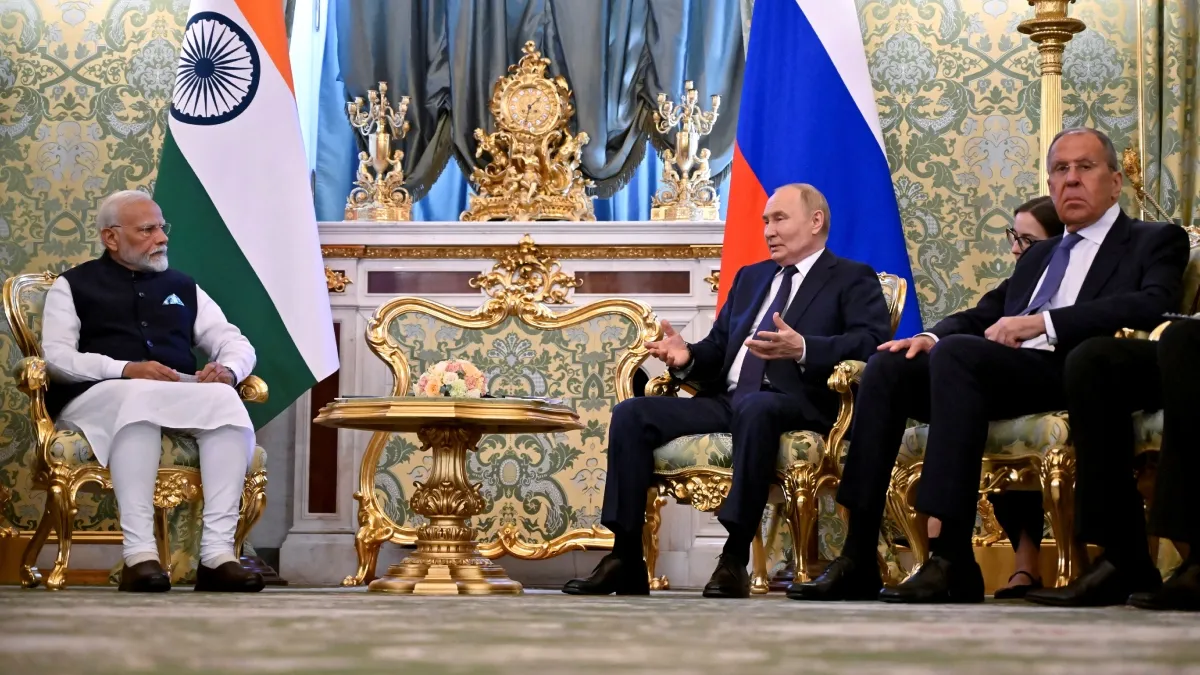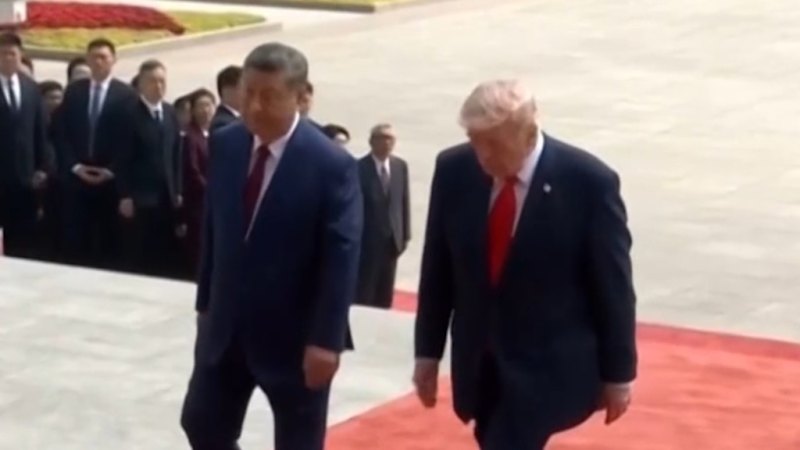
The current trajectory of US-China high-stakes dialogue is not a search for a "grand bargain" but a calculated management of structural friction. While mainstream reporting focuses on the optics of diplomatic visits, the actual substance of these talks functions as a high-frequency risk-mitigation system designed to prevent localized economic or military skirmishes from cascading into systemic collapse. This is a game of strategic attrition where success is defined by the absence of catastrophe rather than the presence of cooperation.
The negotiation framework currently in play relies on three distinct operational layers:
- The Floor Establishment Mechanism: Identifying the absolute minimum level of communication required to prevent accidental kinetic escalation.
- The Asymmetric Decoupling Logic: A process where the US seeks to "de-risk" specific high-technology supply chains while China attempts to maintain broad market access and internalize core competencies.
- The Multi-Theater Pressure Balancing: Managing flashpoints in the Taiwan Strait, the South China Sea, and Eastern Europe as interconnected variables in a single geopolitical equation.
The Calculus of Controlled Escalation
Modern diplomacy between Washington and Beijing operates under a "tit-for-tat" model that is increasingly constrained by domestic political feedback loops in both nations. This creates a bottleneck for progress. For the US, any perceived softening on trade or security is penalized by a bipartisan consensus on containment. For China, concessions are viewed through the lens of national rejuvenation and ideological resilience.
The logic of these talks follows a strict cost function. Every diplomatic gesture has a domestic political price. Therefore, negotiators only move when the cost of inaction (market volatility, military miscalculation, or supply chain paralysis) exceeds the political cost of engagement.
Tactical Divergence in Technology Sovereignty
A primary source of friction is the divergent definition of "national security" as applied to dual-use technologies. The US has shifted from a broad trade-deficit focus to a "small yard, high fence" strategy. This framework isolates specific sub-sectors—primarily 3nm/5nm logic chips, quantum computing, and generative AI architectures—while maintaining trade in less sensitive commodities like soybeans or mid-range consumer electronics.
This creates a structural imbalance. China views this selective restriction not as a security measure, but as a containment strategy designed to cap its technological ceiling. The Chinese counter-strategy involves:
- Weaponization of Raw Materials: Controlling the export of gallium, germanium, and graphite to signal vulnerabilities in the Western semiconductor and EV battery supply chains.
- Alternative Financial Architecture: Accelerating the adoption of the Cross-Border Interbank Payment System (CIPS) to reduce reliance on the SWIFT network and hedge against future sanctions.
- State-Directed R&D: Funneling capital into domestic lithography and EDA (Electronic Design Automation) tools to bypass Western intellectual property moats.
The Economic Interdependence Paradox
Despite the rhetoric of decoupling, the trade volume between the two powers remains a critical stabilizer. The relationship is governed by a concept of "Mutually Assured Economic Destruction." If the US were to implement a total embargo, the resulting inflationary shock and loss of the Chinese consumer market would destabilize the domestic US economy. Conversely, if China were to liquidate its US Treasury holdings or halt manufacturing exports, its internal unemployment and social stability would reach a breaking point.
Negotiations are currently focused on managing this interdependence through "Managed Competition." This involves:
- Tariff Normalization: Moving away from broad-spectrum Section 301 tariffs toward targeted duties that penalize specific subsidies without collapsing entire trade corridors.
- Investment Screening: Establishing transparent "outbound investment" rules that provide US firms with a predictable regulatory environment while preventing the transfer of capital into Chinese military-industrial sectors.
- Currency Stability: Coordinating, or at least communicating, on central bank policies to ensure that the Yuan-Dollar exchange rate does not trigger a competitive devaluation cycle.
Structural Vulnerabilities in Bilateral Communication
The "hotline" or direct military-to-military communication remains the most fragile component of these talks. The US prioritizes these links as a safety valve; China often views them as a "concession" or something to be withheld during periods of heightened tension to force US caution. This misalignment in the purpose of communication creates a high-risk environment during naval or aerial encounters.
The second limitation is the lack of a shared definition for "fair competition." The US points to state-owned enterprises (SOEs) and industrial subsidies as market distortions. China points to US export controls and the CHIPS Act as government-led market interference. Without a baseline agreement on what constitutes a "market-based" activity, talks frequently devolve into a feedback loop of reciprocal accusations.
The Three Pillars of the Current Diplomatic Stasis
To understand why these talks continue without producing major breakthroughs, one must analyze the three pillars that support the current status quo.
1. Risk Containment over Resolution
The objective of recent meetings is not to resolve the status of Taiwan or to end the trade war. Instead, it is "guardrail installation." This is a pragmatic recognition that the underlying ideologies and long-term goals of the two nations are fundamentally incompatible. Success is now measured by the frequency of high-level meetings rather than the signing of treaties. This "process-as-product" approach keeps markets calm even while the underlying tension increases.
2. Strategic Ambiguity and Its Decay
For decades, strategic ambiguity served as a stabilizer. However, as China's naval capacity grows and the US increases its security assistance to regional allies, the space for ambiguity is shrinking. Negotiators are now forced to discuss "red lines" with a level of specificity that was previously avoided. This increases the risk that a red line will be tested, leaving no room for a face-saving retreat.
3. The Third-Party Variable
The US and China are no longer negotiating in a vacuum. The alignment of the "Global South" and the shifting priorities of the European Union act as gravity wells. The US is attempting to build a "lattice" of alliances (AUKUS, Quad, IPEF), while China is expanding the BRICS+ framework and the Belt and Road Initiative. The high-stakes talks are, in many ways, an attempt by both sides to convince the rest of the world that they are the responsible hegemon.
The Cost Function of Non-Engagement
If the current dialogue were to fail, the immediate result would be an "Uncontrolled Decoupling." The mathematical outcome of such a scenario includes:
- Supply Chain Fragmentation: A shift from "Just-in-Time" to "Just-in-Case" manufacturing, which adds a structural 2-3% inflation premium on all global goods due to redundant inventory and less efficient production hubs.
- Bifurcated Technical Standards: A world with two internets, two GPS systems, and two sets of telecommunications protocols. This creates a massive inefficiency for global business, doubling the cost of compliance and R&D for multinational corporations.
- Higher Risk Premium on Capital: Investors would demand higher returns to compensate for the "geopolitical risk" inherent in any cross-border venture, effectively slowing global GDP growth by an estimated 0.5% to 1% annually over a decade.
The Strategy of the Long Plateau
We have entered a period of "The Long Plateau." This is a state where the relationship neither improves significantly nor descends into total war. It is characterized by persistent friction, frequent "crises" that are eventually managed, and a steady, slow-motion reorganization of global trade.
Businesses and policymakers must operate under the assumption that the "High-Stakes Talks" are the new normal. They are not a precursor to peace, but a permanent feature of the 21st-century operating environment. The goal of a strategy consultant in this environment is not to predict when the tension will end, but to build systems that are resilient to its permanence.
The primary strategic move for global entities is "Geographical Arbitrage." This involves moving high-value IP and assembly to "buffer" jurisdictions—Vietnam, Mexico, India, and Poland—while maintaining the minimum necessary footprint within the US and China to service their respective domestic markets. This "In China, For China" and "In US, For US" strategy is the only way to insulate a balance sheet from the volatility of the bilateral relationship.
The next twelve months will likely see a tactical "thaw" in rhetoric but a hardening of structural positions. Watch for movement on low-level cooperation, such as fentanyl precursor regulation or climate-related technology exchanges, as these are "cheap" wins used to mask the lack of movement on the core issues of semiconductors and territorial sovereignty. The dialogue is the armor, not the olive branch.