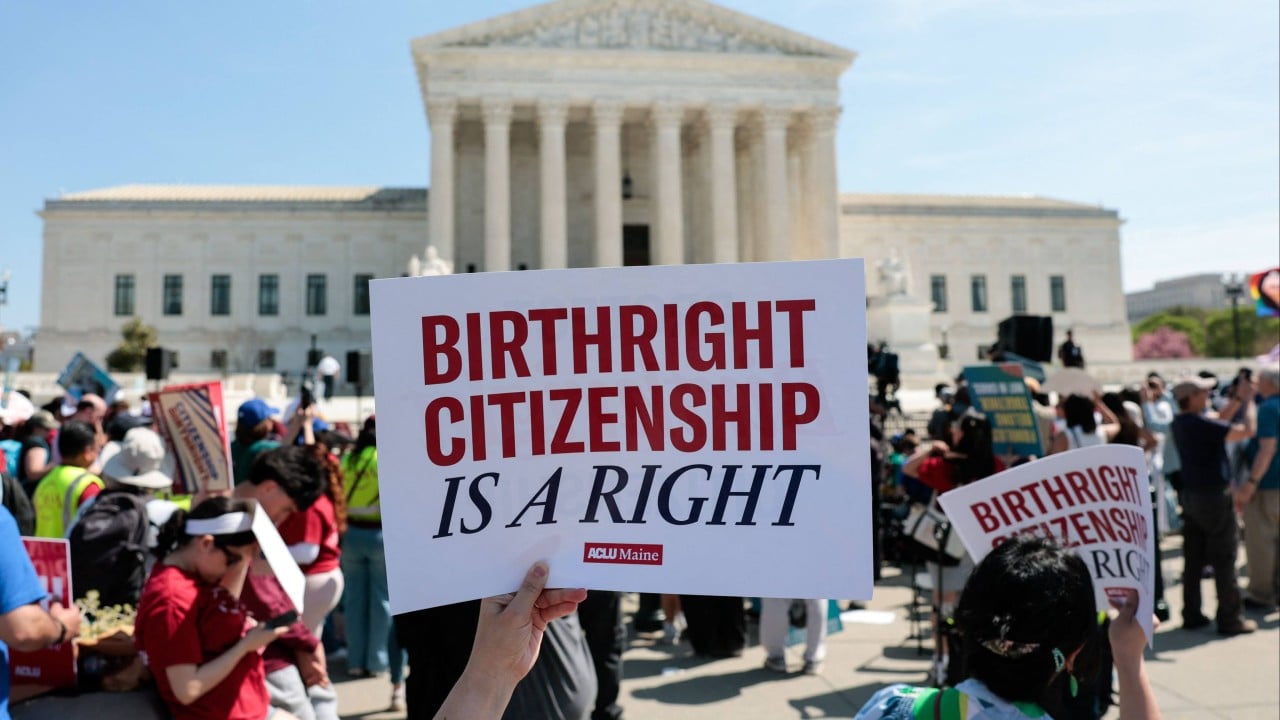
The United States Supreme Court ruling in Trump v. Barbara establishes a definitive operational boundary for executive power over national demographics. By striking down the executive order that sought to unilaterally deny birthright citizenship to children of non-citizens, the 6-3 decision reinforces a structural constraint on immigration policy. The executive branch cannot alter the criteria for sovereign membership through administrative decree.
This ruling must be evaluated not through political rhetoric, but through the dual mechanisms of constitutional architecture and administrative law. The conflict reveals a fundamental tension between the executive's intent to regulate population inputs and the judiciary's enforcement of baseline legal constraints.
The Dual-Track Matrix of Judicial Nullification
The decision to invalidate the executive order relied on two distinct lines of legal reasoning. The distinction between these tracks is vital. A constitutional ruling permanently blocks executive intervention, whereas a statutory ruling leaves open the possibility of a legislative override.
                  [ Trump v. Barbara: 6-3 Decision ]
                                  |
         +------------------------+------------------------+
         |                                                 |
[ 5-4 Constitutional Track ]                     [ 6-3 Statutory Track ]
   - Led by Chief Justice Roberts                   - Led by Justice Kavanaugh
   - Focus: 14th Amendment Clause                   - Focus: Immigration & Nationality Act
   - Invalidation: Permanent                        - Invalidation: Legislative Contingent
The Constitutional Track: 14th Amendment Jurisdiction
The core of the majority opinion, written by Chief Justice John Roberts and joined by Justice Amy Coney Barrett alongside the three liberal justices, centers on the Citizenship Clause of the Fourteenth Amendment. The text establishes a two-part requirement for automatic citizenship: birth within the United States and being "subject to the jurisdiction thereof."
The executive branch attempted to narrow the definition of "jurisdiction" by arguing it required a formal political allegiance, thereby excluding the children of undocumented immigrants and temporary visa holders. The majority rejected this interpretation by applying a territorial framework. The Court confirmed that "subject to the jurisdiction" means being bound by U.S. laws, an obligation that applies to anyone physically present within U.S. borders. This interpretation aligns with historical precedent, notably United States v. Wong Kim Ark (1898), which secured birthright citizenship for the children of permanent foreign residents.
The Statutory Track: Legislative Preemption
The second track focuses on statutory authority, presenting a distinct bottleneck for executive overreach. Justice Brett Kavanaugh concurred with the majority's conclusion but did so based on statutory rather than constitutional grounds. Kavanaugh argued that the executive order violated federal immigration law, specifically the Immigration and Nationality Act (INA).
The INA codifies birthright citizenship in terms that mirror the Fourteenth Amendment. By attempting to change these criteria through an executive order, the administration bypassed Congress's explicit authority to establish a uniform rule of naturalization. This statutory violation created a 6-3 supermajority against the order, even though only five justices agreed on the broader constitutional restriction.
The Operational Consequences of Demographic Invalidation
The failure of the executive order prevents a major disruption to the country's legal and administrative systems. Had the order been upheld, it would have introduced significant operational challenges across federal, state, and private sectors.
An analysis by immigration legal scholars estimated that the order would have denied citizenship to approximately 250,000 children annually. Cumulatively, this would have created a population of roughly 5 million stateless or non-citizen individuals born within U.S. borders by 2045.
The creation of this group would have triggered several systemic issues:
- Identity Document Bottlenecks: Federal agencies like the Social Security Administration and the Department of State would have had to build new verification infrastructure to determine the precise legal status of parents at the exact moment of a child's birth before issuing identification.
- Labor Market Distortions: Over a twenty-year horizon, millions of U.S.-born residents would have entered the workforce without legal authorization to work, expanding the informal economy and lowering tax revenues.
- Civil Infrastructure Costs: State and local municipal budgets would face increased pressure, as non-citizen populations often have limited access to federal safety net programs, shifting healthcare and social costs onto local providers.
The Dissenting Frameworks and Future Legislative Risks
The dissenting opinions, written by Justices Clarence Thomas, Samuel Alito, and Neil Gorsuch, outline the legal arguments that future challenges to birthright citizenship may use. Their analysis focuses on an originalist reading of the Fourteenth Amendment's historical context.
The dissents argue that the framers of the Fourteenth Amendment in 1866 designed the Citizenship Clause specifically to guarantee citizenship to formerly enslaved people, not to provide an open-ended right for foreign nationals. Justice Alito focused on incentives, stating that the territorial interpretation maintains a strong incentive for individuals to enter or remain in the country without authorization.
The split within the conservative majority reveals a critical vulnerability for immigration advocates. Because Justice Kavanaugh based his decision on statutory grounds, a future Congress could theoretically amend the Immigration and Nationality Act to restrict birthright citizenship for certain groups. If such legislation were passed, the Supreme Court would be forced to rule directly on whether the Fourteenth Amendment permits Congress to limit citizenship by birth, a scenario where the current 5-4 constitutional majority would face its ultimate test.
With the executive path blocked by Trump v. Barbara, immigration policy efforts will shift toward the legislative branch. Organizations seeking to alter the rules of birthright citizenship must now focus on passing federal legislation to test the statutory boundaries identified by Justice Kavanaugh. Conversely, those defending the current system must build legislative defenses to prevent changes to the Immigration and Nationality Act, recognizing that the current constitutional protections depend on a narrow 5-4 judicial margin.


