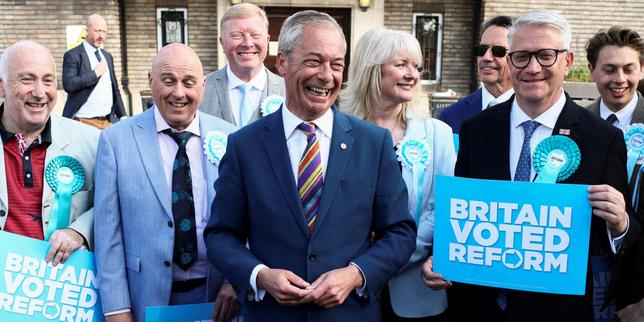
The fragmentation of the United Kingdom’s two-party system is not an ideological anomaly; it is a structural certainty driven by electoral decay and the optimization of right-wing populist mobilization strategy. Standard political commentary treats the rise of figures like Nigel Farage as a triumph of raw charisma or a vague breakdown of democratic conventions. This is an analytical failure. Farage’s political efficacy is a function of system arbitrage, exploiting structural vulnerabilities within the First-Past-The-Post (FPTP) electoral framework and the systemic failure of the Conservative Party to maintain its traditional voter coalition.
To understand the trajectory of British electoral politics, one must move past the superficial narrative of "populist waves" and dissect the precise mechanisms of this realignment. The disruption operates across three distinct vectors: the asymmetric efficiency of protest voting under FPTP, the ideological vacancy left by center-right triangulation, and the exploitation of media fragmentation to bypass traditional institutional gatekeepers.
The Mathematics of Electoral Arbitrage Under First Past The Post
The British electoral system was designed for a binary political market. When third-party actors enter this market, the mechanics of FPTP shift from a tool of stable governance to a mechanism of acute instability. Populist strategies, specifically those employed by Reform UK and its predecessors (the Brexit Party and UKIP), leverage an asymmetric cost function against the incumbent Conservative Party.
Under FPTP, a insurgent party does not need to win a plurality of seats to exercise immense structural power. It merely needs to threaten the marginal seats of the dominant party.
Populist Vote Share Target = (Total Conservative Vote Share in Marginal Seats) - (Margin of Victory)
By capturing a critical threshold of the electorate—historically between 8% and 15%—the insurgent party creates a vote-splitting bottleneck. The incumbent party faces a structural dilemma:
- The Compounding Depletion: The loss of a small, ideologically rigid subset of voters to a populist competitor shifts marginal seats directly to the center-left opposition (Labour or the Liberal Democrats), even if the opposition's absolute vote share remains static or declines.
- The Inefficient Capture Rate: To recapture these voters, the incumbent must pivot its policy platform rightward, which simultaneously alienates its centrist, socially liberal suburban voter base, triggering a secondary leak on its opposite flank.
This creates an compounding electoral trap. The populist strategy functions as a low-overhead, high-leverage enterprise. It does not bear the systemic burden of preparing for national governance; instead, it operates as a specialized political hedge fund, shorting the incumbent party’s equity to force a hostile takeover of its policy platform.
The Three Pillars of Democratic Decay
The assertion that democratic conventions are collapsing in the UK requires a rigorous definition of what those conventions are and how they are being dismantled. The erosion is not marked by a sudden, authoritarian coup, but by a progressive institutional hollow-out characterized by three specific variables.
1. The Erosion of Institutional Gatekeeping
Historically, British political parties operated as strict filters. Local constituency associations and parliamentary party structures held absolute authority over candidate selection and policy formulation. This insulated the legislative body from sudden populist shifts.
The democratization of party leadership contests—allowing paying, non-vetted party members to overrule the parliamentary party—effectively broke this filter. Populist actors outside the formal party structures can now dictate the internal leadership dynamics of mainstream parties by threatening grassroots rebellions or mass membership defections.
2. The Asymmetry of the Normative Contract
The British constitution relies heavily on unwritten rules, conventions, and the self-restraint of its actors—often referred to as the "Good Chap" theory of governance. When an actor identifies that the enforcement mechanisms for these conventions are social rather than legal, the strategic incentive shifts toward total non-compliance.
By systematically violating rhetorical norms regarding institutional independence (e.g., attacking the judiciary, civil service, or public broadcasting), populist actors alter the baseline of acceptable political discourse. This forces mainstream actors to either adopt similar rhetoric to retain relevance or defend institutional complexities that the electorate perceives as bureaucratic self-preservation.
3. The Commodification of Grievance Architecture
Economic stagnation since the 2008 financial crisis, compounded by the fiscal constraints of the 2010s and productivity plateaus, created a profound geographic divergence in wealth distribution. Populist strategy maps this economic reality onto a cultural axis.
Instead of proposing complex, capital-intensive structural reforms to fix productivity bottlenecks, the strategy relies on a highly efficient diagnostic framework: identifying externalized scapegoats (e.g., supranational bodies, migration flows, metropolitan elites). This framework lowers the cognitive load for voters seeking an explanation for their diminished economic security.
The Strategic Failure of Center Right Co Optation
A recurring error among mainstream conservative strategists is the belief that populist movements can be neutralized by absorbing their core rhetoric and policies. This strategy ignores the fundamental law of political authenticity: when given the choice between a compromised imitation and an unvetted original, the disaffected voter consistently selects the original.
The implementation of Brexit serves as the definitive case study for this failure. The Conservative Party assumed that executing the departure from the European Union would permanently neutralize the UKIP/Reform UK threat vector. This assumption miscalculated the nature of the populist mandate. The vote to leave the EU was not an end state; it was a proxy manifestation of a broader demand for structural insulation from globalized economic forces.
When the post-Brexit reality failed to instantly deliver the idealized economic and social outcomes promised to the de-industrialized regions, a narrative bottleneck emerged. The populist architect is never penalized for the failure of their policy; they simply shift the diagnosis to a lack of purity in execution. The failure of Brexit to radically reduce net migration or immediately restore regional economic vitality was not framed as an inherent limitation of the policy itself, but as a betrayal by the bureaucratic "deep state" or a compromised political class.
Consequently, the center-right party finds itself on a treadmill of perpetual escalation. Each concession fails to satisfy the populist voter base, requiring a further, more radical policy shift that systematically destroys the party's credibility among moderate, institutionalist demographics necessary for a governing majority.
Media Fragmentation and the Deconstruction of Public Verification
The structural realignment of British politics cannot be decoupled from the transformation of the media ecosystem. The traditional model of British political communication was anchored by a highly regulated broadcast environment (governed by Ofcom's strict impartiality requirements) and a polarized but institutionalized print press.
This duopoly has been disrupted by two structural shifts:
- The Growth of Non-Traditional Broadcast Outlets: The emergence of highly opinionated, Americanized news networks (such as GB News) has effectively bypassed the spirit of impartiality regulations. These platforms act as closed-loop amplification chambers for populist narratives, providing round-the-clock legitimization of fringe political figures without the friction of adversarial journalistic cross-examination.
- Algorithmic Optimization of Micro-Targeted Discontent: Social media platforms prioritize high-arousal negative emotions—specifically outrage, fear, and resentment—to maximize user retention metrics. Populist messaging, which naturally relies on binary us-versus-them frameworks and conspiratorial explanations, possesses a significantly higher organic velocity within these algorithms than nuanced, policy-driven analysis.
Farage’s strategic advantage lies in his early recognition of this shift. He transitioned from a traditional politician seeking parliamentary access to a media brand operating a political vehicle. By controlling the distribution channel—whether through digital video platforms or highly curated public appearances—he immunizes his movement against the standard accountability mechanisms applied by legacy media outlets.
Strategic Forecasting: The Realignment Vector
The structural vulnerabilities outlined above suggest that British politics is entering a phase of permanent fragmentation rather than a temporary swing of the political pendulum. The Labour Party’s return to power does not represent a stabilization of the old system; it is a superficial equilibrium achieved due to the total collapse of the Conservative voter coalition under the weight of its internal contradictions.
The mid-term trajectory points toward an intensifying battle for the hegemony of the British right. There are two primary scenarios that political analysts and corporate strategists must plan for.
The Subjugation Scenario
The Conservative Party, remaining out of power and facing sustained electoral pressure on its right flank from Reform UK, undergoes a complete ideological capitulation. Elements within the parliamentary party orchestrate a merger or a formal coalition agreement with Farage's faction. In this scenario, the traditional, institutionalist, business-friendly center-right in the UK ceases to exist as an independent electoral force. The party is rebuilt entirely around a populist-nationalist framework, focusing on radical protectionism, aggressive immigration restrictions, and systematic attacks on administrative state institutions.
The Fragmented Gridlock Scenario
The Conservative Party attempts to maintain its traditional brand but remains incapable of suppressing the populist leakage. The right-wing vote remains permanently split between a traditionalist rump and an insurgent populist party. Under FPTP mechanics, this division ensures prolonged center-left governance, even if the combined vote share of the right exceeds that of the left. This dynamic leads to severe geographic polarization, where entire regions of the country become permanently alienated from a centralized government that they perceive as unrepresentative, accelerating the decay of national social cohesion.
For enterprise risk management and long-term capital allocation, the implication is clear: the United Kingdom can no longer be modeled as a predictable, stable two-party system governed by incremental policy shifts. The structural guardrails have eroded, and the primary driver of political change for the foreseeable future will be the weaponization of voter alienation through highly sophisticated, platform-optimized electoral arbitrage.