The U.S. Air Force’s pursuit of ground-based launching systems for unmanned aerial vehicles and missile platforms represents a fundamental re-architecting of theater geometry and force survivability. Historically, air superiority relied on fixed infrastructure—monolithic airbases with extensive runways that served as the primary nodes for power projection. Modern long-range precision strike capabilities possessed by peer adversaries have transformed these fixed bases into high-priority, easily targetable liabilities. Shifting the launch phase of autonomous air assets and munitions from vulnerable runways to mobile, distributed ground platforms alters the cost-exchange ratio of theater denial, introduces strategic ambiguity, and diversifies the vector mechanics of modern aerial warfare.
The Vulnerability Cost Function of Runway Dependency
The core driver behind ground-launched air architecture is the mitigation of runway dependency. In a contested peer conflict, the operational availability of a standard runway degrades rapidly under sustained ballistic and cruise missile bombardment. The mathematical reality of runway denial operations forces a defensive posture focused heavily on active missile defense and rapid runway repair, both of which consume disproportionate resources.
To understand the strategic shift, the vulnerability of air asset deployment can be modeled through three distinct operational vectors:
- Fixed Node Vulnerability: Airfields possess permanent geographic coordinates, allowing adversaries to pre-program targeting sequences and optimize missile flight paths for maximum kinetic impact.
- Launch Window Predictability: Aircraft sorties require specific prep times, taxi sequences, and runway lengths. Satellites and forward-deployed intelligence assets can monitor these indicators, eliminating the element of surprise.
- The Concentration Risk: Parking multi-million-dollar aircraft, fuel reserves, and munitions payloads within a centralized perimeter creates a high-density target environment where a single incoming warhead can cause cascading material losses.
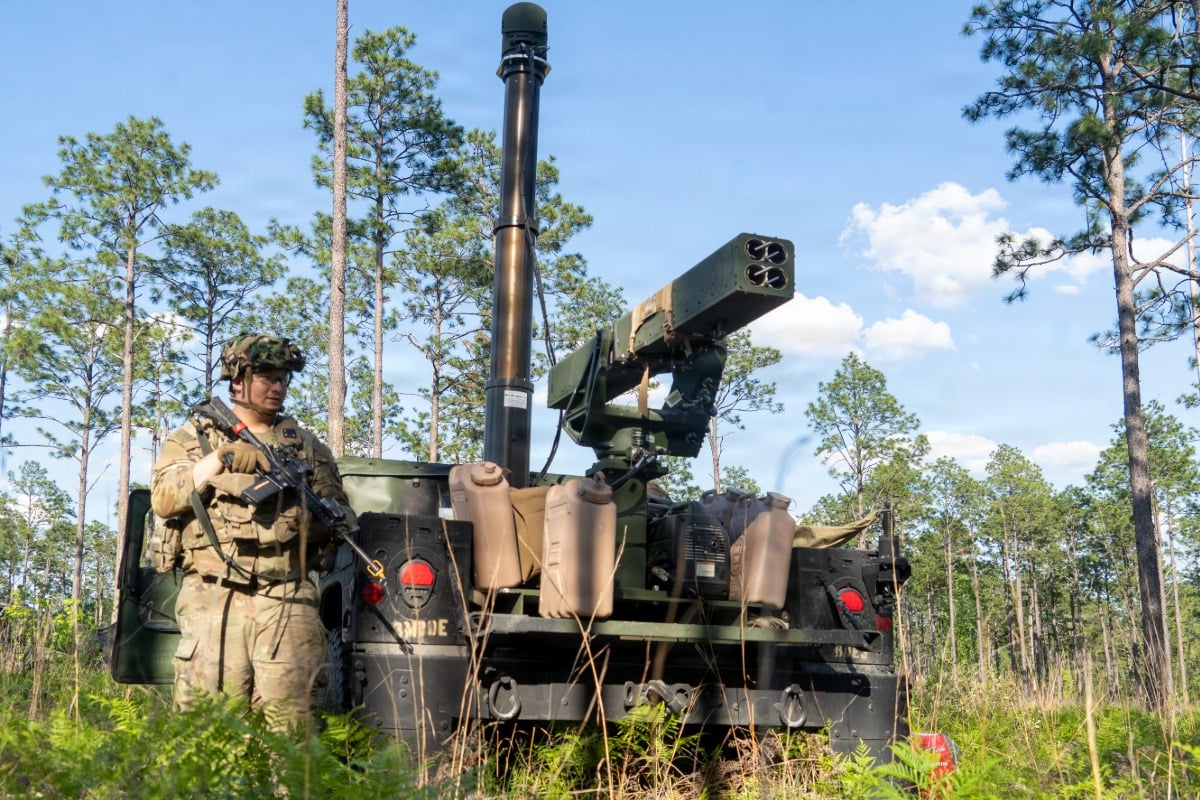
Distributing the launch capability across an array of mobile, containerized ground units fragments this target profile. By utilizing standard commercial shipping dimensions or standard tactical vehicle chassis, the Air Force converts thousands of miles of public highway, austere clearings, and unimproved terrain into potential launch sites. This distribution complicates the adversary’s targeting cycle, forcing them to expend limited long-range munitions searching for highly mobile, low-signature targets rather than firing at fixed base infrastructure.
The Strategic Architecture of Agnostic Launching Systems
Developing a ground-based launcher capable of deploying both unmanned aerial vehicles (UAVs) and cruise missiles requires a modular approach to mechanical engineering and software integration. Instead of designing bespoke platforms for individual weapon systems, the technical imperative focuses on common carriage architectures.
Pneumatic and Hydraulic Acceleration Mechanics
Air-breathing drones and missiles require a minimum relative airspeed to achieve sustained lift and engine ignition. When launched from an aircraft, this initial velocity is gifted by the carrier platform. When launched from a stationary ground position, the system must generate this kinetic energy instantly through auxiliary propulsion or mechanical acceleration.
Two primary mechanisms satisfy this requirement:
- Rocket-Assisted Take-Off (RATO): Solid-fuel rocket boosters attach to the airframe, providing high thrust for a brief duration to accelerate the asset to its operational velocity vector. Once the primary engine reaches self-sustaining RPMs and the airframe achieves stable flight, the spent boosters decouple and fall away. This mechanism introduces logistical footprints, requiring the transport, storage, and handling of explosive hazardous materials alongside the primary air assets.
- Mechanical Catapults and Pneumatic Rails: Closed-loop pneumatic or hydraulic rail launchers accelerate the drone along a fixed track. This system eliminates the chemical hazard and thermal signature of rocket boosters, lowering the thermal detection risks during the launch sequence. However, these launchers require mechanical footprints that limit mobility and increase setup times.
Common Control Architecture and Open Systems
The software layer of a dual-use ground launcher must utilize an open-systems architecture capable of translating distinct mission data files. A cruise missile requires target coordinates, terrain-contour matching data, and GPS initialization profiles before leaving the tube. A loitering munition or a reusable reconnaissance UAV demands a bidirectional data link capable of transmitting real-time telemetry, sensor feeds, and dynamic retargeting commands.
Integrating these capabilities requires a software-defined fire control system that recognizes the payload upon connection, executes diagnostic checks, and routes the appropriate power and data streams without hardware reconfiguration. This plug-and-play capability ensures that a single ground unit can switch from an offensive strike posture to an intelligence-gathering posture by swapping containers.
Operational Bottlenecks Logistics and Command Coordination
While ground-launched systems offer clear survivability advantages, they introduce severe friction points into the logistical chain and the broader command and control network. The Air Force cannot simply adopt ground launchers without addressing the structural shifts required in personnel training and distribution logistics.
The Tyranny of Intratheater Transport
Moving containerized launch units across a contested theater introduces significant transport burdens. Unlike aircraft that fly over geographic obstacles at hundreds of knots, ground assets are bound by terrain, road infrastructure, weight limits of bridges, and the availability of heavy tactical trucks.
A single battery of ground launchers requires a dedicated convoy of support vehicles carrying reload munitions, diagnostic tools, secure communications arrays, and fuel. If the operational area lacks robust road networks, or if the maritime domain divides landmasses—as seen in the Indo-Pacific—the movement of these assets becomes dependent on amphibious transport ships or cargo aircraft, reintroducing the exact node vulnerabilities the system was designed to bypass.
Airspace Deconfliction and Fire Integration
Integrating ground-launched air assets into the broader Joint Force Air Component Command presents an administrative and electromagnetic challenge. Traditional air operations rely on strict airspace control measures, restricted operating zones, and timed corridors to prevent fratricide and mid-air collisions.
[Ground Launcher Deployment] ---> [Low-Altitude Ingress] ---> [Joint Airspace Integration]
                                                                     |
[Traditional Air Base Airframe] -> [High-Altitude Ingress] --------->+---> [Target Area Entry]
When a ground unit launches a salvo of low-altitude drones or cruise missiles from an unannounced jungle clearing or coastal highway, those assets must integrate into the active airspace. Without real-time, low-latency, and jam-resistant data links connecting the ground launcher crews directly to airborne early warning platforms, the risk of intersecting flight paths or misidentification by friendly air defense systems increases significantly.
Economic Realities of Mass vs Exclusivity
The fiscal viability of ground-launched drone and missile systems hinges on bending the cost curve of modern warfare. Traditional air superiority platforms are prohibitively expensive to manufacture and maintain. The loss of a single advanced fighter aircraft represents a significant drain on tactical capability and financial capital.
Ground launchers permit the deployment of "attritable" or low-cost airframes in mass quantities. By stripping away the life-support systems, heavy landing gear, and complex multi-spectral stealth coatings required for manned penetration of enemy airspace, the per-unit cost drops significantly. The objective shifts from absolute platform survivability to mission-success-per-dollar.
This economic framework enables saturation strategies. Launching a high-volume swarm of low-cost drones from multiple dispersed ground sites forces an adversary's integrated air defense network to expend high-tier interceptor missiles on cheap targets. Once the defensive magazine is depleted or overwhelmed, conventional strike assets can penetrate the remaining defensive gaps with a vastly higher probability of survival.
Technical Limitations of Ground-Launched Profiles
Any objective analysis must acknowledge the physics-based trade-offs inherent in launching an air-breathing platform from zero initial altitude and zero velocity.
- Range Degradation: A missile launched from an aircraft at 40,000 feet and Mach 0.8 possesses substantial potential and kinetic energy. A ground-launched equivalent must expend a significant percentage of its onboard fuel or solid-propellant mass simply climbing to an efficient cruise altitude and overcoming atmospheric drag. This reduces the effective operational radius of the payload compared to its air-launched counterpart.
- Payload Capacity Constraints: Mobile ground launchers are constrained by road legal limits, standard container dimensions, and the lifting capacities of field-expedient cranes. These physical boundaries limit the length, wingspan, and weight of the deployed airframes, skewing the inventory toward smaller, shorter-range munitions with lighter warhead payloads.
Deployment Realities and the Path Forward
Implementing a viable ground-launched capability requires the Air Force to resolve a fundamental institutional identity crisis. The service is structurally optimized around pilot-centric doctrine and established airfield infrastructure. Transitioning to distributed, ground-based operations requires borrowing operational concepts from the Army and Marine Corps, specifically regarding camouflage, concealment, deception, and field-expedient maintenance.
Forces operating these systems must master the art of signature management. A mobile launcher is only survivable if its radio emissions, infrared output, and visual tracks are masked. This necessitates the development of strict emission control protocols, decoy deployment strategies, and highly disciplined convoy movements that operate entirely outside the traditional comfort zone of centralized airbase logistics.
The final integration matrix requires the establishment of multi-domain task forces where ground launcher units operate as decentralized nodes within a wider sensor network. Rather than relying on organic radar systems that give away their positions upon activation, these units must receive targeting telemetry passively from orbital satellites, high-altitude surveillance aircraft, or forward-deployed naval vessels. The ground launcher remains dark, silent, and mobile until the exact moment of ignition, minimizing exposure time and maximizing the tactical surprise of the launch sequence.