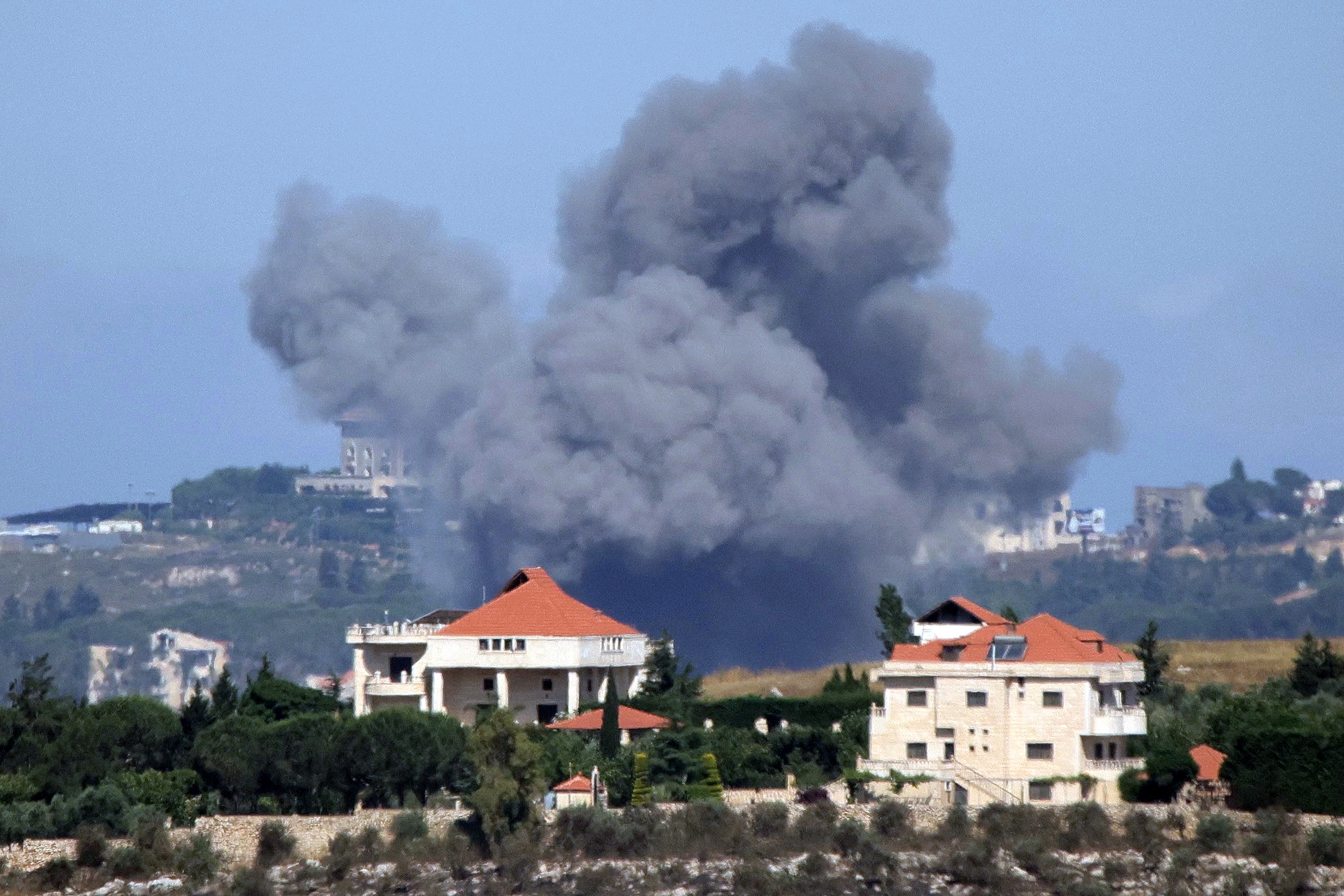
The retaliatory strike executed by Israel against Hezbollah targets in Beirut's southern suburbs represents a calculated application of calibrated kinetic deterrence rather than an isolated act of retribution. Western media frequently characterizes these exchanges as a cyclical tit-for-tat dynamic, a narrative that misinterprets the strategic logic governing state versus non-state actor conflicts in the Levant. The operation operates within a highly defined escalation matrix, designed to achieve maximum psychological and operational degradation of Hezbollah's command architecture while remaining precisely under the threshold that triggers a regional theater-wide war.
To understand the strategic reality of this strike, the conflict must be broken down into its core operational variables: the breakdown of established deterrence thresholds, the physics and intelligence requirements of urban kinetic targeting, and the economic and logistical constraints governing both combatants.
The Deterrence Threshold Breakdown
Military operations between Israel and Hezbollah have historically adhered to an unwritten code of conduct known as the rules of the game. This framework traditionally restricted kinetic actions to contested border zones, specifically the Blue Line, the Shebaa Farms, and targeted operations within southern Lebanon, matched by reciprocal rocket fire into northern Israel. The recent strike in Beirut’s suburbs violates the geographic boundaries of this agreement, shifting the conflict from a border attrition model to a high-value targeting model within dense urban centers.
This shift is driven by a fundamental change in Israel's threat-assessment calculus. The threshold for acceptable risk was permanently altered following sustained rocket fire that caused civilian casualties within Israeli-controlled territory. When a non-state actor demonstrates the capability and intent to bypass defensive umbrellas like the Iron Dome, the state actor is compelled to re-establish deterrence by raising the cost of the adversary's operations.
[State Deterrence Threshold]
       │
       ├─► Traditional: Localized Border Attrition (Low Risk / Low Yield)
       │
       └─► Current: High-Value Urban Targeting (High Risk / High Yield)
The cost function of this strategy relies on a specific asymmetry. Hezbollah derives its political legitimacy within Lebanon from its claim to protect national sovereignty. By penetrating the security zone of Dahiyeh—Hezbollah’s heavily fortified bureaucratic and military hub in southern Beirut—Israel forces the group into a strategic dilemma. Hezbollah must either respond with an escalatory deep-theater strike on Israeli metropolitan centers, risking an all-out conventional war for which Lebanon's collapsing economy is unprepared, or absorb the blow, exposing a vulnerability in its domestic security apparatus.
The Intelligence-Kinetic Integration Matrix
Executing a precision strike inside an urban density environment like Beirut requires a highly integrated intelligence and kinetic pipeline. The target selection cannot be indiscriminate; it demands absolute certainty to minimize collateral damage while maximizing the elimination of high-value targets (HVTs).
The operational pipeline relies on three distinct layers of data acquisition:
- Signals Intelligence (SIGINT): The interception of encrypted communications, cellular metadata, and electromagnetic emissions. Despite Hezbollah’s shift away from smartphones toward localized pager networks and hardwired fiber-optic infrastructure, the physical nodes of these systems remain vulnerable to interception at transit points.
- Geospatial Intelligence (GEOINT): High-resolution satellite imagery coupled with real-time synthetic aperture radar (SAR) data. This allows targeting cells to track changes in structural density, underground construction, and vehicular movement patterns within the target perimeter.
- Human Intelligence (HUMINT): Ground-level verification. In dense urban environments, electronic data alone cannot confirm the physical presence of an HVT inside a specific room or subterranean bunker. On-the-ground assets provide the final validation required to clear the strike legally and operationally.
Once the intelligence pipeline confirms the target coordinates, the kinetic execution must match the structural realities of the urban environment. Beirut’s southern suburbs feature high-rise residential buildings constructed over subterranean storage facilities and command bunkers. Standard high-explosive ordnance is ineffective against these structures because it detonates on contact, destroying upper civilian floors while leaving the underlying military infrastructure intact.
To solve this physical constraint, the strike profile utilizes precision-guided penetrating munitions, such as the GBU-39 Small Diameter Bomb or heavier BLU-109 bunker busters, configured with delayed-fuse assemblies. The physics of the strike follow a precise sequence:
- Kinetic Penetration: The reinforced nose cone of the munition pierces the concrete roof and subsequent floors of a structure using purely kinetic energy.
- Delayed Detonation: The internal fuse detects the deceleration of the weapon as it moves through structural barriers, delaying detonation until the payload reaches the designated subsurface depth.
- Overpressure Containment: The blast occurs within the confined space of the subterranean bunker. The resulting overpressure wave maximizes structural collapse from within, neutralizing the target while mitigating the outward blast radius that would otherwise level neighboring civilian blocks.
The Logistical and Supply Chain Bottleneck
The sustainability of Israel's campaign in Lebanon is dictated by supply-chain logistics and ordnance expenditure rates. Precision-guided munitions (PGMs) are not infinite resources. A sustained campaign requires thousands of joint direct attack munition (JDAM) kits and specialized penetrating warheads. This creates an external dependency on foreign supply chains, primarily the United States, for inventory replenishment.
Hezbollah faces a parallel logistical bottleneck. Its arsenal of long-range precision missiles, such as the Fateh-110, depends entirely on land and air supply corridors running from Iran through Iraq and Syria into Lebanon. By striking Beirut, Israel aims to disrupt the coordination node where these weapons systems are assigned to operational units.
The strategic goal is to alter the inventory exchange ratio. If Israel can destroy Hezbollah’s specialized missile infrastructure and senior command personnel faster than Iran can replenish them through contested supply corridors, Hezbollah’s strategic leverage decreases. This creates a highly technical race against time, where operational success is measured not by territory gained, but by the degradation rate of the adversary's long-range strike capacity per week.
Domestic Political Drivers and Asymmetric Constraints
The conflict cannot be decoupled from the domestic pressures acting upon both leadership structures. For Israel, the primary political driver is the displacement of over 60,000 citizens from northern communities due to continuous cross-border anti-tank guided missile (ATGM) fire and rocket barrages. No sovereign government can tolerate the indefinite internal displacement of its population without forfeiting its foundational security mandate. The Beirut strike is intended to signal to the Israeli domestic audience that the military is actively shifting from a defensive posture to an offensive strategy designed to push Hezbollah forces north of the Litani River, in alignment with UN Resolution 1701.
Conversely, Hezbollah operates under acute domestic constraints within Lebanon. The country is mired in a protracted economic depression, characterized by hyperinflation, a paralyzed banking sector, and failing state infrastructure. The broader Lebanese public, including segments of the non-Shia population, strongly opposes any action that would invite a repeat of the devastating 2006 war.
Consequently, Hezbollah’s leadership must calibrate its response to maintain its domestic political standing. If it triggers a full-scale war that destroys Beirut's remaining functional infrastructure, it risks losing its grip on the Lebanese state apparatus. This reality creates a strategic buffer that Israel exploits: knowing that Hezbollah's threshold for total war is higher than its threshold for absorbing localized high-value strikes.
The Escalation Ladder Mechanics
The primary risk of the Beirut strike is the potential for unmanaged escalation due to miscalculation. In strategic theory, the escalation ladder consists of discrete rungs of intensity. A stable conflict relies on both actors agreeing on the meaning of each rung.
[THE ESCALATION LADDER]

▲ HIGH RISK: Unrestricted Theater War (Targeting Major Metros / Total Infrastructure)
│
├─► CURRENT RUNG: Deep Kinetic Interdiction (Beirut Suburbs / High-Value Command)
│
▼ LOW RISK: Contested Border Friction (Blue Line / Localized Attrition)
By striking the capital city, Israel has advanced the conflict to the rung of deep kinetic interdiction. The stability of the next phase depends entirely on how Hezbollah defines its retaliatory response. If Hezbollah selects a target of equal symbolic and operational weight within Israel—such as a military command center in Tel Aviv—the ladder advances toward unrestricted theater war. If Hezbollah responds with a high-volume barrage directed exclusively at military targets in northern Israel, it signals a desire to reset the deterrence equilibrium without crossing the line into a total conventional confrontation.
The vulnerability of this model lies in the margin for technical error. A missile intercept failure by the Iron Dome over a major population center, or an off-target Israeli munition causing high civilian casualties in Beirut, immediately strips political decision-makers of their strategic flexibility, forcing an escalatory response regardless of the long-term systemic costs.
The Operational Directive
The strategic imperative for regional stability requires an immediate transition from kinetic dominance to diplomatic consolidation. Israel’s tactical success in penetrating Dahiyeh and eliminating key operational commanders yields diminishing returns if it is not leveraged into a enforceable security framework.
The immediate next move must focus on establishing a verifiable maritime and land border demarcation backed by a reconstituted international monitoring force with real interdiction capabilities. Relying on Hezbollah to voluntarily withdraw north of the Litani River is a failed strategy. Instead, the cost of their presence in the south must be made unsupportable through continuous intelligence-led interdiction of their supply lines coupled with economic leverage applied via international banking channels to isolate the group's financial networks. Continued reliance on kinetic strikes in urban centers without a clear political endpoint will inevitably exhaust ordnance stockpiles, degrade international diplomatic capital, and increase the probability of an unintended regional war that serves the strategic interests of neither state.