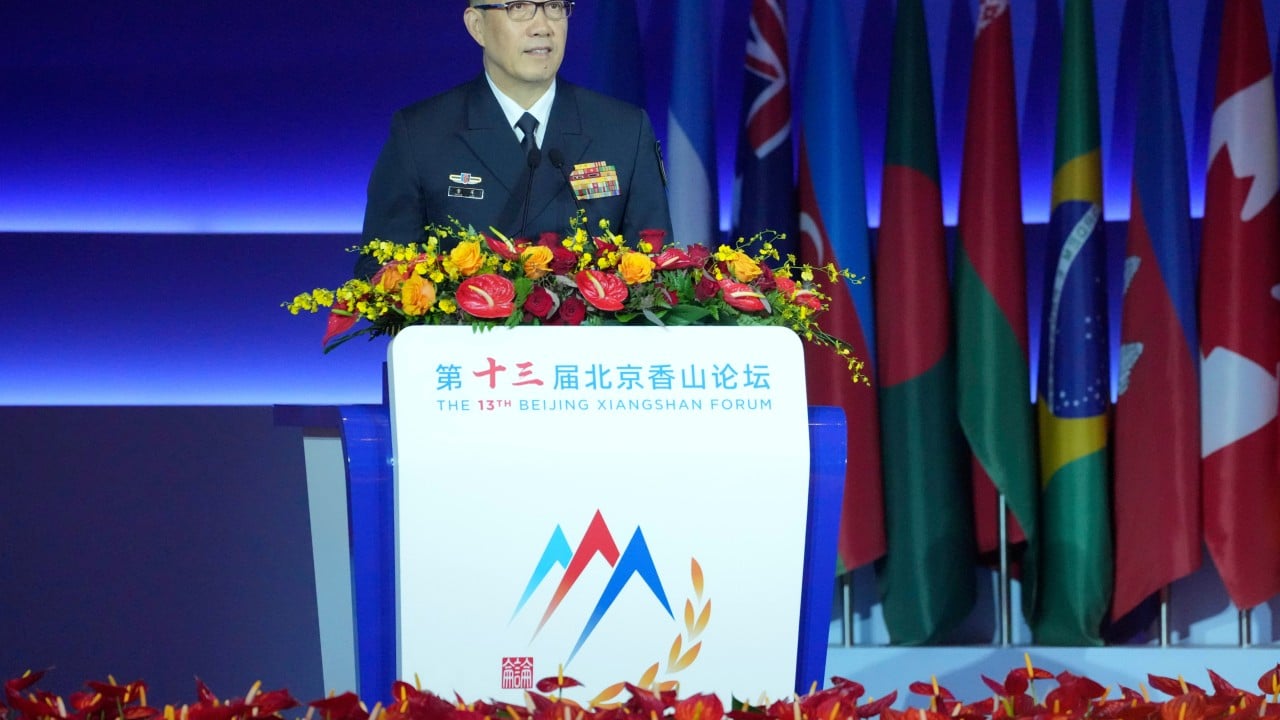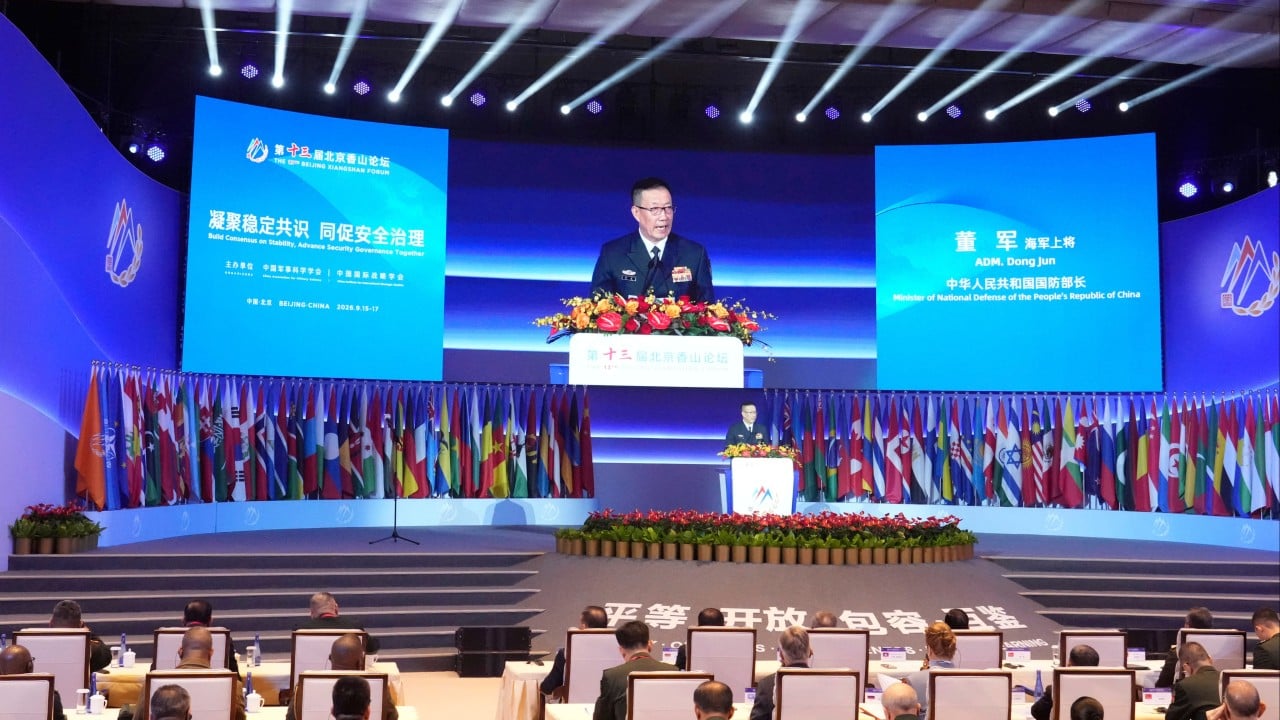
Statecraft often relies as much on what is left unsaid as on what is formally proclaimed from a podium. At the thirteenth Beijing Xiangshan Forum, Chinese Defense Minister Dong Jun delivered an address that served as a masterclass in strategic signaling. Stripped of explicit condemnations of Washington or Tokyo, the twenty-minute keynote presented an alternative architecture for global security governance. Beneath the diplomatic veneer of cooperation and mutual respect lies a calculated campaign to redefine international norms, contest Western-led security structures, and anchor the strategic orientation of the Global South within Beijing's orbit.
Evaluating this speech requires moving past surface-level placations. Observers who interpreted the absence of direct references to Taiwan or the South China Sea as a softening of posture misread the operational logic of the forum. Beijing utilizes the Xiangshan platform not as a tactical theater for immediate territorial disputes, but as a strategic laboratory for long-term normative competition. By examining the structural components of Dong's address, analysts can map how military diplomacy operates as an instrument of statecraft designed to fracture traditional alliance networks without triggering direct military escalation.
The Architecture of Strategic Omission
The most telling feature of the address was its strict avoidance of specific flashpoints. In previous iterations of the forum, senior Chinese military officials explicitly addressed maritime disputes and sovereignty claims over Taiwan. The deliberate pivot away from localized grievances in favor of high-altitude generalizations about global stability reflects a calibrated shift in messaging strategy.
When a major power omits its most contentious territorial assertions from a premier defense platform, it is rarely an act of appeasement. Instead, it represents an elevation of the discourse from tactical friction to structural philosophy. By neutralizing immediate flashpoints in the speech, Beijing shifted the analytical burden onto its competitors. Western delegations arrived expecting to counter aggressive territorial rhetoric, only to find themselves forced to engage with abstract critiques of unipolar hegemony and zero-sum security models.
This tactical silence achieves three distinct objectives. First, it lowers the rhetorical barrier for non-aligned delegations from the Global South to engage with Chinese security initiatives without feeling complicit in regional escalation. Second, it starves hostile media narratives of the explicit threats required to validate containment policies. Third, it allows Beijing to project an image of measured maturity, contrasting sharply with the crisis-driven posturing often observed in Western capitals. The omission is an offensive maneuver disguised as diplomatic restraint.
Economic Security as a Vector of Influence
A core pillar of the presented strategy is the explicit linkage between economic development and regional stability. The assertion that development serves as the primary guarantee of security is not a novel diplomatic talking point; it is the theoretical foundation of Beijing's foreign policy doctrine. However, within the context of a defense forum, this formulation carries distinct strategic implications.
By framing economic security as the prerequisite for sovereign stability, Beijing directly challenges the Western security model, which prioritizes alliance-building, forward military presence, and deterrence through hardware accumulation. For developing states navigating high inflation, debt distress, and infrastructural deficits, the promise of developmental security offers an attractive alternative to military alignment.
The mechanism relies on structural dependency. When security is defined through the lens of economic resilience, access to capital markets, supply chain integration, and technological transfer become instruments of defense policy. Beijing positions itself not merely as a military supplier, but as the indispensable engine of global growth. Through practical military cooperation, joint training exercises, and defense technology exchanges offered to states in need, the People's Liberation Army embeds its operational standards, equipment footprints, and institutional philosophies across developing nations. This creates a deeply entrenched security architecture anchored in material dependency rather than treaty-bound obligations.
Contesting the Vocabulary of International Order
Diplomacy is fundamentally a contest over definitions. Dong Jun's address dedicated substantial intellectual space to challenging the prevailing security vocabulary utilized by Western institutions. Concepts such as indivisible security, non-aligned agency, and inclusive multilateralism were deployed to construct an alternative normative framework.
The critique of zero-sum security models resonates deeply across regions that have historically borne the collateral damage of great power competition. Western security architecture, anchored in bilateral alliances and collective defense treaties, is frequently characterized in Beijing's strategic communications as inherently exclusionary. By contrast, the proposed alternative champions a diffused security network where states retain total operational independence while participating in functional cooperation.
Yet, this theoretical construct contains an inherent contradiction. While the rhetoric champions non-aligned agency and opposes the formation of exclusive blocs, the practical execution of Beijing's security strategy relies heavily on asymmetrical bilateral relationships. Smaller states are invited to reject major power coercion, but within a system where one gravitational center vastly outweighs all others. The strategic challenge for these smaller states lies in navigating a unipolar economic reality masked by multipolar multilateral rhetoric. The framework grants agency in theory while cementing subordination in practice.
The Institutional Role of the Xiangshan Forum
To fully understand the speech, one must analyze the institutional vehicle through which it was delivered. The Beijing Xiangshan Forum was originally conceived as a modest, track-two academic gathering. Over the past decade, it has evolved into a state-sponsored, track-one-and-a-half diplomatic instrument designed specifically to challenge the dominance of the Shangri-La Dialogue hosted annually in Singapore.
The institutional competition between these two forums mirrors the broader geopolitical contest for the narrative high ground in the Indo-Pacific. While the Shangri-La Dialogue frequently functions as a venue for Western defense officials to articulate deterrence strategies, coalition building, and rules-based maritime order criticisms, the Xiangshan Forum serves as the mirror image. It provides Beijing with an uncontested home-court advantage where the agenda, guest lists, and framing concepts are curated to highlight alternative priorities.
This institutional bifurcation entrenches global fragmentation. Instead of a unified global security discourse, the international community faces two parallel ecosystems of military diplomacy. Each ecosystem operates with its own internal logic, its own accepted vocabulary, and its own validation mechanisms. Participants who rotate between these venues often find themselves navigating entirely different realities, where actions condemned as aggressive violations of international law in one forum are interpreted as legitimate defensive countermeasures in the other.
Navigating the Contradictions of Multilateral Security
The widening chasm between cooperative rhetoric and operational reality remains the defining characteristic of contemporary military diplomacy. While senior officials articulate visions of shared destiny and mutual trust, regional coast guards engage in high-stakes maneuvering, air defense identification zones overlap with contested frequency, and intelligence-gathering operations intensify along critical maritime corridors.
For external observers and regional governments, parsing this dual-track reality requires an analytical framework that separates strategic intent from tactical execution. The rhetoric deployed at the Xiangshan Forum outlines the long-term destination: a security order where Western alliance systems are delegitimized, regional institutions are anchored around Chinese economic gravity, and alternative governance models replace traditional international law.
Evaluating the success of this strategy does not depend on immediate consensus or treaty signatures. Normative shifts occur incrementally through the repeated use of alternative terminology until those terms frame the entire debate. By shaping the intellectual parameters of how security, development, and sovereignty are discussed, Beijing secures strategic victories long before any physical deployment of force occurs.
The Strategic Outlook for Regional Stability
The implications of this evolving security competition extend far beyond the immediate geography of the Indo-Pacific. As traditional multilateral institutions face paralysis and major powers retreat into economic nationalism, alternative diplomatic platforms will grow in influence.
Governments outside the primary power blocs can no longer afford to treat security forums as mere dialogue exercises. The conceptual frameworks articulated in Beijing represent active attempts to rewrite the rules of international engagement. Responding effectively requires abandoning complacency and recognizing that normative warfare is just as consequential as physical deterrence. The future international order will not be determined solely by who holds the military advantage, but by whose conceptual vocabulary ultimately defines the boundaries of permissible state behavior.