Language has weight. It is not merely a tool for trade or a collection of sounds meant to fill the silence between strangers; it is an architect. Every phrase we choose lays down a floorboard or tears down a wall. When a political figure stands before a microphone and shapes a sentence, they are not just talking to the room. They are drawing a map of belonging.
Consider the recent political landscape, where a single phrase can ignite a firestorm of identity and exclusion. The story begins with a historic Senate victory, a moment that should have belonged entirely to the triumph of representation and the hard-won climb of a candidate stepping onto a national stage. Instead, the air quickly filled with friction over how we define our collective home.
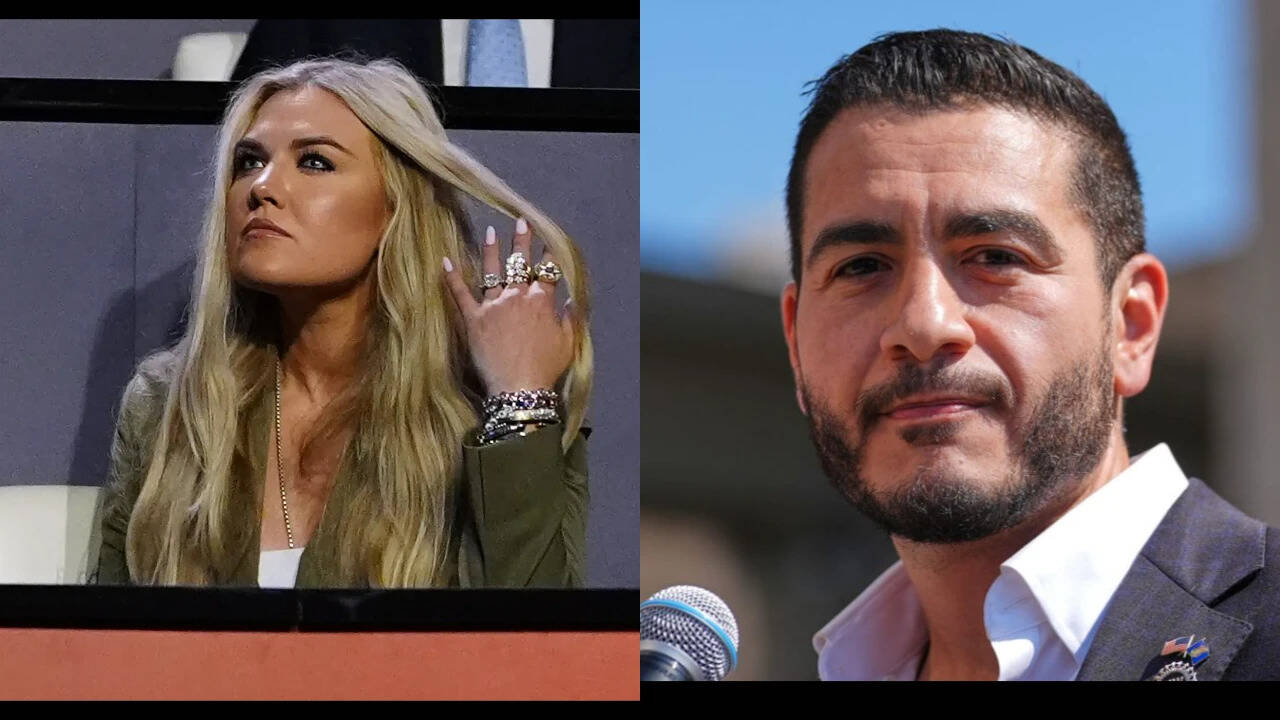
Abdul El-Sayed, stepping forward in his political journey, utilized the term "Arab America" to describe a vibrant, woven thread of culture, struggle, and civic participation. To him, and to countless communities across the nation, it was an acknowledgment of heritage—a way of honoring the specific history and resilience of an ethnic group that contributes deeply to the fabric of the country. It was an embrace of both halves of an identity: the roots grown elsewhere and the branches stretching out under a new sky.
Enter Erika Kirk.
With sharp brevity and an unyielding tone, Kirk pushed back, slamming the phrasing. Her declaration was stark and uncompromising: "There is only the United States of America."
On the surface, it sounds like a traditional patriotic rallying cry. It echoes the classic American melting pot ideal—a plea for unity under one banner, one flag, and one shared nationality. But language rarely stays on the surface. When you tell a group of people who have historically navigated exclusion that their specific modifier is redundant or dangerous, you are sending a complex signal. You are telling them that their hyphen must be dropped at the door.
This clash is not just about two politicians sparring over soundbites. It is a mirror reflecting a deeper, ongoing identity crisis within the modern political body. How do we hold unity without erasing diversity? Can a person love their ancestral heritage and their civic home with equal ferocity, or must one always devour the other?
Think about what it feels like to walk into a room where your name is consistently stumbled over. Think about the quiet exhaustion of having to prove, over and over again, that your loyalty to your home is not conditional on where your grandparents were born. For many Americans belonging to diasporas, adding a descriptor like "Arab," "Asian," "Latino," or "Italian" isn't a declaration of separation. It is an act of storytelling. It says: Here is where I came from, and here is how I add my unique note to the chorus.
Yet, critics like Kirk argue that such distinctions fracture the whole. They fear that hyphenated identities create silos, turning a unified nation into a patchwork of competing tribal interests. From this viewpoint, emphasizing specific ethnic or cultural markers weakens the shared civic identity necessary to keep a diverse democracy stable. It is a philosophy rooted in the fear of division, a belief that if we stop looking at ourselves as simply "Americans," the fragile glue holding the republic together might dissolve.
Both sides of this argument are haunted by fear. One side fears erasure—the terrifying prospect of being forced to strip away parts of oneself to be deemed acceptable. The other side fears fragmentation—the unraveling of a common story into a thousand isolated chapters that can no longer speak to one another.
When these fears collide in the political arena, nuance dies. Headlines flatten the human element into a cheap game of political football. We get summaries of who slammed whom, who won the news cycle, and who lost political capital. But beneath the flashing cameras and the churning social media feeds, real people are watching. They are wondering whether their presence in this grand experiment is valued as a whole person or just tolerated as a demographic statistic.
The debate over "Arab America" versus "The United States of America" forces us to confront the limits of our own vocabulary. Words are clumsy tools for building a multiracial, multiethnic democracy. They are prone to misuse, misinterpretation, and weaponization.
True unity cannot be achieved by dictating what people are allowed to call themselves in moments of cultural pride. Nor can a healthy society thrive if its citizens refuse to find common ground beneath a shared flag. The tension is real, and it is uncomfortable. There is no easy synthesis that satisfies everyone.
Perhaps the resolution does not lie in choosing one phrase over the other. Perhaps it lies in the willingness to sit in the discomfort of that tension. To listen when someone explains why their heritage matters to their daily existence, and to listen just as closely when someone expresses a desperate yearning for shared national cohesion.
A nation is not a monolith. It is a conversation. Sometimes that conversation is quiet and respectful, and sometimes it is loud, messy, and sharp-edged. But as long as the conversation continues, the map is still being drawn. And the ink we use matters immensely.