Seven hundred and eighty-seven thousand dollars.
Say that number out loud in the fluorescent hum of a grocery store aisle at six in the morning. Say it while your lower back aches from lifting frozen pallets of pepperoni pizza, and your knees pop every time you crouch to check an expiration date. In the cold math of American retail, $787,000 is not merely a windfall. It is an escape hatch. It is thirty years of alarm clocks silenced in a single afternoon. It is a paid-off mortgage, a reliable transmission, and the luxury of never again apologizing to a stranger because the store ran out of thin-crust four-cheese.
Yet when that exact sum materialized in a GoFundMe account bearing his name, the Red Baron delivery worker at the center of the viral storm did something that broke the internet's collective brain.
He hit pause. Then he told strangers to keep their money—or better yet, give it to someone who actually needed it.
To understand why this single act of refusal feels so jarring, you have to understand the quiet desperation that defines modern work, and the strange, intoxicating slot machine we have turned online charity into.
The Anatomy of a Viral Miracle
We know the script by heart now. A camera phone comes out in a fluorescent-lit store or on a rain-slicked porch. Someone catches a glimpse of dignity under pressure—an elderly man stocking shelves long past retirement age, a delivery driver trudging through a blizzard with a smile, a vendor hustling in the heat—and uploads thirty seconds of raw humanity to TikTok or X.
The internet, starved for proof that goodness still breathes, reacts with ferocious generosity. Within hours, a stranger sets up a crowdfunding page. Five dollars becomes five thousand. A local news station picks up the clip. Morning shows chime in. By Tuesday, a person who was counting quarters for gas is staring at a digital dashboard climbing toward seven figures.
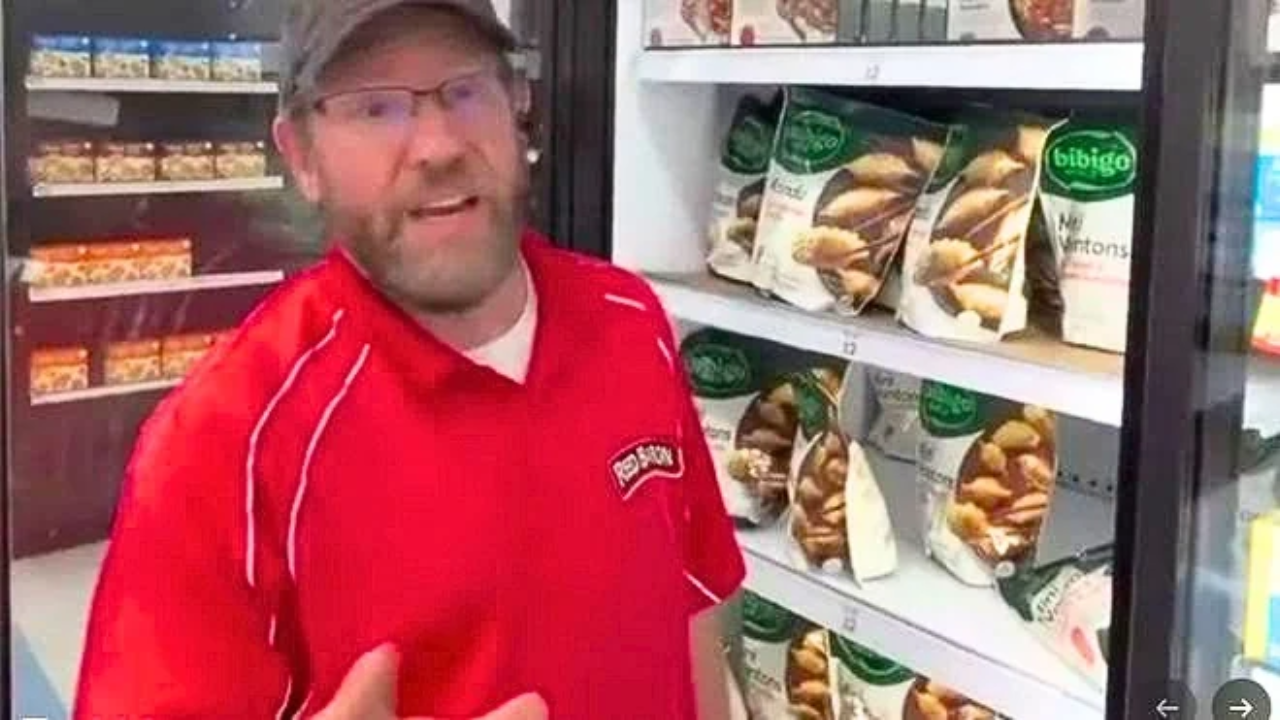
That is precisely what happened to the Red Baron vendor. One moment, he was simply doing the unglamorous, repetitive work of keeping frozen pizza cases stocked—a job millions of Americans perform invisibly every single day. The next, a viral video turned him into a symbol of quiet, uncomplaining grit. Sympathetic viewers, projecting their own exhaustion and empathy onto his image, opened their wallets. The counter spun past $100,000, blew through half a million, and crested at $787,000.
Most of us, if we are brutally honest with ourselves, know what we would do. We would refresh the page until our thumbs went numb. We would mentally draft the resignation text to our manager. We would call a financial advisor, pay off the credit cards, and buy the house with the wraparound porch. And nobody—not a single soul—would blame us. In an economy where one medical bill can bankrupt a household, taking the money isn't greed. It's survival.
Which is why his reaction landed like a thunderclap.
Instead of cashing out and vanishing into early retirement, he stepped in front of the tidal wave and put both hands up. He asked for the fundraiser to be stopped. He looked at $787,000—a sum that could fundamentally alter the trajectory of his bloodline—and decided he didn't want it.
What We Miss When We Look at Working People
Why would anyone walk away from three-quarters of a million dollars?
The answer reveals an uncomfortable blind spot in how comfortable, laptop-class internet culture views service and retail workers. When a viral video captures someone working hard in a blue-collar or service role, the internet's default reaction is pity. We assume that anyone stocking shelves or hauling freight must be trapped in a state of quiet tragedy, waiting desperately for a benevolent crowd to rescue them from their own life.
Consider a hypothetical character—let's call her Elena—who works the night shift at a regional distribution warehouse. To a passerby filming a viral clip, Elena looks like a cautionary tale about late-stage capitalism. Her boots are scuffed; her vest is stained; her shift starts when the rest of the town is winding down. If someone raised $800,000 for Elena, the internet would pat itself on the back for saving her.
Yet inside Elena's actual life, the picture is far more complicated. Maybe Elena likes the quiet predictability of the night shift. Maybe her union benefits cover her daughter's insulin, her bills are paid, and her pride is anchored in the fact that she earns every dime she spends. To be treated as a charity case—even by well-meaning millions—can feel less like salvation and more like erasure.
I have worked those early-morning stock shifts myself, back when the cold air from the freezer doors would chap my knuckles until they bled, and the loudest sound in the building was the squeak of a pallet jack on polished concrete. There is a specific, stubborn dignity in that work that outsiders rarely comprehend. You show up. You square the boxes so the labels face forward. You take pride in the neatness of an aisle that will be torn apart by shoppers before noon. You don't ask for handouts because, in your own estimation, you aren't broken.
When the Red Baron worker halted the fundraiser, he wasn't rejecting generosity. He was rejecting the narrative that he was a victim in need of rescue.
The Invisible Weight of Sudden Money
There is another, quieter truth buried beneath his decision, one that behavioral economists and lottery winners understand all too well: sudden, unearned wealth is heavy.
Think of sudden viral money not as a gift, but as an uninvited houseguest who moves into your living room and rearranges all your furniture. Overnight, your relationships warp. Cousins you haven't spoken to since high school suddenly remember your phone number. Coworkers who used to share coffee with you in the breakroom now look at you across an invisible chasm of resentment and expectation. Every choice you make—whether you keep driving your ten-year-old sedan or buy a new truck—becomes a public referendum on your character.
Worse still is the internal reckoning. When you earn $45,000 a year, you know exactly what your labor is worth and how your life fits together. When $787,000 drops out of the sky because a stranger liked your face on a screen, a strange imposter syndrome sets in. Why me? What about the woman stocking bread two aisles over whose husband just lost his job? What about the teenager mopping the floors while saving for community college?
Behavioral researchers have documented this phenomenon for decades. Humans are wired with an acute sense of fairness—not just when we are shortchanged, but when we are over-rewarded at random. In classic economic experiments, people routinely reject windfalls they perceive as arbitrary or unearned if accepting them violates their internal code of equity.
The Red Baron worker didn't need an academic study to feel that friction. He looked at the number on the screen, looked at the world around him, and felt the imbalance immediately. He wasn't starving. He wasn't facing eviction. He had a job, a roof, and his self-respect. Meanwhile, millions of people were genuinely drowning.
So he pointed the spotlight away from himself. He urged donors to redirect their compassion toward people facing real emergencies—medical crises, housing insecurity, families on the brink.
How Crowdfunding Turned Empathy Into a Lottery
The real problem lies elsewhere, far beyond one humble delivery worker in a grocery store aisle. It lies in how we have structured modern generosity.
Over the past fifteen years, platforms like GoFundMe have quietly become America's unofficial social safety net. One in three campaigns on major crowdfunding sites is launched to pay for medical care. Thousands more exist to cover funeral expenses, prevent evictions, or keep utilities turned on.
Yet crowdfunding does not distribute aid based on need. It distributes aid based on virality.
Consider what happens next when empathy is governed by an algorithm:
- The Photogenic Bias: A heartwarming thirty-second video with good lighting and an uplifting caption can raise $787,000 in forty-eight hours, while a quiet, unglamorous GoFundMe for a single mother's chemotherapy stalls at $340.
- The Passive Hero Complex: Clicking "donate" on a trending story gives the donor an immediate dopamine hit—a feeling of participating in a collective triumph—without requiring the harder, slower work of supporting local food banks, mutual aid funds, or systemic change.
- The Burden of Gratitude: Recipients of viral charity are expected to perform endless, tearful gratitude for millions of strangers, turning private lives into public spectacles.
When the Red Baron worker pulled the emergency brake on his own fundraiser, he inadvertently exposed the absurdity of the entire machine. He forced hundreds of thousands of donors to confront a basic question: Were we giving because this man was in crisis, or because giving to him made us feel good?
By refusing the payout and asking people to help others instead, he turned an impulsive internet spectacle into a mirror.
The Radical Power of "Enough"
We live in a culture obsessed with more. Every billboard, every feed, every productivity podcast whispers the same relentless commandment: never be satisfied. Optimize. Monetize. Squeeze every drop of leverage out of every lucky break. If the universe hands you a lottery ticket, you cash it, frame the check, and write a book about your mindset.
Against that deafening noise, saying "I have enough" is a quiet act of rebellion.
To declare that you have enough is to step off the treadmill voluntarily. It means your self-worth isn't indexed to your net worth. It means you can look at three-quarters of a million dollars—enough money to silence a thousand anxieties—and recognize that taking it would cost you something more valuable than cash: your sense of proportion, your solidarity with your peers, and your peace of mind.
Think about what happens to the donors who had their money refunded or redirected because of his decision. At first, some were surely bewildered. You try to hand someone a fortune, and they hand it back. You almost feel cheated out of your own generosity.
Then the dust settles, and the lesson sinks in.
True generosity isn't about anointing a single random stranger as a millionaire while ignoring the structural struggles of everyone else in the store. True dignity isn't measured by how much money strangers throw at you on the internet. Sometimes, dignity is simply doing your job well, knowing what you actually need, and refusing to take a single dollar away from someone whose need is greater than your own.
Somewhere right now, a delivery truck is backing up to a loading dock before sunrise. The metal ramp drops with a heavy clang against the asphalt. A worker pulls a jacket tighter against the chill, grips the handles of a hand truck loaded with boxes of frozen pizza, and wheels them through the double doors into the fluorescent light.
Nobody is filming. There is no donation counter ticking upward in the corner of the screen. There is only the steady, unhurried rhythm of a person who knows the exact value of an honest day's work—and the rare, unshakable freedom of wanting nothing more than what is truly theirs.